
Bam Margera’s tattoos belong to the same unruly visual world as his skate videos and television work, but the collection has more structure than the old photographs suggest. His ink includes the Heartagram linked with HIM, the words Book Worm spread across his fingers, and visible neck lettering that became part of his recognisable appearance. The public inventory is broad, while the quality of the explanations varies from design to design.
A careful guide has to separate a named tattoo from a guessed meaning. Body Art Guru and The Vanishing Tattoo provide useful descriptions of locations and designs, while public portraits show how the pieces sit on Margera’s body. The Heartagram has a clear music connection. The finger lettering is easy to transcribe. Some smaller marks are visible without a reliable statement from Margera, so they are described rather than interpreted.
The Heartagram connects Bam Margera to HIM’s visual world
The best-known piece in Margera’s tattoo record is the Heartagram, a symbol that combines a heart and a pentagram. It is associated with HIM and became closely linked with Margera through his friendship with Ville Valo and the band’s presence in his work. Public tattoo references place the design on the lower abdomen, where the black symbol and surrounding ornamental lines can be seen clearly in the available image.
The symbol is more specific than a generic heart or star. It belongs to a particular musical culture, and Margera’s connection to HIM gives the design a plausible personal context. The published tattoo descriptions identify the association, but readers should still avoid turning the symbol into a complete biography. A tattoo can signal admiration without revealing every detail of a friendship or a period in someone’s life.
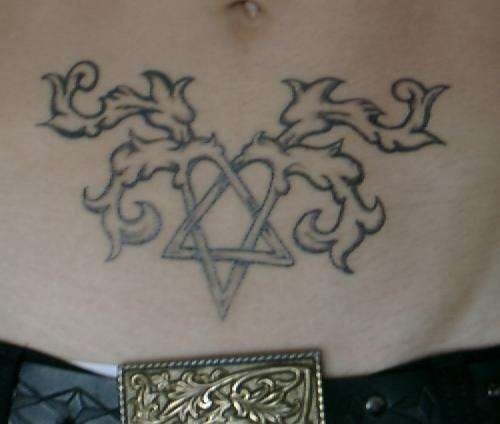
The placement also matters. The lower abdomen is not usually visible in a red-carpet photograph or a skateboarding event image, which is why tattoo archives and older personal photographs are useful here. A close image shows the scale of the design and the ornamental framing. It also makes clear that a generic Heartagram drawing is not automatically proof of Margera’s exact tattoo. The attached reference is used because it shows the tattoo form associated with him, not because every Heartagram in circulation belongs to him.
Margera’s broader public image helped make the design memorable, but the tattoo should be discussed as a specific piece rather than a costume accessory. The design has its own visual history, and the music connection gives it a stronger documented identity than many of the smaller marks in the collection.
Book Worm turns Margera’s fingers into a piece of lettering
The words Book Worm are spread across Margera’s fingers, with the letters on one hand spelling BOOK and the letters on the other spelling WORM. Body Art Guru’s inventory notes that the Os contain small heart shapes, a detail that is easy to miss in a distant photograph. The finger placement makes the tattoo readable when his hands are held together, but individual letters can disappear when he is moving or holding a skateboard.
This is a good example of why tattoo-specific images are important. A full-body portrait may establish that Margera has hand tattoos, yet it may not reveal the lettering. A close crop shows the letters, the heart details and the relationship between the two hands. It also keeps the article from assigning the phrase to a different mark on his knuckles or fingers.
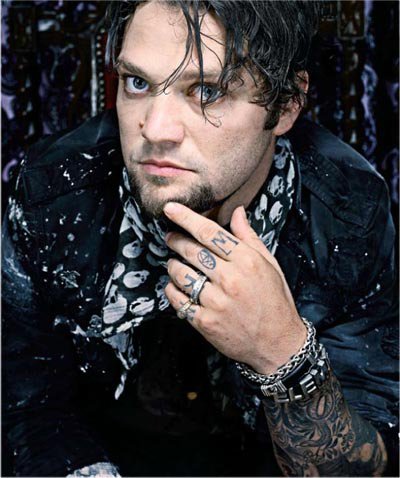
The wording itself is playful and fits the visual language associated with Margera’s public work, but the reviewed sources do not establish one formal explanation for why he chose it. The phrase can be documented without claiming that it refers to a particular book, person or event. The little hearts inside the Os are equally worth describing because they are visible design choices, not speculation about his private life.
Finger tattoos also age and photograph differently from larger pieces. Hands are constantly moving, and the skin can make small lines look heavier or softer depending on the image. That is why older lists should be compared with close photography rather than copied as permanent official counts. The inventory records the design as described by the source, while leaving room for later changes or cover-ups.
Anathema gives the neck a darker word mark
The front of Margera’s neck carries the word Anathema, with additional lettering or symbols reported nearby. It is one of the marks that helped define his early public appearance because the neck is visible in interviews, portraits and skate footage. The word has a strong visual presence, but a dictionary definition is not the same thing as Margera’s personal explanation.
Close portraits show why the neck tattoo is easier to recognise than to interpret. The letters are visible against the skin, while the smaller adjoining marks can be obscured by angle, hair or clothing. A responsible guide identifies the main word and describes the location without assigning a private story that the reviewed sources do not confirm.

The tattoo also sits beside a wider collection of symbols, portraits and hand designs. Readers may see a photograph and assume that every nearby mark belongs to the same idea. The image should instead be treated as a location reference for Anathema. Other tattoos can be recorded in separate entries when a source names them, but they should not be folded into one invented theme.
Margera’s tattoo record is strongest when the design and placement are clear. The Heartagram has a documented music connection. Book Worm has a precise letter arrangement. Anathema is a visible word on the neck. Those three entries are enough to show the range of the collection without pretending that every old image can answer every question about it.
Why the larger inventory needs careful wording
Margera has been photographed with many additional designs, including portraits, symbols, script and family-related pieces. Some tattoo lists attach meanings to those designs, but the evidence is not equally strong for all of them. A guide should keep direct statements, source descriptions and visual observations in separate lanes.
That method also makes the article more useful to readers comparing old and new photographs. Tattoos can be added, covered or changed, and public figures are rarely photographed from every angle. The most dependable entries are the ones with a clear design, a clear location and a source that explains why the item belongs in the inventory.