
Dave Grohl’s tattoos are tied closely to the music that shaped him. The earliest stories involve punk bands, teenage decisions and designs made with far less ceremony than a modern studio appointment. Later pieces carry the names and symbols of musicians he admired, including the Ace of Spades tattoo he got after Lemmy Kilmister died. The collection is easier to understand when its designs are placed in time rather than treated as one finished sleeve.
Grohl has spoken about several tattoos in interviews, which gives this subject unusually strong first-person evidence. He has described making the Black Flag tattoo himself and has explained the connection between an arm symbol and John Bonham. Photographs then help confirm the placement and appearance, especially for the later Motörhead tribute.
The Black Flag tattoo began as a teenage act of devotion
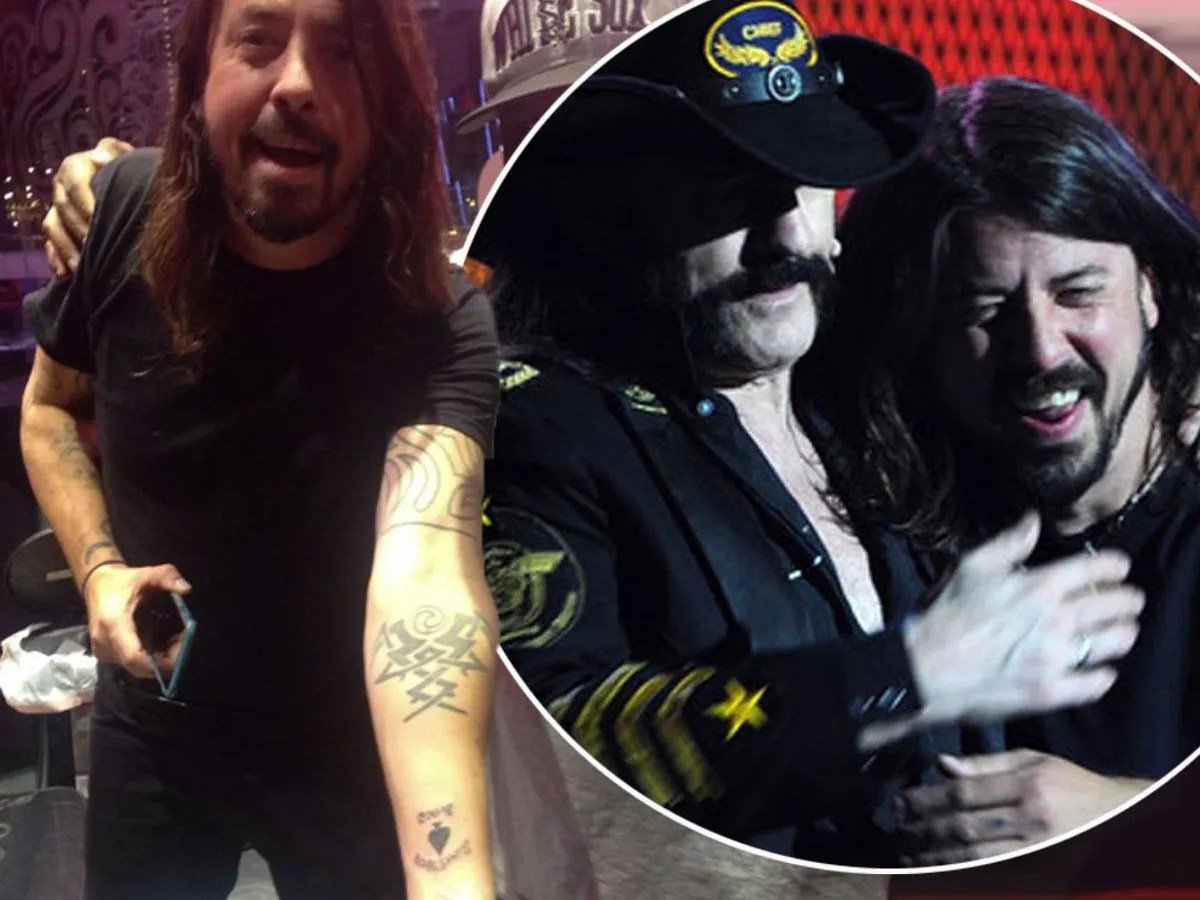
Grohl’s Black Flag tattoo is one of the clearest examples of music fandom becoming permanent. In archived interviews, he has described tattooing the band’s bars on himself when he was young. Different retellings vary on the exact age, but the consistent point is that the tattoo came from his teenage commitment to the band and was not a polished piece commissioned after he became famous.
The design itself is economical: the familiar bars are instantly recognisable because the symbol is built from repetition rather than shading. That simplicity suits the story. Grohl did not need an elaborate portrait to mark the influence. A compact graphic could carry the band name for anyone who knew the logo, while remaining legible on the arm.
Later photographs show the tattoo among other black-ink work, which can make its edges harder to isolate. A wide image establishes the arm as a larger field, but a closer crop is better for the bars themselves. The guide should not claim that every nearby mark belongs to the same period. The documented story concerns Black Flag; the surrounding tattoos developed across different years.
The self-made origin also explains why the tattoo is discussed differently from the Ace of Spades tribute. The Black Flag piece belongs to adolescence and musical discovery. It records the intensity of hearing a band and wanting its mark on the body immediately. That does not make it a joke or a mistake. Grohl has continued to discuss it as part of his history.
The Ace of Spades marks Grohl’s friendship with Lemmy
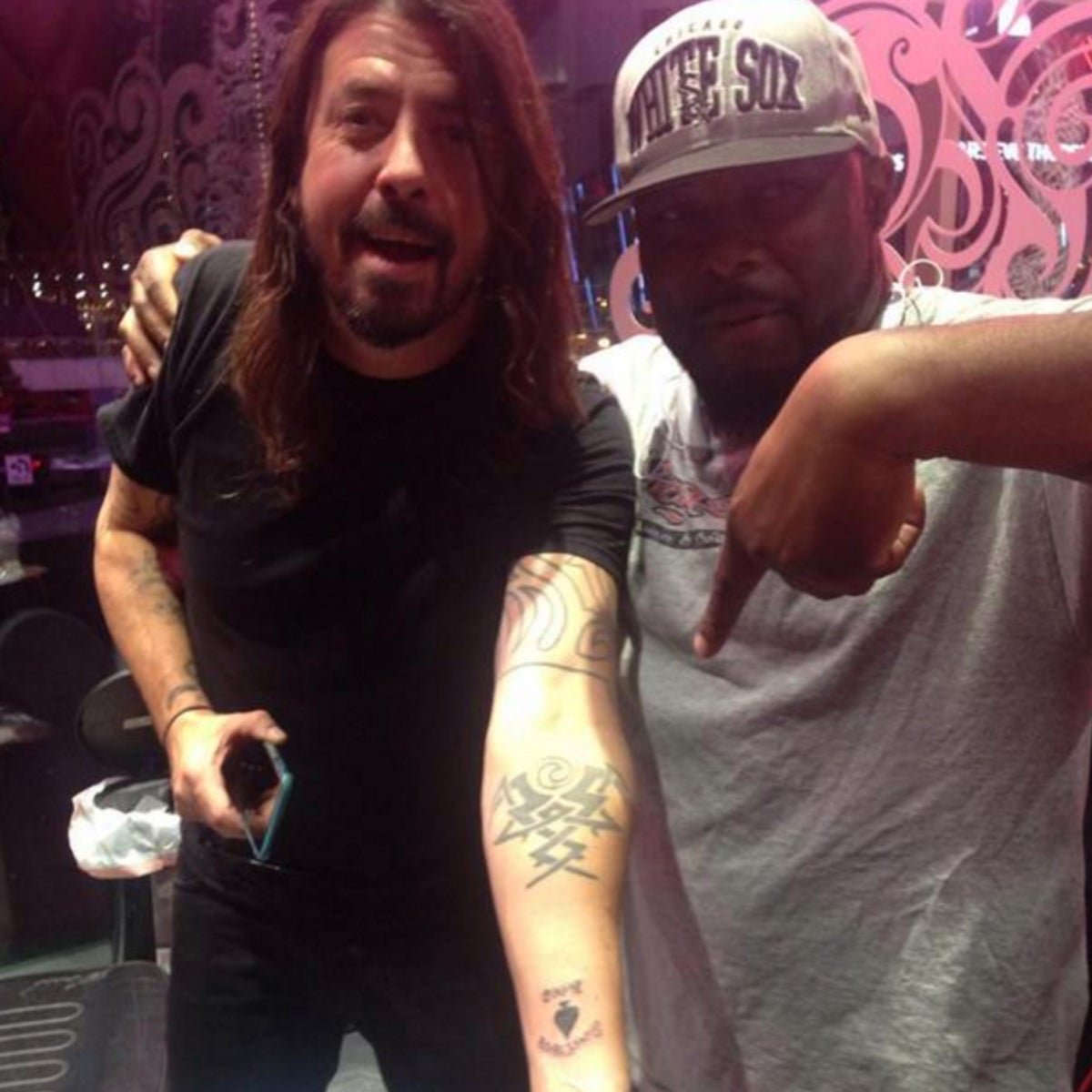
Grohl’s Ace of Spades tattoo is the most clearly documented tribute in the collection. After Lemmy Kilmister died in 2015, photographs circulated showing Grohl’s forearm with the Motörhead logo. Time and The Independent both connected the tattoo to his friendship with Lemmy and to the influence Motörhead had on him.
The design is immediately readable because it reproduces the distinctive Ace of Spades emblem rather than using a vague reference to the band. The spade, lettering and heavy black treatment make the source easy to identify. It is a useful example of how a tattoo can work as both an image and a proper musical name.
The timing gives the piece its emotional context. Grohl and Lemmy had performed and worked around the same rock community, so the tattoo was not a distant fan gesture. It was a tribute to a person he knew. The published accounts do not require the guide to invent a private ritual around the appointment. The visible design and the reported connection are enough.
The forearm placement also makes the tattoo practical to show in photographs. Grohl can extend his arm toward a camera or raise it onstage, allowing the symbol to be seen without a full shirtless portrait. That visibility helped the image circulate quickly after Lemmy’s death, while the tattoo remains a simple piece rather than a crowded memorial mural.
John Bonham’s symbol connects Grohl to another drummer
In the Mojo interview archived by FooArchive, Grohl discussed a symbol associated with John Bonham. The design is often described as runic or stylised, and the important documented point is its connection to the Led Zeppelin drummer. It belongs to the part of Grohl’s tattoo history that honours musicians who influenced his own approach to rhythm and performance.
Bonham’s place in Grohl’s story is obvious from his long-standing admiration for Led Zeppelin, but the tattoo still deserves careful wording. The interview supports the association and the design’s place on Grohl’s body. It does not support turning every line around it into a separate Bonham reference. A tattoo guide should keep the named symbol distinct from the other arm work visible in the same photograph.
The visual contrast with Black Flag is useful. Black Flag is a stark logo tied to a teenage punk identity. The Bonham symbol is more cryptic and depends on the viewer knowing the person it honours. One piece announces a band through its logo; the other uses a mark whose meaning comes from musical memory and the owner’s explanation.
Because the symbol is less familiar than the Ace of Spades, image selection matters. A distant concert photograph can show that Grohl has ink on his arm without allowing a reader to inspect the design. The guide should use a close or well-lit source image when making the claim, then describe only the features that remain visible after compression.
The early pentagram story belongs to Grohl’s teenage years
Another archived interview recounts a pentagram tattoo from Grohl’s youth. The story is useful because it shows that his early tattoo decisions were experimental and connected to the music culture around him. It should be kept separate from the Black Flag account: both are teenage stories, but the sources describe different designs.
A pentagram is easy for writers to overload with assumptions. Its appearance does not automatically establish a belief system, ritual practice or fixed identity. Grohl’s interview supplies the context of an early tattoo, while the guide should resist adding a meaning he did not state. That restraint is especially important when a symbol has many possible interpretations outside the wearer’s own life.
Together, the early tattoos show a musician building a visual vocabulary before fame made every mark a subject of scrutiny. The Black Flag bars are direct and graphic. The pentagram is more ambiguous to a modern reader. The common thread is not one secret message but a willingness to let music and subculture shape permanent choices.
Grohl’s tattoo history is therefore best read as a route through influences: punk devotion, metal friendship, drummer admiration and teenage experimentation. The photographs show the ink; the interviews explain the connections. Keeping those two forms of evidence beside each other produces a fuller account than a generic list of symbols.