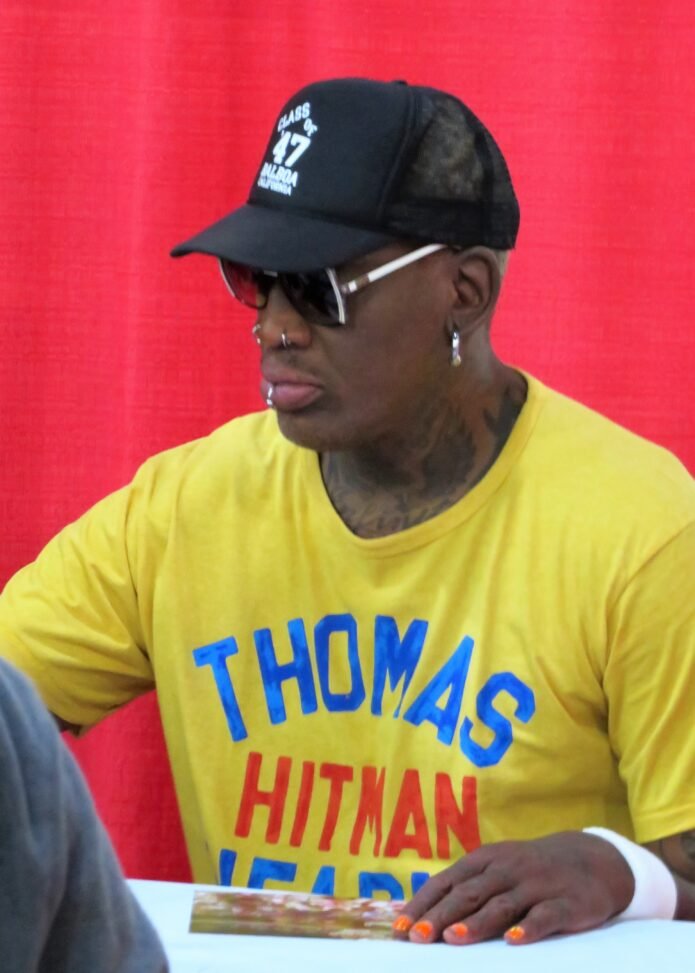
Dennis Rodman’s tattoos became part of his public image alongside his dyed hair, piercings and deliberately unpredictable style. The designs are not a single uniform sleeve. They spread across his chest, stomach, arms, neck and face, with bold tribal shapes sitting beside words, portraits, sports references and newer relationship imagery. The available photographs are unusually useful because the captions identify several individual designs and locations.
Rodman has also spoken about tattoos as a way to move pain into a physical form. In the Graham Bensinger interview, he describes body modification as an outlet rather than a fashion accessory. That context matters, but it should not be strplaced on a private explanation for every mark. The visual evidence is strongest when it names the design, body area and period clearly.
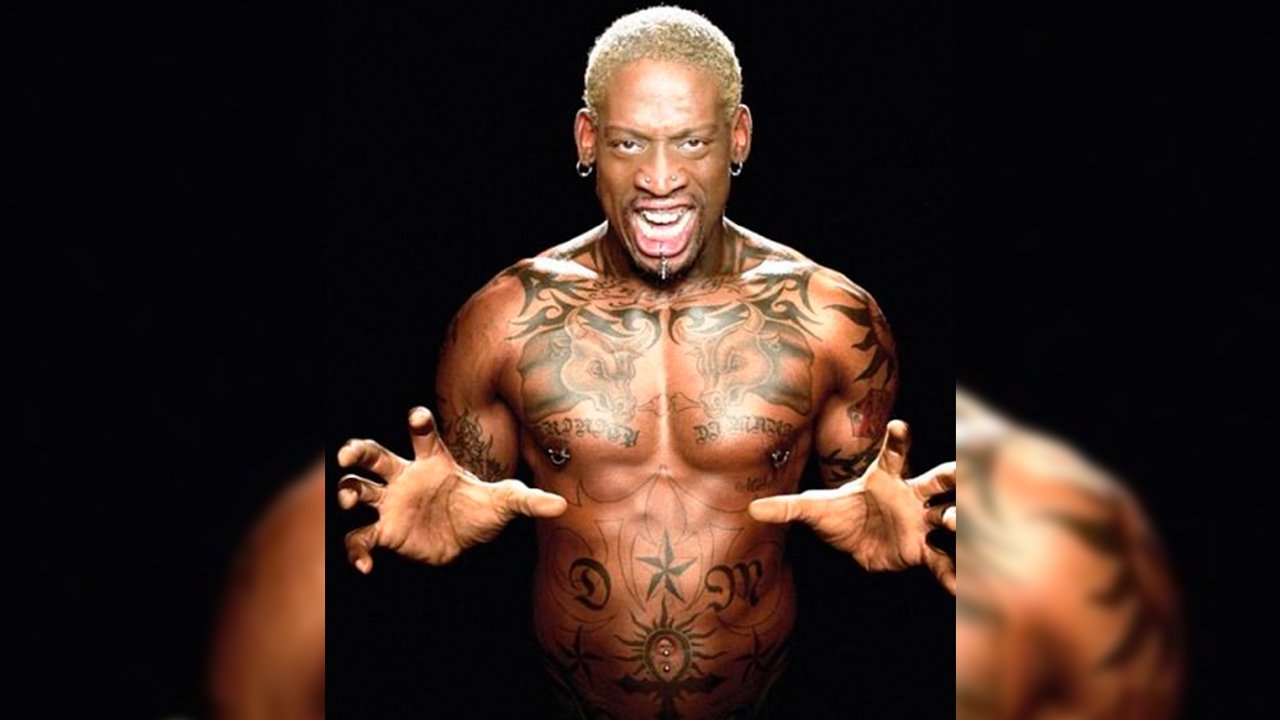
The paired bulls give Rodman’s chest its most recognisable centre
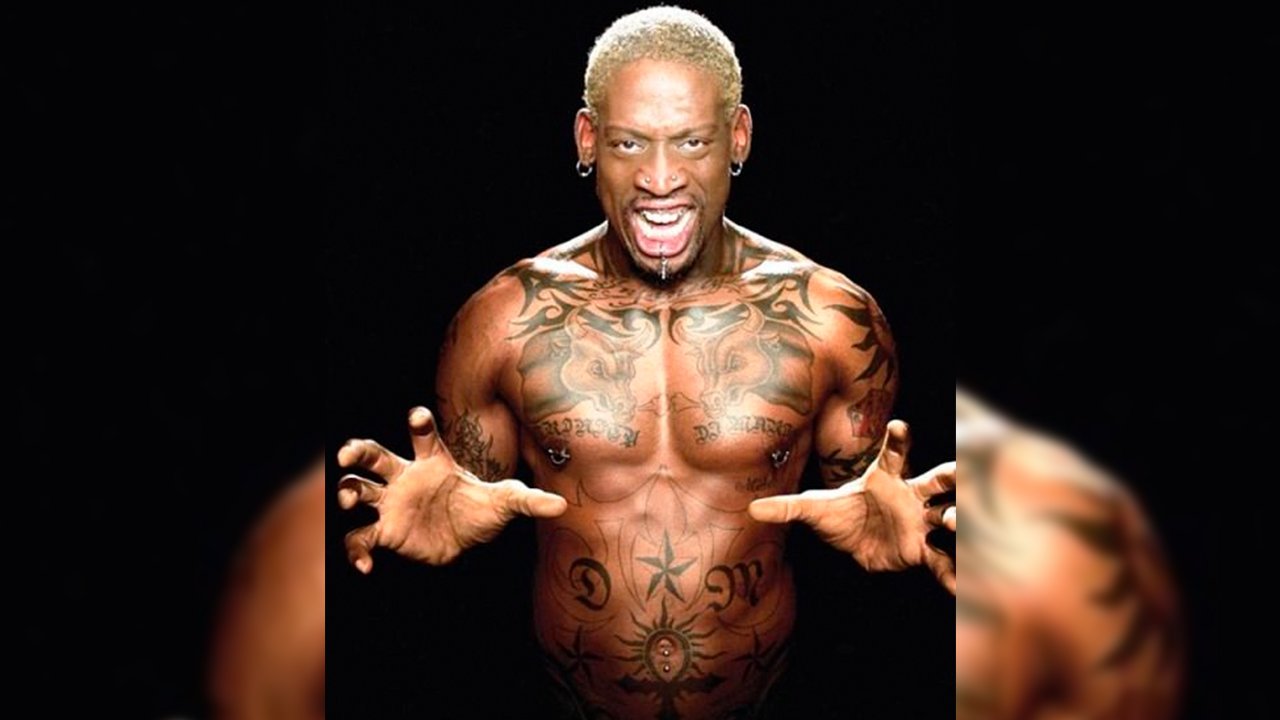
Two fierce bulls dominate the chest in the clearest published portraits. Their heads face inward, creating a mirrored composition that turns the upper torso into a wide, symmetrical focal point. TUDN’s photo captions describe them as angry or furious bulls, while the image itself shows the heavy outlines and shaded forms that make the pair readable even beside the other work.
The bulls are important because they establish the scale of Rodman’s tattoo map. This is not a tiny chest symbol that disappears under a jersey. The designs occupy enough space to remain visible when he is photographed in a tank top or open shirt, and they work with the muscular geometry of the chest. The surrounding ink adds noise and texture, but the paired heads remain the first clear subject.
It would be easy to attach a grand meaning to the animals because Rodman cultivated an aggressive basketball persona. The sources do not require that leap. They document the bulls and their placement. Rodman’s interviews explain the wider role tattoos played in his life, but they do not turn the chest pair into a confirmed statement about a single season or team.
Infinity appears as lettering rather than an isolated picture
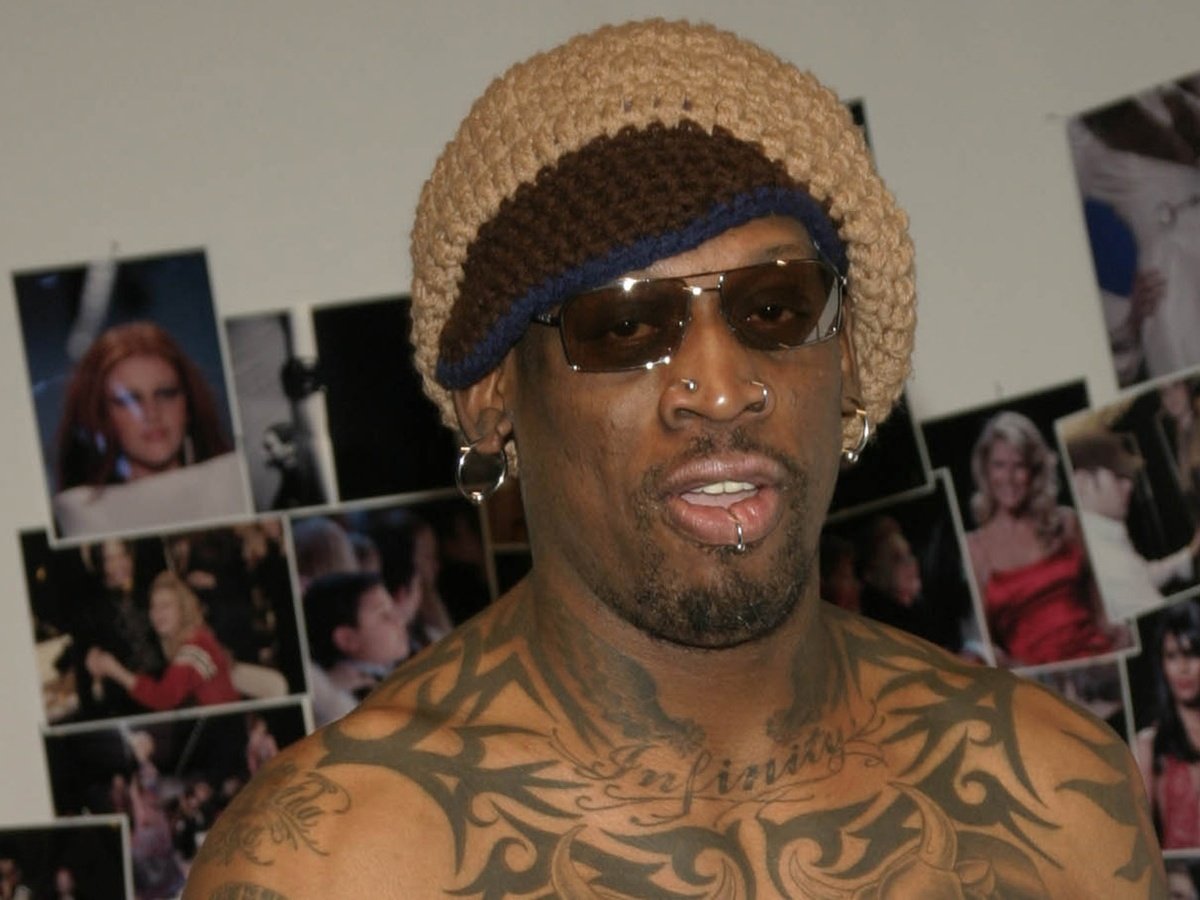
The word Infinity is reported on Rodman’s right wrist and again at the base of his neck. That repetition gives the lettering a different role from the chest bulls. It is a word that appears in more than one location, so the tattoo map includes a visual echo instead of one large central image.
Words are easy to misread in photographs, especially when sunglasses, hair, jewellery or a turned wrist interrupt the frame. The TUDN captions are useful because they identify the lettering directly. A guide should preserve that exact word and its locations without claiming a private philosophy that Rodman has not stated in the cited material.
The repeated placement also shows how Rodman’s collection mixes legibility with excess. The chest is filled with large shapes, while Infinity functions as a clean line of text. The two approaches sit together without needing to be forced into one tattoo style. That contrast is part of what makes the photographs useful for readers studying placement.
A motorcycle, cross and bracelet build the right-arm group
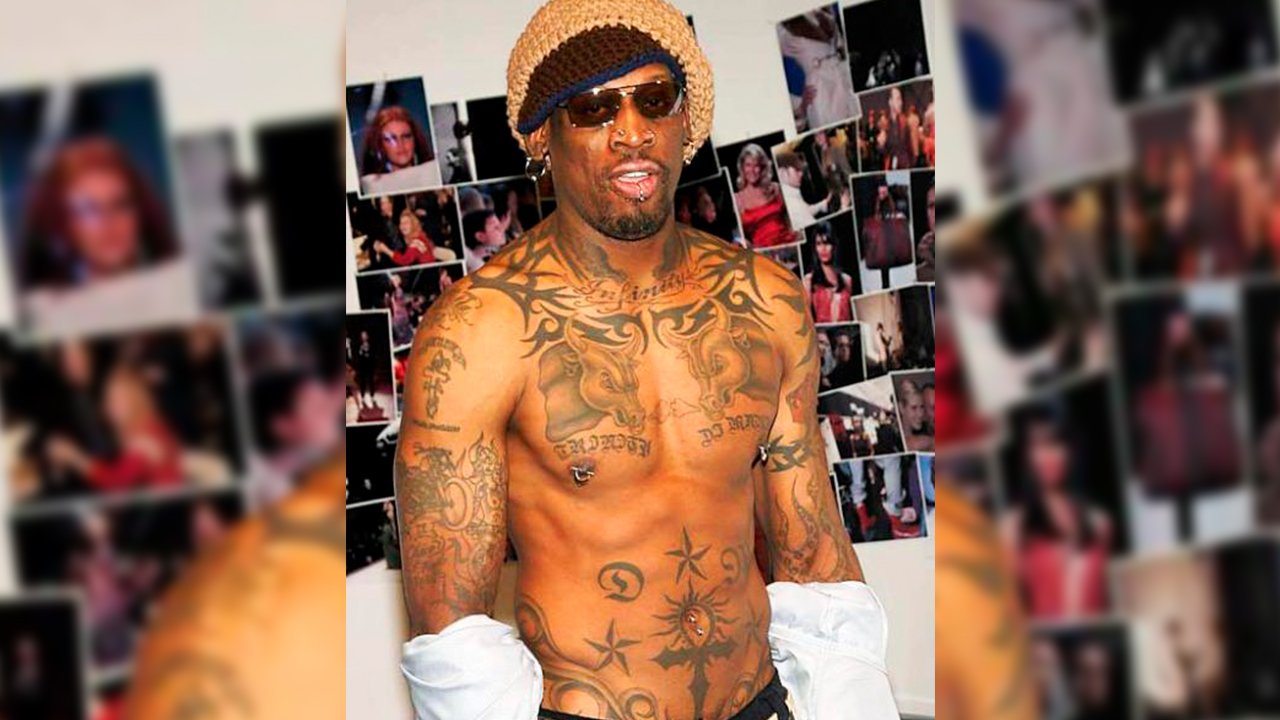
TUDN identifies a motorcycle, a cross and a bracelet on Rodman’s right arm. The group is more specific than a broad claim that he has a tattooed sleeve. Each design occupies a different visual role: the motorcycle brings machinery and movement, the cross introduces a religious shape, and the bracelet creates a band around the limb.
Arm photographs can make a collection look fuller or sparser depending on the angle. A turned shoulder may hide the inside of the bicep, while a flexed forearm can bring one design forward and push another into shadow. The published caption gives readers a useful inventory, and the photograph helps establish the relationship between the separate designs.
Rodman’s public image often encourages viewers to read every tattoo as part of the same rebellious persona. The evidence is more practical. The arm contains distinct subjects with different outlines and proportions. They can be studied as separate tattoo ideas even though they share the same body area.
Portrait imagery moves from the arm to the face
One of the TUDN captions identifies a child’s face on Rodman’s left arm. Later coverage of a new tattoo describes a portrait of his partner placed on his cheek. Those two designs belong to different public moments and should not be merged into one vague claim about portrait tattoos. The arm image and the later face photograph document separate pieces.
Portrait tattoos also require more caution than simple lettering. A blurred face can be mistaken for another subject, and a new photograph may capture a different expression or a cover-up. The Chicago Sun-Times coverage is valuable because it reports the later session and records Rodman’s own attitude toward the decision. The article can identify the portrait without inventing a larger relationship narrative.
The change in location is notable on its own. An arm portrait can be covered by clothing and revealed for a planned photograph. A cheek portrait is present in every close-up and becomes part of the face people recognise first. That difference helps explain why the later tattoo received a different kind of attention from the older designs.
What Rodman’s tattoo record actually establishes
Rodman’s collection is well documented in broad outline and uneven in small detail. The paired bulls, Infinity lettering, right-arm motorcycle and cross group, and portrait imagery can be named because published captions or reports support them. Other marks remain visible without a reliable explanation, so they should be described by location and appearance rather than assigned a private story.
The collection also belongs to more than one period. The Los Angeles Times reported Rodman discussing his many tattoos in the 1990s, while later photo features show the body art expanding alongside his changing public image. A current image is not a complete replacement for an older one. It is another point on the timeline.
For readers looking at design ideas, the practical lesson is variety within one body map. Large animal imagery can anchor the chest. Repeated lettering can connect distant locations. A motorcycle and cross can share an arm without becoming one indistinct block. Portraits demand enough contrast to keep faces readable. Rodman’s tattoos remain memorable because the designs are specific, the placements are visible and the collection never settles into a single formula.
One thought on “Dennis Rodman’s Tattoos: Bulls, Infinity and a Lifetime of Ink”