
Jared Leto’s tattoos are unusually easy to confuse with the character work built for his film roles. The ink most firmly tied to Leto himself is the large geometric design on his upper back, while much of the imagery associated with his Joker was makeup and character styling. A careful guide therefore has to separate what was photographed as permanent body art from what belonged to a production.
The Orbis Epsilon back tattoo is the clearest confirmed piece
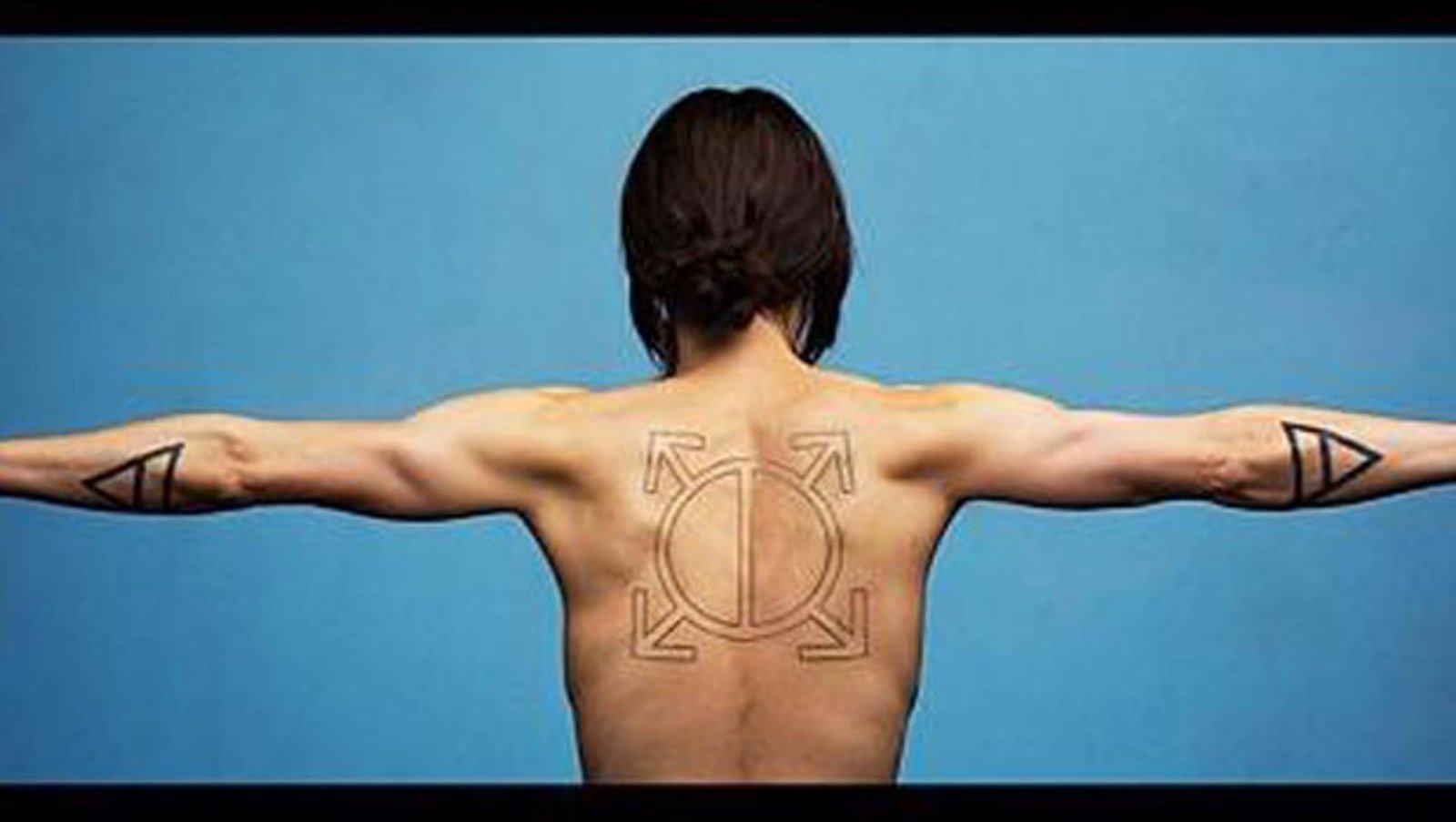
The best-documented Jared Leto tattoo is the Orbis Epsilon design between his shoulder blades. Aftonbladet reported that Leto promised to reveal a new back tattoo when he reached one million Twitter followers, then posted the image as promised. The design is a circle divided into two sections, with four arrow-like projections extending from it. It is not a random abstract pattern: Orbis Epsilon is a recurring Thirty Seconds to Mars symbol used across the band’s visual identity.
The reveal also explains why this tattoo appears so often in fan discussions. It has a clear public origin story, an identifiable shape and a direct connection to Leto’s music career. That is stronger evidence than a caption that simply labels a photographed mark as meaningful. The public record supports the design and the band connection. It does not require us to invent a more intimate explanation that Leto has not supplied.
Forearm triangles are reported, but their meaning needs care
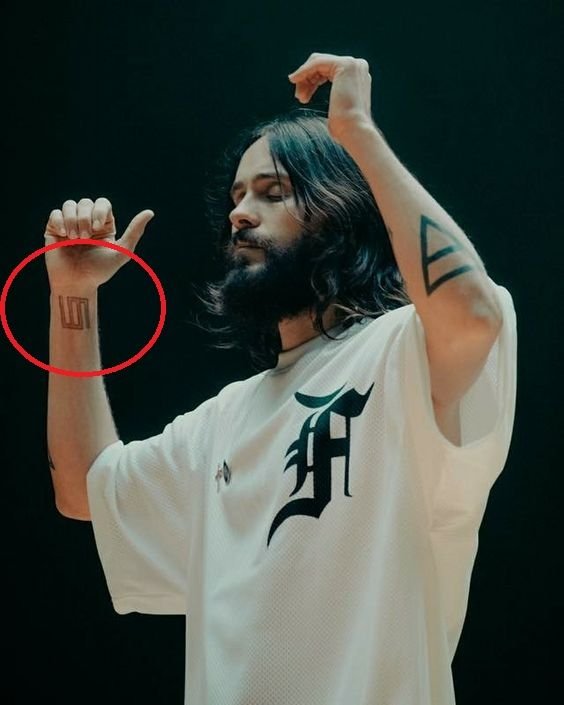
Specialist tattoo references describe solid black triangles on Leto’s forearms and associate them with the alchemical symbol for air. The geometric marks fit the visual language of his better-known back piece, but the source trail is not the same as the direct reveal reported for the large back design. There is no comparable Leto interview in the reviewed material in which he explains each triangle in his own words.
That difference matters. It is reasonable to describe the shapes and the reported symbolism. It is not reasonable to present the air interpretation as a private statement from Leto. Photographs can establish that a design appears on skin; they cannot automatically establish why it was chosen. The triangles are therefore best treated as documented designs with a limited interpretation rather than as fully explained personal tattoos.
The Thirty Seconds to Mars glyph and the language of the band
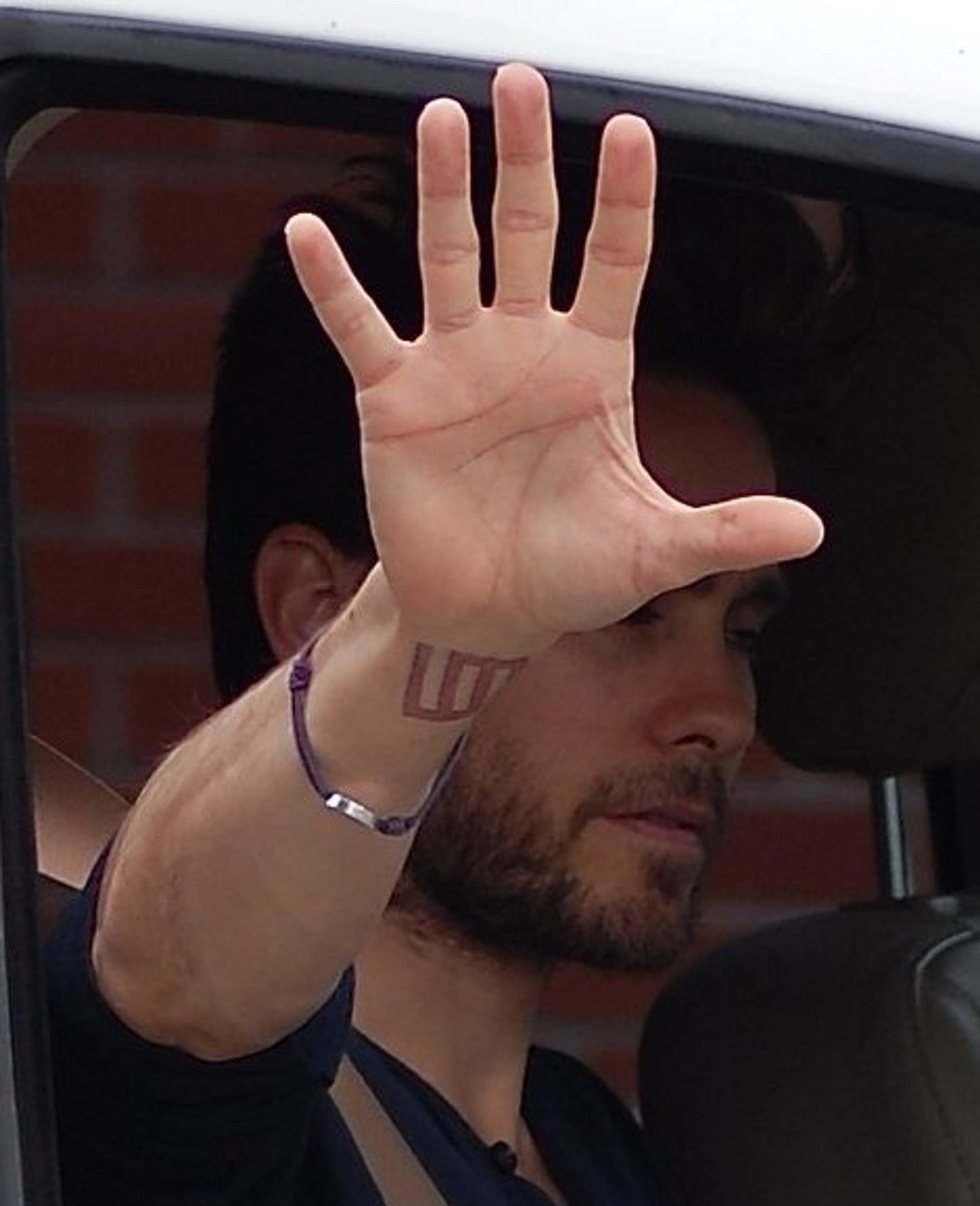
Another design repeatedly associated with Leto is the first Thirty Seconds to Mars glyph, reported around the wrist. The band’s symbols have appeared on album artwork, merchandise and fan material, so the connection is plausible and visually consistent with the large back design. Still, the exact visibility of the wrist mark changes from one photograph to another, and the public references do not provide a detailed first-person explanation.
This is a useful example of how to read celebrity tattoo coverage. The band relationship can be reported when the design is identified in a specialist record, but the article should avoid turning a logo into a biography. Leto’s work with Thirty Seconds to Mars gives the glyph context. It does not prove a specific event, relationship or private memory behind the tattoo.
What is known about the collarbone phrase
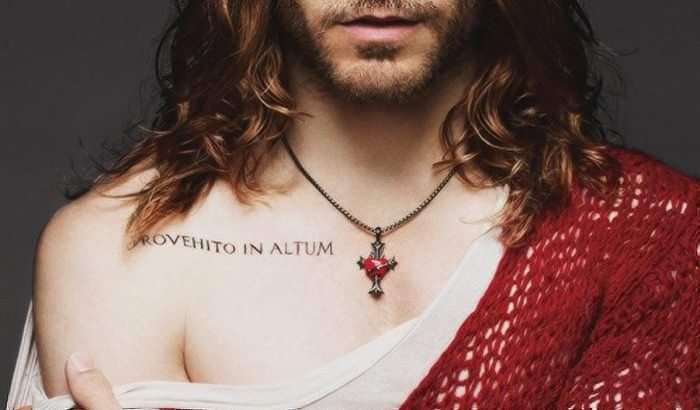
Reference material also lists the Latin phrase “Provehito in Altum,” commonly translated as “launch forth into the deep,” around Leto’s collarbone. The phrase is strongly associated with Thirty Seconds to Mars and is familiar to the band’s fan community. Its reported presence fits the larger pattern of music-linked symbols in Leto’s tattoo record.
The lettering is not consistently clear in the source photographs reviewed for this article. That makes the phrase a reasonable catalogue entry, but not a good candidate for a confident visual claim about every letter or its current condition. It is also a reminder that tattoo lists can preserve an older observation after cover-ups, fading or changes in visibility. The safest wording is that the phrase has been reported and associated with Leto, while the available image record does not establish every detail.
The cross or Echelon X mark remains less fully explained
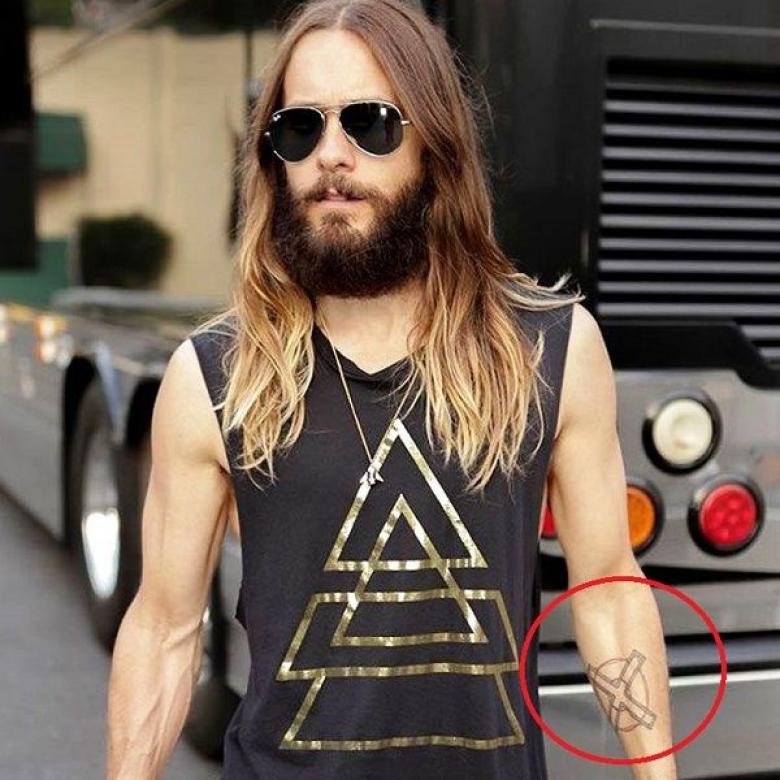
A small cross or Echelon-style X on the forearm is included in specialist descriptions of Leto’s ink. It belongs to the same broad family of symbols connected with his band, but it has not been accompanied by a direct explanation from Leto in the sources reviewed here. It should therefore remain a secondary entry in the inventory, not the headline claim.
That distinction keeps the article useful without overstating the evidence. Readers can learn which designs are commonly catalogued, where they are said to sit and how they relate to the band’s imagery, while still seeing the boundary between observation and interpretation.
Jared Leto’s Joker tattoos were character design, not a personal collection
The tattoos seen on Leto’s Joker in Suicide Squad belong to a different category. “Damaged,” the lettering across the forehead, the hand smile and the other graphics were created for the film’s version of the character. They helped communicate a specific fictional history and were discussed by director David Ayer as part of that story. They should not be added to a list of Leto’s permanent tattoos simply because they appeared on his body during filming.
This distinction is especially important because Joker photographs dominate image searches for Jared Leto tattoos. A search result can look like proof while actually showing prosthetic makeup, temporary lettering or a role-specific design. A real guide should identify those images as character references, not use them to pad a biography of Leto’s own ink.
Reading the record without overclaiming
Leto’s tattoo record is smaller and more selective than the online Joker galleries suggest. The large back piece has the strongest documentation, while the arm and wrist designs are reported with less consistent first-person explanation. Their meanings and current visibility are not equally confirmed. That uneven evidence is part of the story, not a gap to fill with invented symbolism.
For readers comparing photographs, the practical takeaway is simple: start with the geometric back tattoo, then look for the band-linked marks on the arms and wrist. Treat the Joker imagery as a film reference. Where a design is visible but unexplained, describe it plainly. That approach produces a more accurate account of Jared Leto’s tattoos than a longer list built from character makeup and repeated internet claims.
Frequently asked questions
What is Jared Leto’s most clearly documented tattoo?
The Orbis Epsilon geometric design on his upper back has the clearest public reveal and the strongest connection to Thirty Seconds to Mars.
Are Jared Leto’s Joker tattoos real?
They were character designs used for his portrayal of the Joker, not evidence of a permanent personal collection.
What do Jared Leto’s tattoos represent?
The documented designs are closely linked to Thirty Seconds to Mars, but several individual meanings have not been explained directly by Leto.