
Aaron Paul’s personal tattoo collection is small, but it has unusually clear stories behind it. The two designs most consistently documented are a line of script connected to Breaking Bad and a tiny heartbeat tracing shared with Lauren Paul. Neither is a large sleeve or a showy chest piece. Their importance comes from the people and moments attached to them.
That makes Paul’s tattoos a useful example of why a celebrity tattoo list should begin with first-person evidence. Photographs can establish where a mark sits and how it looks, but Paul’s own explanations establish why these two designs exist. The public record is strong enough to describe those stories without padding the article with guesses about every faint mark in an old photograph.
Aaron Paul’s confirmed tattoos are small, personal and easy to identify
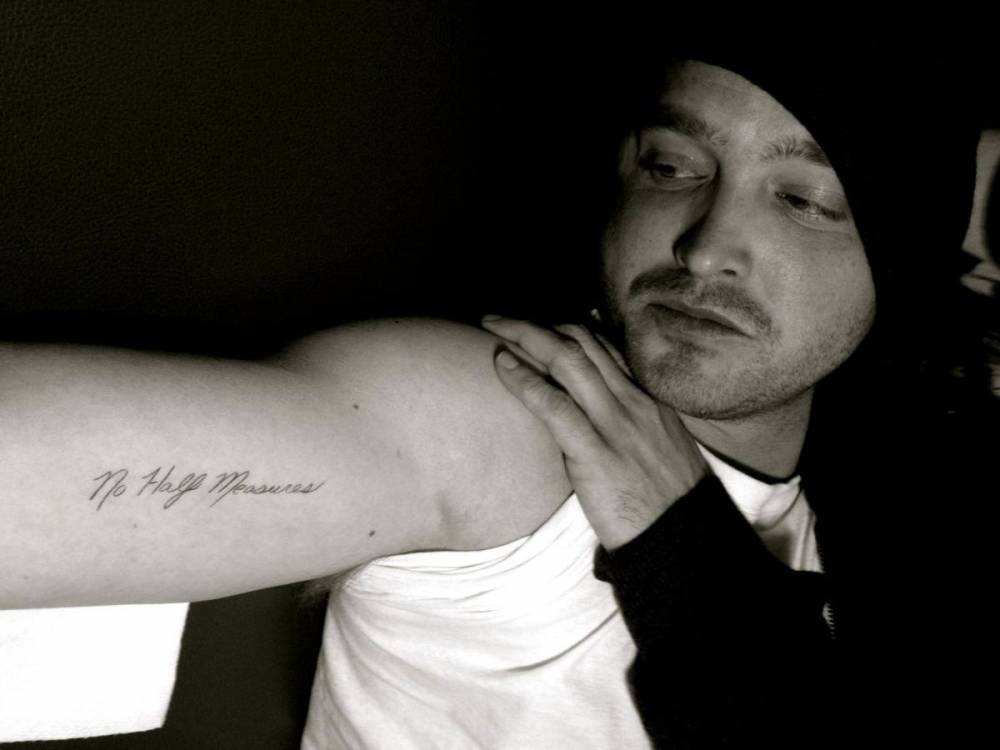
The clearest piece is the script tattoo reading “No Half Measures” on Paul’s upper arm. The phrase comes from Mike Ehrmantraut’s warning in the Breaking Bad episode “Half Measures.” Paul chose it with a group of roughly twenty people connected to the show on the final day of filming. Bryan Cranston chose the abbreviated show logo, while Paul kept the sentence that had become part of the production’s shared language.
The wording matters because it carries two histories at once. Inside the series, the line is advice about committing to a decision instead of drifting into a compromise that solves nothing. Outside the series, it records the end of a long collaboration and the crew relationships built over years of work. Paul’s tattoo is therefore more than a piece of fan merchandise: it is a private souvenir of the people who made the show with him.
The design is deliberately plain. Narrow script lets the words read as a sentence rather than as a logo, and the relatively compact placement keeps the tattoo from looking like a full character portrait or a piece of theatrical styling. That restraint suits the story Paul tells about it. The phrase is recognisable to fans, but its strongest meaning comes from the final-day ritual and the shared decision to carry a small piece of the production forward.
Placement also affects how often the tattoo appears in public photographs. A sleeveless shirt, a bent arm or a close-up from a press appearance can reveal the lettering, while a normal red-carpet pose may hide it. A tattoo can be well documented without being visible in every image, especially when it sits on the upper arm rather than across the hands, neck or face.
Paul has also described a much smaller tattoo on his ring finger: a tracing of Lauren’s heartbeat. They had their electrocardiograms printed and each kept part of the other person’s line. This is a precise origin story, not an interpretation borrowed from generic tattoo symbolism. The line represents a shared physical record, and its placement makes the design intimate rather than performative.
The heartbeat is easy to miss because a finger turns constantly. A hand angled toward a camera may show a ring, knuckle, reflection or shadow while hiding a fine line along the side. That explains why photographs tend to document the existence of the tattoo less consistently than they document the arm script. The lack of a perfect close-up should not be treated as evidence that the piece never existed.
Together, the tattoos cover different parts of Paul’s life. “No Half Measures” belongs to the group of people and work that shaped his best-known role; the heartbeat belongs to the relationship he carried beyond the set. Both designs are modest in scale, but neither is an afterthought.
Jesse Pinkman’s tattoos should not be counted as Aaron Paul’s:
The arm lettering, its connection to the final day of Breaking Bad production and the heartbeat tattoo on Paul’s ring finger are supported by his own descriptions. The exact artist, appointment dates and current condition of the fine-line heartbeat are less consistently documented. Those gaps do not weaken the two confirmed stories; they show where the public record ends.
There is also no need to turn a small collection into a larger one for the article to be interesting. The script has a specific line, a specific show and a specific group ritual behind it. The heartbeat has a specific method and a specific relationship behind it. That is more useful than an inflated count built from character makeup or uncertain image captions.
Read that way, Aaron Paul’s tattoos form a compact record of two kinds of attachment: loyalty to the people who made a defining show, and a private line shared with his partner. The designs are easy to overlook, but the explanations are unusually direct.
Paul’s confirmed tattoos are smaller and more personal than the ink worn by his Breaking Bad character. That distinction matters. Jesse Pinkman’s tattoos belong to the role, while Aaron Paul’s own pieces belong to his life away from the show. The images help separate the two records and prevent a prop from becoming part of the actor’s biography.
The best-documented designs are readable because they use compact lettering and simple symbols. Their scale makes them easy to miss in a red-carpet photograph, especially when a sleeve or jacket covers the arm. A close-up can establish placement, but meaning should only be attached where Paul has explained it.
The collection is therefore a good example of why tattoo guides need restraint. A short inventory of confirmed work is more useful than a long list built from rumours, old character stills or marks that could be lighting.
The smaller pieces are also easy to confuse with wardrobe details or production styling. A photograph from a film set may show temporary ink, drawn-on markings or a character tattoo, while a personal portrait shows Paul’s own work. Separating those sources is essential before adding a design to the inventory.
Paul’s tattoos do not need exaggerated mythology to hold attention. Their interest comes from the contrast between the actor’s understated personal pieces and the heavily tattooed character many viewers associate with him. The confirmed designs should therefore be described with clear placement notes and useful close images, while uncertain marks stay outside the main list.
A timeline helps readers understand why the count changes. Tattoos can be covered by sleeves, faded in older photographs or revealed only during a particular interview. The guide should show those limits openly and give each confirmed mark enough space to be recognisable.
That balance gives readers a better picture of Paul’s actual collection. He has enough documented work to discuss placement and design, but not every blurry mark deserves a confident name. The article can be detailed without becoming speculative: show the image, identify the confirmed tattoo, explain the background that is supported and leave the rest alone.
Keeping character ink out of the personal inventory:
Aaron Paul’s own tattoos should stay separate from Jesse Pinkman’s prop tattoos. The distinction protects the accuracy of the guide and gives the confirmed personal designs more room.
Why the confirmed list stays deliberately focused:
Paul’s tattoos are worth discussing in detail even though the confirmed list is shorter. The design, placement and connection to his life matter more than padding the inventory with marks that could belong to a character, a temporary drawing or a shadow. That is also why the images are kept beside the passages they support.
A casual portrait can show the heartbeat line or script, but a production still may show something entirely different. Readers should not have to guess which version is personal. The clean separation between Aaron Paul and Jesse Pinkman protects both the tattoo guide and the show’s visual history.
As the collection changes, the same pieces may be photographed under different lighting or partly covered by clothing. A dated close-up remains the best evidence for a small tattoo. The writing can stay relaxed and readable while still being clear about what is known.
The personal pieces also deserve a timeline. A script tattoo connected to Breaking Bad is still Aaron Paul’s own tattoo, but it should not be confused with the temporary designs used for Jesse Pinkman. The distinction is simple once the photographs are separated, yet it is often lost when a tattoo list repeats images from the show without checking their source.
Paul’s collection works well in a focused guide because the confirmed designs have clear relationships behind them. The heartbeat line points toward family life, while the script carries a different connection. Their scale is modest, but the placement and evidence give readers enough to understand why each piece belongs in the inventory.
There is no need to turn an incomplete photograph into a new tattoo. A careful article can be detailed about the confirmed work and still say when a mark is too soft to identify. That approach leaves room for later updates if Paul shows another design clearly.