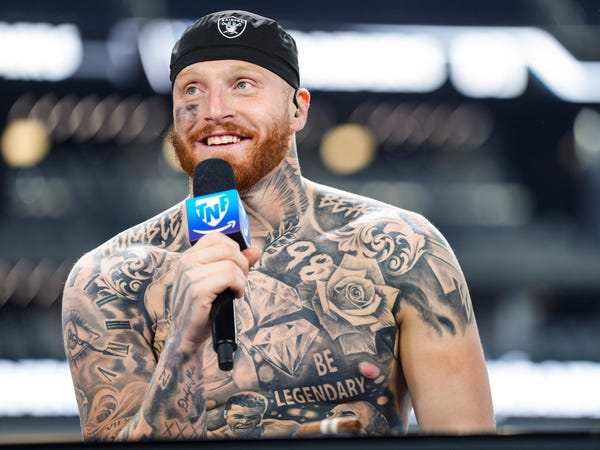
Maxx Crosby’s tattoos are basically a visual scrapbook of the people and things he cares about. His arms carry the Raiders, older family pieces and the rough beginnings of his sleeve. Across his chest and stomach, he has portraits of sports legends, family references, roses, diamonds and the words “Be Legendary.” None of it looks like one tidy plan drawn up years in advance. Maxx has said that his sleeve started out as random pieces, then gradually became something that worked together.
That slow build is the key to reading his ink. In GQ’s tattoo tour, he talks through his first tattoos, his great-grandmother, his mother and the portraits across his torso. Other reports cover the newer tribute work for Michael Jordan, Kobe Bryant and Muhammad Ali, as well as the Raiders imagery on his arm. The guide keeps those stories separate instead of treating every piece as one giant sports collage.
Maxx Crosby’s first tattoo was his name and birth year
Maxx says his first tattoo was his surname and the year he was born, placed on his wrist when he was seventeen. He used his brother’s ID to get it, which gives the piece a very different feel from the huge chest work he wears now. It was a teenage decision, small enough to hide and personal enough to stay with him as the rest of his collection grew around it.
That early wrist tattoo matters because it sets up the way Maxx talks about his ink. He does not present the collection as a perfect catalogue. He remembers when he got pieces, who they were for and how the sleeve changed. The first design was straightforward: his own name and the year he entered the world. It is a marker rather than a performance of the image he later built as the Raiders’ defensive star.
The wrist also shows why older photographs are useful. A jersey cuff or athletic tape can hide the original lettering, while a close interview image may reveal it for a moment. The tattoo is not the largest piece on his body, but it anchors the timeline. Everything else came after that first decision to put a private detail where he could still see it.
The great-grandmother portrait was made for his mother
One of the most personal tattoos in Maxx’s collection is the portrait of his great-grandmother on his forearm. He has explained that she was very close to his mother and died when he was young, so the tattoo was chosen for both of them. That context gives the portrait a clear emotional centre. It is not simply an old-fashioned face in a sleeve; it is a family image with a specific reason for being there.
The forearm placement makes the portrait visible when Maxx is working out, talking to reporters or standing on the sideline. Around it sit other pieces that were added at different times. The portrait therefore has to be read as its own tattoo, even when a photograph makes the whole arm look like one continuous black-and-grey panel.
Maxx has also spoken about regretting some of his younger decisions and becoming more selective later. That does not erase the earlier tattoos. It explains why the great-grandmother portrait stands out. The design has a person and a story attached to it, while some of the surrounding marks are remembered more as part of the gradual process of filling the sleeve.
The image is clearest when the arm is uncovered. Game photographs can flatten the details under stadium lighting, and tape can cover the lower forearm. A proper tattoo reference should show the face and the surrounding linework clearly, rather than using a distant action shot where the portrait becomes an unidentifiable patch of ink.
His chest and torso carry tributes to Jordan, Kobe and Ali
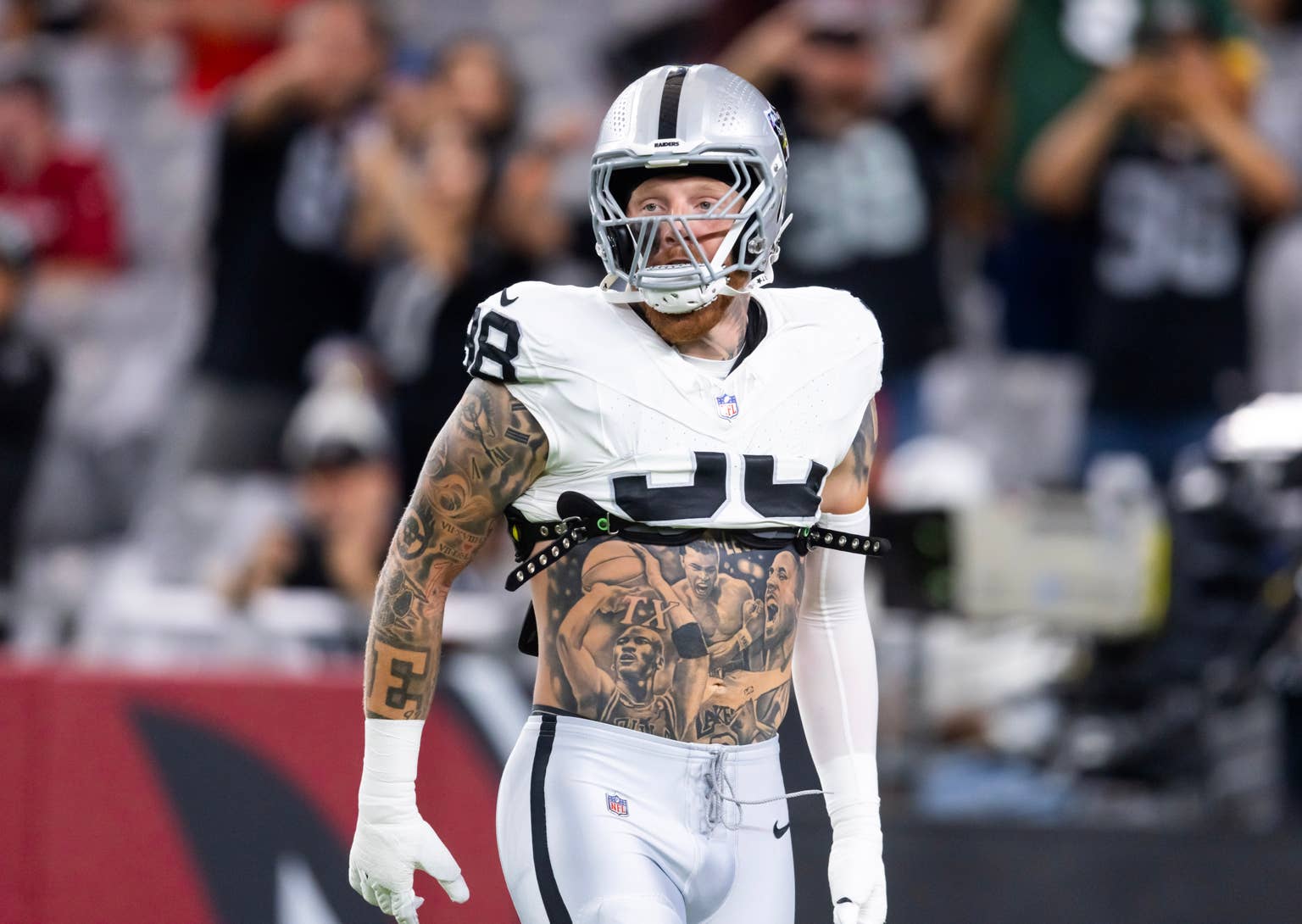
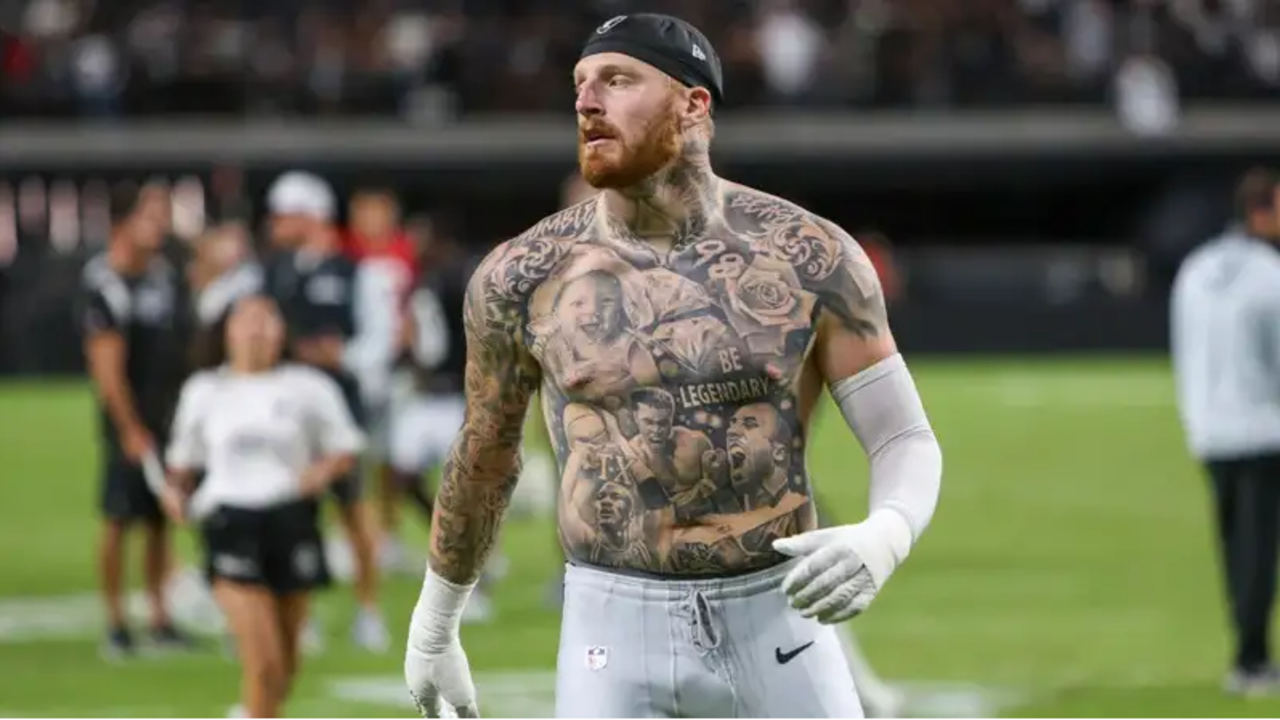
The biggest change in Maxx’s tattoo collection came with the large torso composition honouring Michael Jordan, Kobe Bryant and Muhammad Ali. Those portraits sit across the chest and stomach, surrounded by shading, lettering and other decorative elements. Sports coverage has described the work as a tribute to athletes who influenced him, while photographs show how the portraits are arranged around the words “Be Legendary.”
The phrase gives the centre of the tattoo a clear visual anchor. It sits across the torso instead of being tucked away as a tiny motto, so it reads alongside the portraits and the number 98 associated with Maxx’s playing identity. A photograph from the field can show the full composition, but a closer interview image is better for studying the faces and the smaller shapes around them.
There are also roses, diamonds and a tattoo connected with his daughter Ella Rose. Reports about the newer torso work describe those details as part of a family addition rather than random filler. The rose works visually with the name, while the diamonds and surrounding shading make the large portrait panel feel finished rather than like four separate photographs pasted together.
This is where the timeline becomes important. Maxx has said his rookie-year sleeve looked terrible because he kept adding one random tattoo and then another. The torso pieces belong to a more deliberate phase. They are still busy, but the images, lettering and spacing have a clearer relationship. The body of work looks planned because the later tattoos were designed to connect parts that had been built separately.
The portraits should not be treated as proof that every tattoo on Maxx’s body has the same meaning. The sources are strongest about the athletes and the daughter tribute. Other faces and symbols are visible, but they should be described carefully when no direct explanation is available. A good tattoo guide can identify a portrait without inventing a speech from the person pictured.
The Raiders sleeve grew from random pieces into a team record
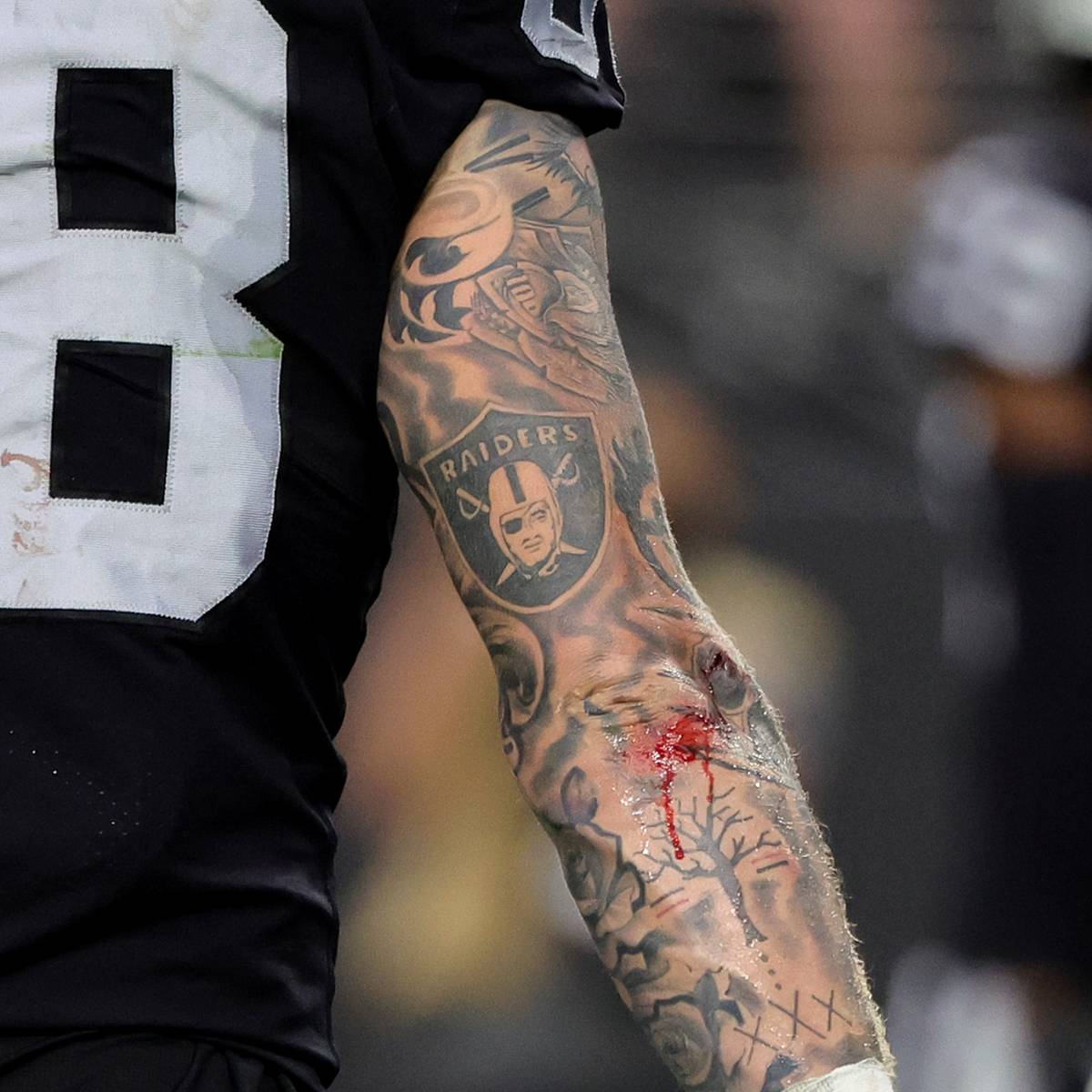
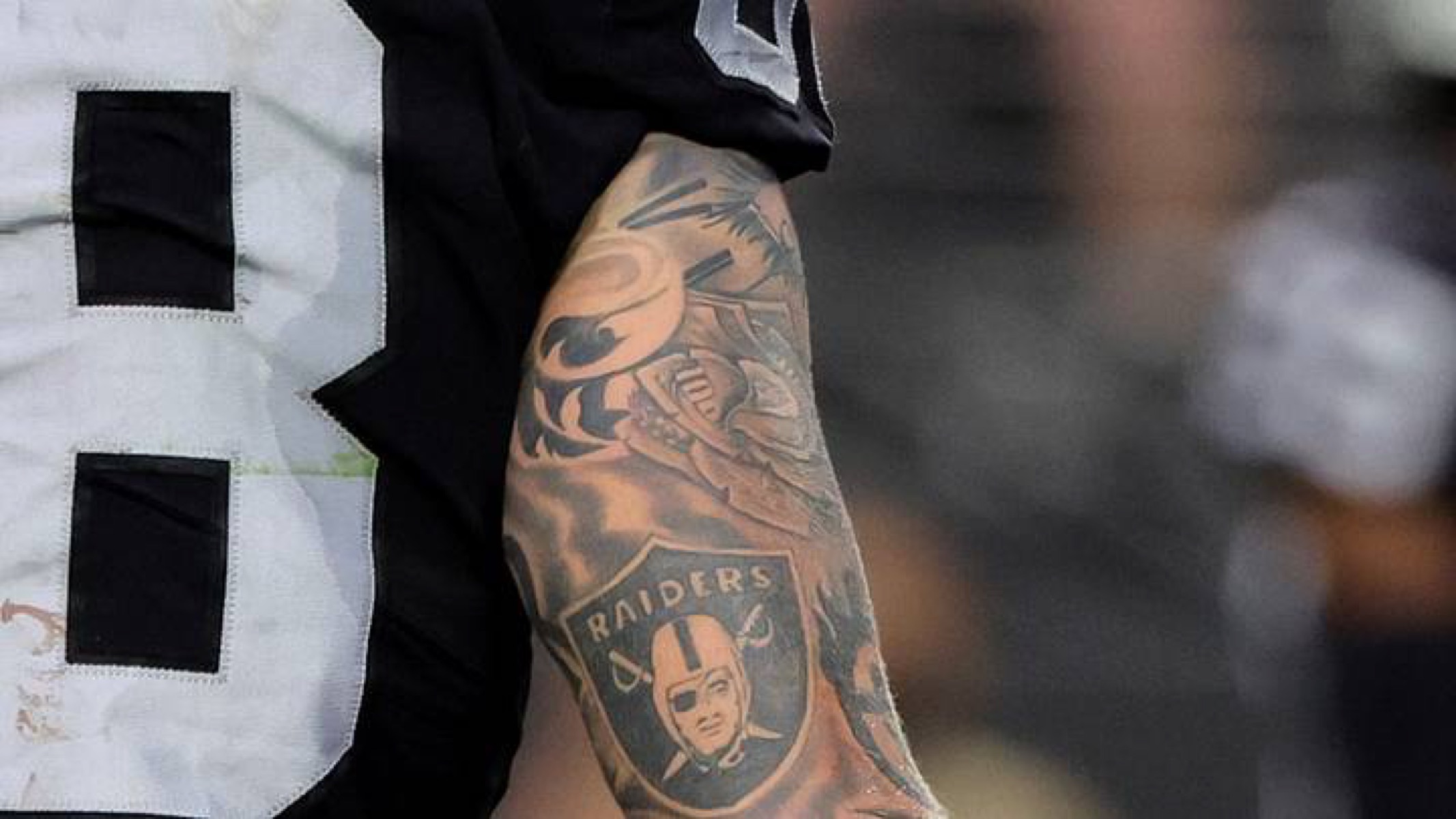
Maxx’s arm sleeve carries the most obvious football imagery. The Raiders shield appears on the upper arm, surrounded by portraits, numbers, lettering and darker traditional-style elements. Some photographs show the logo clearly during games, while others reveal how much work sits above and below it. The sleeve is not only a team badge. It is a mixture of Maxx’s football identity and the tattoos he picked up before the arm had a finished shape.
He has been open about the sleeve’s early messiness. In GQ, Maxx described his rookie-year arm as a collection of separate choices that did not yet fit together. That is useful because it explains the contrast between older small tattoos and later large-scale work. The arm did not appear fully designed overnight. It was built by adding pieces, then finding a way to make the empty spaces work.
Other arm tattoos include a tree, Roman numerals, lettering and smaller symbols that are easiest to see in close-up sports photography. The Raiders shield has the clearest public identity, but the surrounding ink is what makes the sleeve look like Maxx’s rather than a simple piece of team merchandise.
There is a practical side to photographing the arm too. Pads, gloves and jersey sleeves cover large sections during games. A sideline image might show the lower arm while hiding the shoulder, or the shoulder while the wrist is taped. That is why several photographs are needed before calling the sleeve complete. One picture can prove a design exists, but it cannot always show the placement of the neighbouring work.
Maxx has also worked with tattoo artists in Las Vegas, including Carlos at Hart & Huntington. That studio connection belongs to specific sessions and should not be stretched into a claim that one artist created the entire sleeve. His collection developed over years, and the artist history is just as layered as the designs.
The smaller tattoos fill in the family and recovery timeline.
Not every important piece on Maxx’s body is large. The wrist name and birth year, the great-grandmother portrait and the daughter reference give the collection a family timeline, while the Raiders logo and sports portraits cover the public side of his identity. Other small tattoos appear around the arms and torso, but a careful inventory should separate what Maxx has explained from what a photograph only shows as a dark mark.
His recovery story also matters when the tattoos are discussed. Maxx entered rehab for alcoholism in 2020, and later coverage connected parts of his public identity with a more focused approach to football and family. That does not mean every tattoo is a recovery symbol. It simply gives the later family and motivation pieces a date and a wider setting.
The words “Be Legendary” are a good example. They are visible and easy to quote, but the phrase does not need a grand theory attached to it. It works as a personal motto and as part of the torso layout. The portraits beside it give the words a sports context, while the family tattoo adds something more private.
Seen as a whole, Maxx Crosby’s tattoos move from teenage lettering to family portraits, from a rough early sleeve to a more connected torso composition, and from ordinary small marks to the Raiders imagery that fans now recognise. The work is busy, but it is not meaningless. Each area has its own story, and the photos are strongest when they are used to show the exact pieces being discussed.
There is no reliable reason to force a fixed tattoo count onto the collection. New work, cover-ups and added shading can change the total, and game photography rarely shows every area at once. The useful version is a visual map: wrist name and birth year, great-grandmother on the forearm, Raiders sleeve, sports legends across the torso, family references, roses, diamonds and the central “Be Legendary” lettering.
That map gives readers more than a quick list. It shows how Maxx’s ink grew with him, including the rough early choices and the later pieces that carry family, football and personal ambition. The collection looks most honest when the older and newer stages are allowed to sit together.