
Willow Smith’s tattoos have grown in a way that feels very her: curious, a little cosmic, and never too interested in looking like everybody else. The collection runs from small hand tattoos and finger marks to a much larger shoulder piece built around a reaching hand and a galaxy. There are also flowers, script, repeated hand signs, and the detailed figure of Saraswati, the Hindu goddess of knowledge, music, and learning.
Some of the designs have clear stories attached to them. Others are simply tattoos that have been photographed often enough for us to identify their shape and placement, even when Willow has not explained every line. That distinction matters. This is a guide to the work that can actually be seen and documented, not a guessing game about every symbol on her skin.
Willow has also moved through very different visual eras, so photographs do not always show the same set of tattoos in the same condition. A fresh piece can look darker than an older one, and a sleeve can look completely different depending on whether she is wearing a tank top or a jacket. Put the images together, though, and a pretty clear map appears: hands, fingers, upper arm, shoulder, and the long outer arm carry most of the visible work.
The shoulder piece turns a simple hand into a whole scene
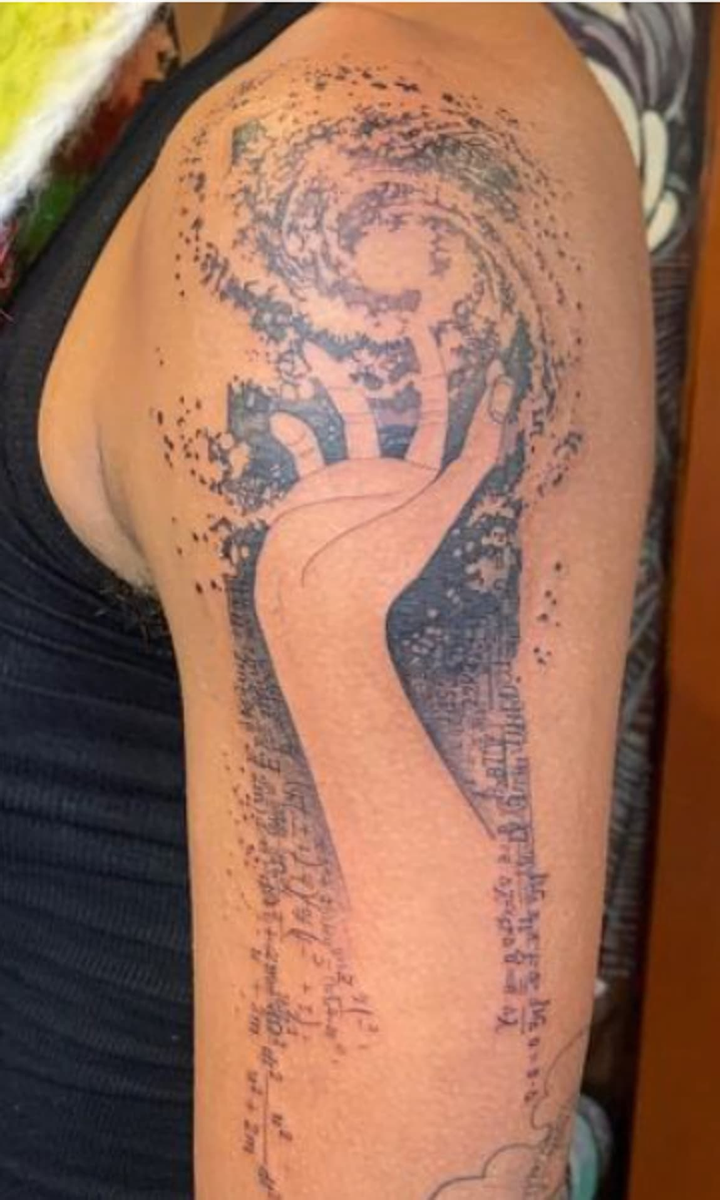
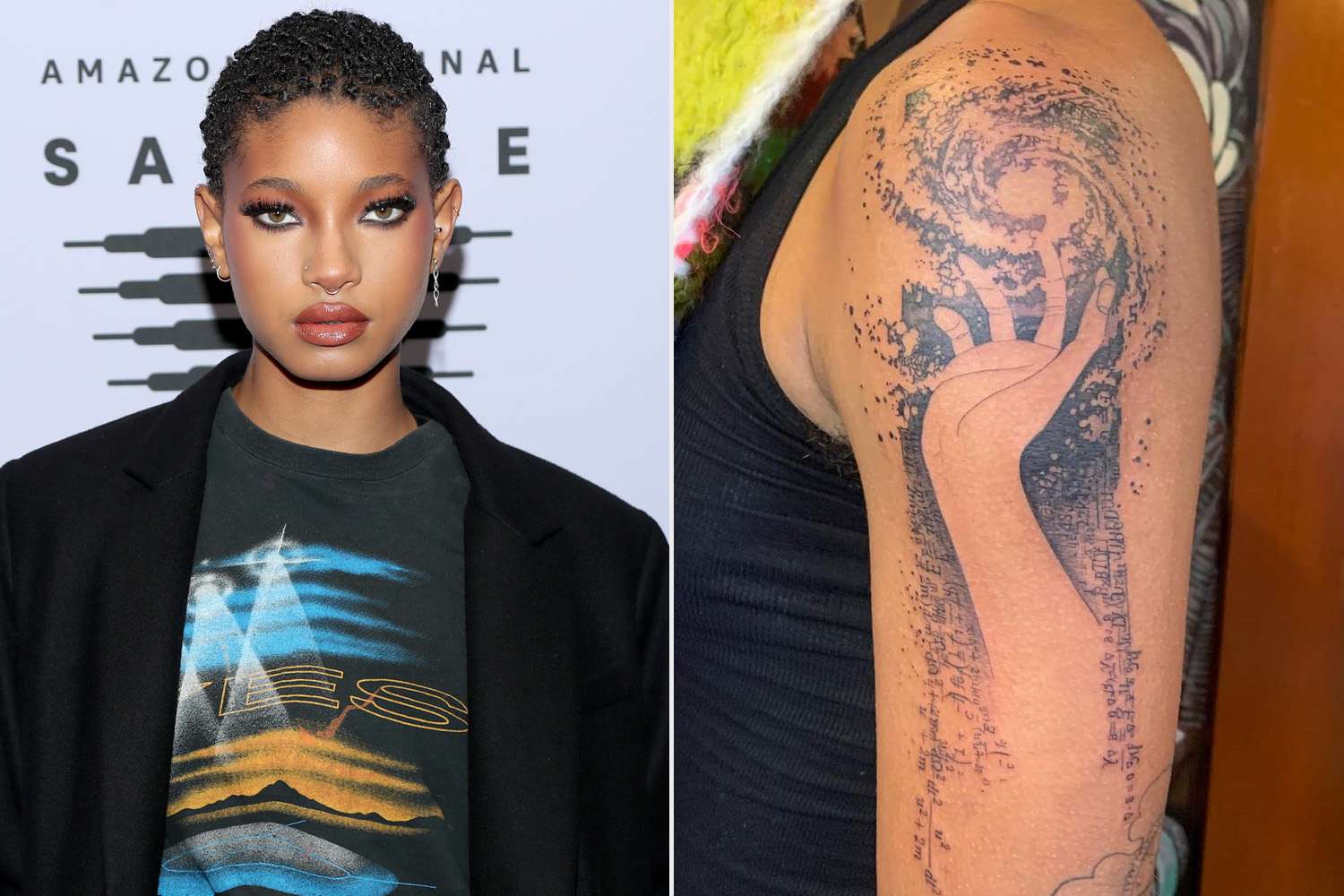
The tattoo that gets the most attention is the large design on Willow’s upper arm and shoulder. The centre of it is a hand reaching upward, surrounded by a swirling galaxy-like field. It is not a tiny outline or a quick flash design. The piece takes up a serious amount of real estate and uses dotwork, shading, scattered marks, and darker blocks to make the arm look as if it is opening into space.
Allure described the tattoo as coming from Willow’s interest in outer space, which gives the main image a little context without forcing a meaning onto every detail. The reaching hand is easy to read visually: it stretches into the cosmic area instead of sitting inside a neat frame. That loose edge is part of the appeal. The tattoo feels like it is still moving, with speckles and lines spreading beyond the central shape.
In photos, the piece begins around the shoulder cap and travels down the outside of the upper arm. Because the work is mostly black and grey, the contrast changes a lot with lighting. In a bright close-up, you can pick out the hand and the surrounding texture. In a darker photo, it reads more like a dense patch of abstract ink. Either way, it is the tattoo that gives the collection its biggest visual anchor.
The important thing is the scale. Willow’s smaller marks do not disappear, but this design changes the balance of her whole arm. It is large enough to be seen across a room and detailed enough to reward a closer look.
Her arm mixes old-school outlines with newer blackwork
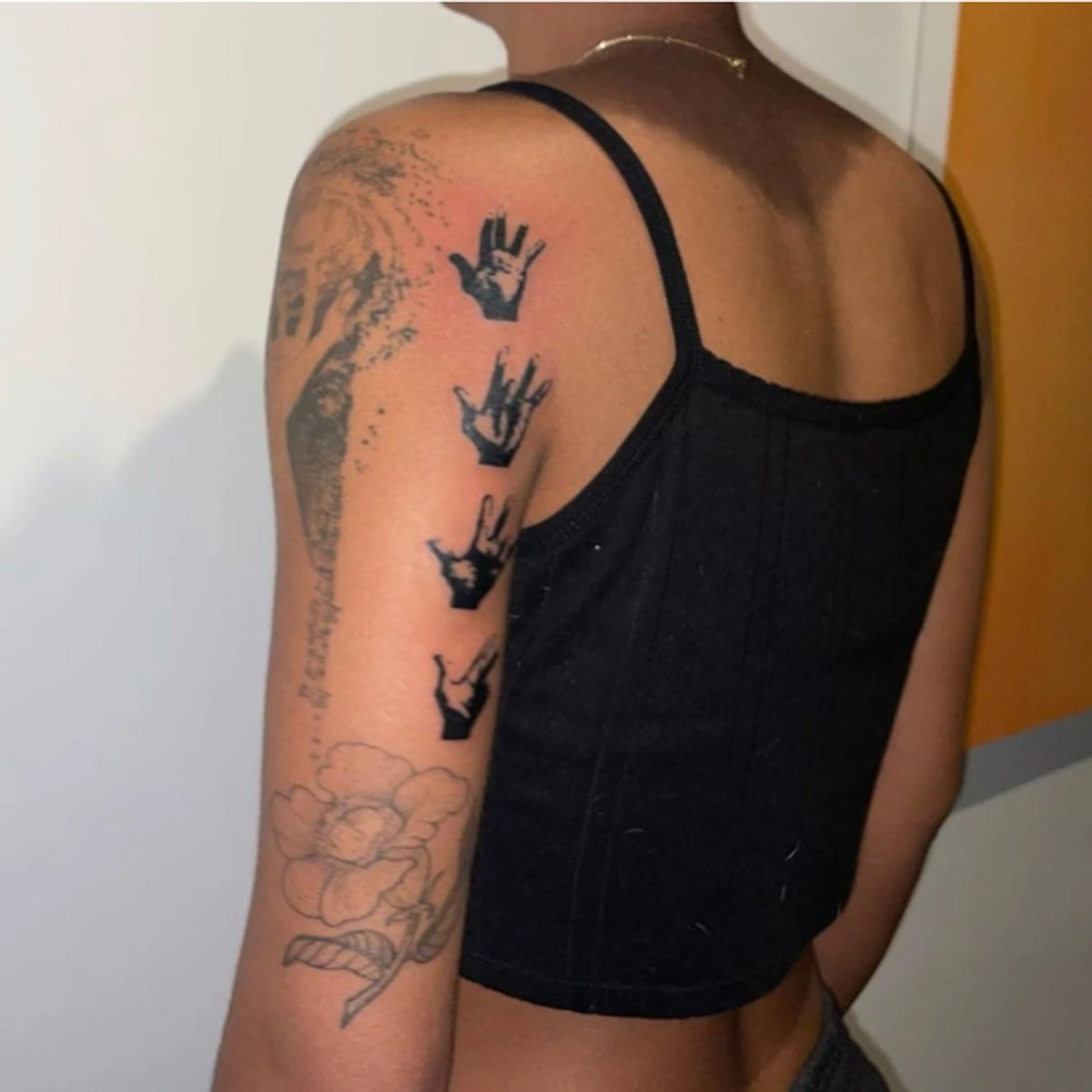
Another useful photograph shows Willow’s upper arm and outer arm from the side. The picture makes it easier to see that her collection is not one single sleeve in one uniform style. There are repeated hand-sign designs down the upper arm, a large outlined flower lower down, and a long curved form that looks like a leaf, ribbon, or botanical stem. Older shaded work sits near newer, darker shapes, leaving the arm with a deliberately built-up feel.
The repeated hand signs are among the easiest details to recognise. They sit one below another and have a bold black silhouette, so they hold their shape even when the rest of the arm is photographed at a distance. They also bring a bit of rhythm to a sleeve that otherwise contains lots of fine lines. Rather than filling every inch with solid black, the designs leave breathing room around one another.
Lower on the arm, the flower is much lighter and more open. Its petals are drawn with thin outlines, and the stem curves into the surrounding work. This contrast is useful because it shows how the tattoo collection has developed over time. The fine-line flower does not try to compete with the shoulder piece. It sits alongside it, giving the lower arm a softer section.
There are also vertical lines of writing or symbols along the outer arm. They are visible in close photographs, but the exact wording is not consistently clear enough to transcribe with confidence. It is better to describe them as fine script-like markings than to invent a translation. That restraint keeps the inventory accurate while still acknowledging an important part of the sleeve.
The hand tattoo is the most personal-looking close-up
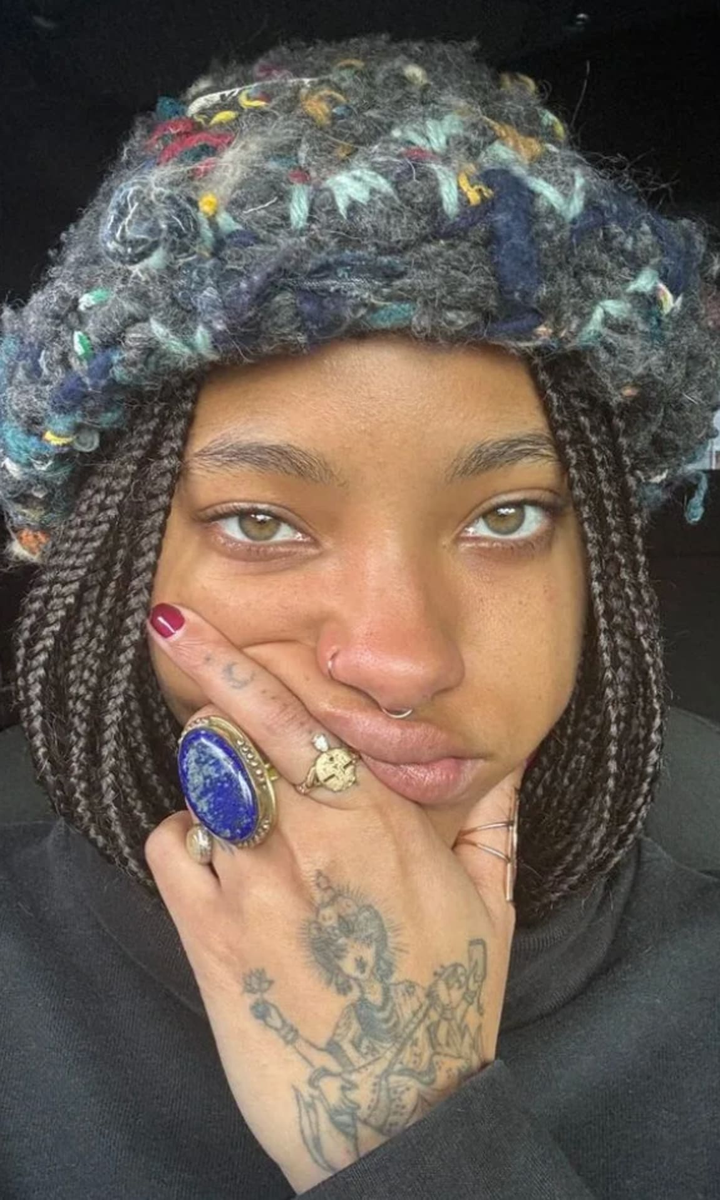
Willow’s hand tattoos are much smaller than the shoulder work, but they are often more immediately noticeable because her hands are part of almost every portrait. One close-up shows a detailed figure seated across the back of the hand, with a decorative crown or halo, flowing clothing, and fine surrounding lines. A tiny flower-like mark appears toward one side, while other small symbols sit across the fingers and knuckles.
Because the hand is curved and constantly moving, the design does not read like a flat illustration. Some lines bend around the knuckles and fade toward the sides of the hand. Rings can cover parts of it, and the angle of a selfie can make one section look darker than another. Still, the central figure is clear enough to separate from the smaller marks around it.
The hand is also where Willow’s jewellery and tattoos overlap visually. Large rings, a nose ring, and painted nails can draw the eye first, then the ink appears underneath. That combination suits her style. The tattoos are not presented as a formal display; they show up in ordinary gestures, while she is resting her chin on her hand or turning her fingers toward a camera.
Not every small symbol has a published explanation. The safest description is therefore about what the photographs show: a detailed hand figure, small botanical marks, finger symbols, and fine lines spread across the hand. That is enough to understand the design without pretending the meaning has been confirmed.
Saraswati appears in a separate hand tattoo story

A separate set of images from the early 2020s shows the hand tattoo in a more direct, almost documentary way. The design is identified in coverage as Saraswati, the Hindu goddess associated with knowledge, music, and learning. The figure sits on the hand with multiple arms, an ornate headpiece, and what appears to be a musical instrument. The lines are much more illustrative than the small finger marks around it.
This piece is worth separating from the general phrase “hand tattoos” because it has a specific documented subject. It is not just an abstract goddess-shaped design. The coverage names Saraswati, and the visual details support that identification. At the same time, the photographs do not give us a full statement from Willow about every reason she chose the image, so it is best not to turn the tattoo into a made-up biography.
The design also explains why the hand can look so busy in newer portraits. The figure covers a broad area, while the fingers carry several smaller marks of their own. From far away, it can look like one dark patch. Up close, there is a lot more going on: jewellery-like detail, curved limbs, thin outlines, and small shapes that sit around the main figure.
It feels less like a logo and more like a miniature illustration. That difference matters when comparing it with the bold hand signs on the upper arm. Willow’s tattoos move between graphic symbols and finely drawn figures without needing to settle on one style.
Finger marks and small symbols keep the collection loose
The smallest tattoos are easy to miss, but they help explain why Willow’s collection feels layered rather than planned as one matching sleeve. Close photos show little symbols on the fingers, short marks near the knuckles, and delicate shapes that sit beside the larger hand figure. Some look like tiny stars, flowers, or geometric signs, although the resolution and angle do not always allow a firm identification.
These pieces also change the way the hand moves in photographs. A simple wave can reveal several marks at once, while a hand-to-face pose hides most of them. The result is a collection that appears and disappears depending on the gesture. That is probably why quick red-carpet photos never tell the whole story.
It is tempting to attach a meaning to every little mark, especially when the larger tattoos have such strong themes. But there is no need to overstate it. The confirmed story is that Willow has a substantial collection of visible hand and arm ink, including a Saraswati figure and space-inspired work. The rest can be described honestly as small, visible symbols whose individual meanings have not been publicly explained.
What the full sleeve says about Willow’s tattoo style
When the photos are viewed together, Willow’s tattoos do not look like one session or one artist trying to make everything match. The collection includes fine-line drawing, dotwork, black silhouettes, botanical outlines, script, and illustrative figures. That mixture gives the arm some history. Older pieces remain visible instead of being swallowed by a blackout sleeve, while newer work adds darker areas and larger shapes.
The cosmic shoulder tattoo is the broadest statement, but the smaller designs stop it from becoming the only thing people see. The hand brings in a more intimate scale. The flower softens the lower arm. The repeated signs create a pattern. The Saraswati image adds a detailed figure with a clear name and cultural reference. Together, those sections make the collection feel personal without requiring every tattoo to have the same explanation.
There is also a practical side to the way Willow wears the work. A jacket can cover most of the upper arm, but a hand tattoo will still show. A tank top makes the shoulder piece obvious. A close selfie can reveal the figure on the hand, while a full-body event photo may only show a hint of blackwork. The tattoos change with the clothes and the camera angle, which is why a proper inventory needs more than one press photo.
Willow Smith’s tattoos are still a work in progress
It would be a mistake to treat this as a final list. Willow continues to change her hair, clothes, jewellery, and body art, and the recent coverage already shows how quickly a collection can develop. The safest snapshot right now includes the large galaxy-and-reaching-hand shoulder piece, repeated hand signs, the outlined flower and fine markings on the arm, the Saraswati hand tattoo, and a group of smaller finger symbols.
The bigger takeaway is that the tattoos do not follow a clean checklist. They feel collected in chapters. Some pieces are bold and graphic, some are delicate, and some are difficult to read unless the image is sharp and close. That is part of what makes them interesting. Willow’s ink is not trying to look perfectly uniform; it looks like a record of different ideas arriving at different times.
For the clearest view, start with the arm and shoulder photographs, then look at the hand close-ups. The relationship between the pieces is easier to understand when you can see the scale: the galaxy work covers a major section, while the goddess figure and small symbols create detail at the edges. The collection is large enough to have its own visual language, but open-ended enough that another new tattoo could change the map again.
Watch Willow talk about the tattoo story
For a quick video look at the tattoo coverage and the meaning discussed around Willow’s larger piece, watch the feature below.