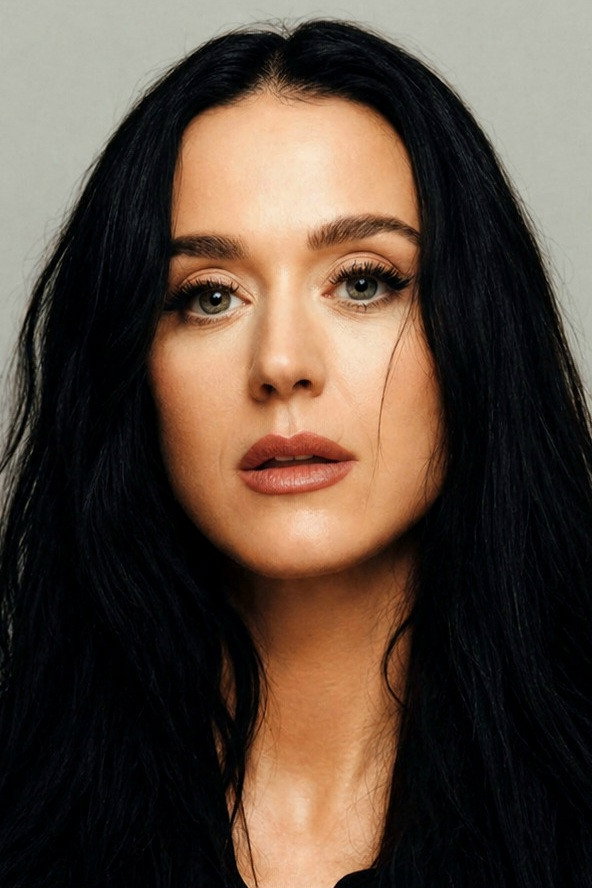
Katy Perry’s tattoos make more sense as a scrapbook of eras than as one fixed style. The collection moves from the cursive word Jesus on her wrist to a Sanskrit phrase shared with Russell Brand, then into bright ankle designs tied to albums and tours. Some pieces carry a plainly stated meaning; others are simply playful images that became part of her visual language.
That difference is worth keeping. Perry has explained several tattoos herself, especially the music milestones, but a lotus or a small finger design does not need a dramatic private story added to it. The most useful account names the design, records the placement and separates confirmed context from fan interpretation.
Jesus and the lotus sit opposite each other on the wrists
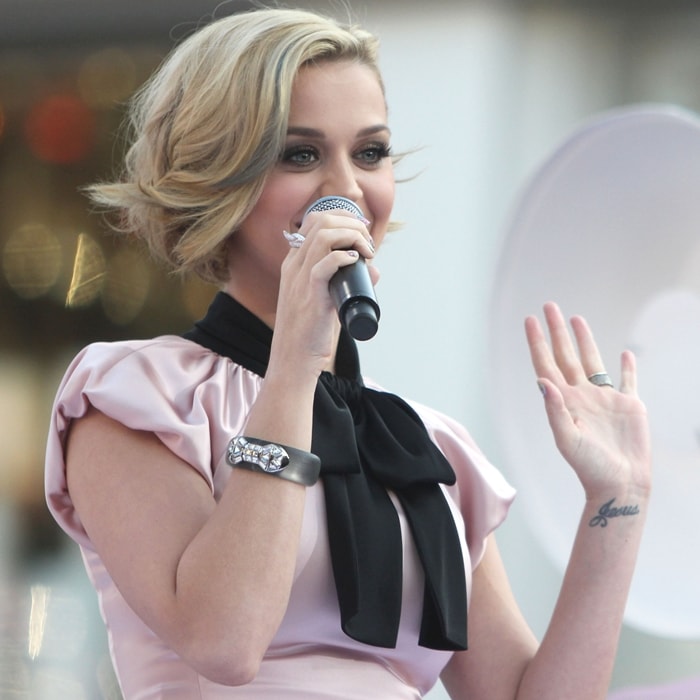
The cursive Jesus tattoo on Perry’s left wrist is one of her earliest and most recognisable pieces. She got it when she was young, during the period when her public identity was still closely connected to gospel music. The word is not hidden in a large composition: it is a small, readable line that stays visible whenever she plays guitar or raises her hand.
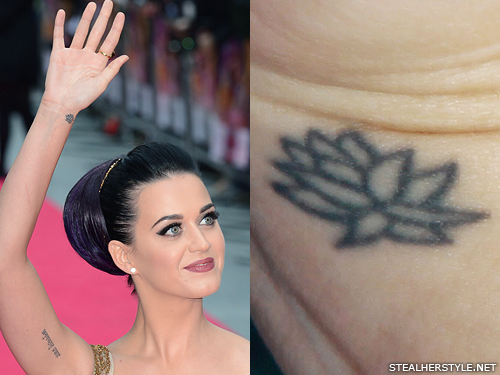
On the opposite wrist, Perry has a simple lotus. The flower is often described as a symbol of new beginnings, but Perry has not supplied a single definitive explanation that needs to be treated as official. What can be said with confidence is that the design is fine-lined, compact and placed where it balances the lettering on the other wrist.
Seen together, the two wrists show the range of the collection. One piece is a word with a direct religious reference; the other is an image whose meaning remains more open. The contrast is more interesting than forcing both tattoos into the same biography.
The Sanskrit phrase on her bicep records a shared idea
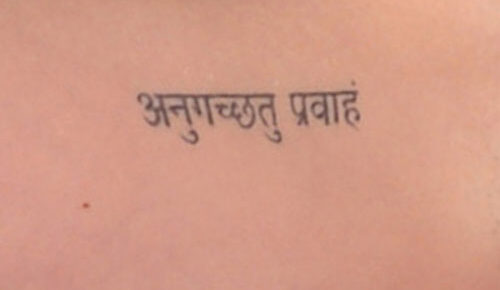
Inside Perry’s right bicep is the Sanskrit phrase “Anuugacchati Pravaha,” commonly translated as “go with the flow.” It was a matching tattoo with Russell Brand, and the phrase was chosen as a compact expression rather than a decorative pattern with no readable message.
The placement matters. The lettering sits high on the arm and can disappear beneath sleeves, which is why it is easiest to see in photographs where Perry lifts her arm. The script also looks different from the playful ankle pieces: it is longer, more deliberate and built around words rather than a cartoon image.
The relationship context is part of the public record, but the tattoo should not be used as a shortcut for the later history of the marriage. The design documents what the couple chose at that moment. It does not need a new meaning invented after the relationship ended.
Strawberry, peppermint, cherry and prism turn album eras into ankle tattoos
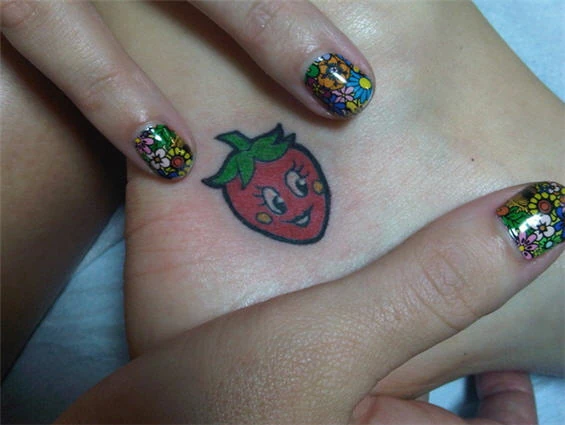
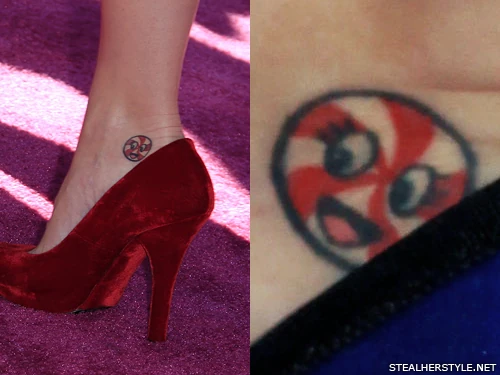
The ankle tattoos are the clearest example of Perry turning a career timeline into body art. A smiling strawberry represents One of the Boys, while the smiling peppermint belongs to the candy-coloured world of Teenage Dream. Both designs are small, cartoon-like and intentionally cheerful.
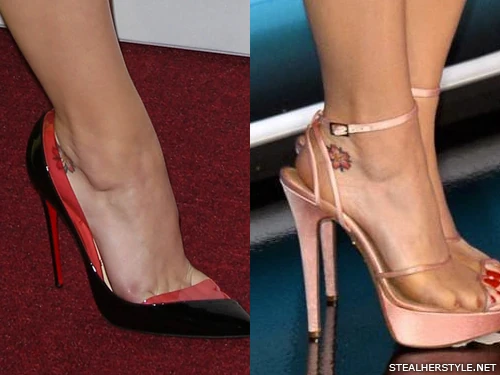
A prism was added for the Prism era, giving the group a more geometric shape. Perry also has a cherry blossom design on her ankle. The blossom is sometimes assigned a large symbolic meaning online, but the stronger evidence is simply the design, its placement and its connection to the wider collection of bright, pop-art-style pieces.
These tattoos are not interchangeable stickers. The strawberry, peppermint and prism each point to a different period of Perry’s music, and the ankle placement makes the set feel like a running visual diary. Even when the images are tiny, the colours and silhouettes make them readable in performance photographs.
Hello Kitty and XLIX mark the playful side of the collection
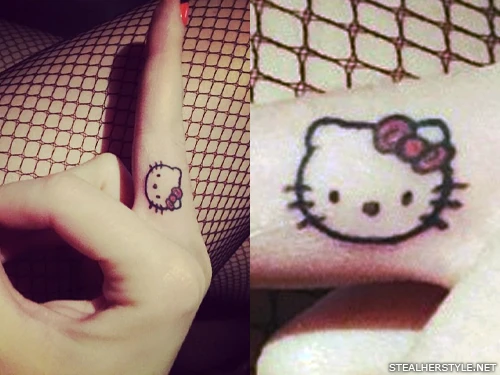
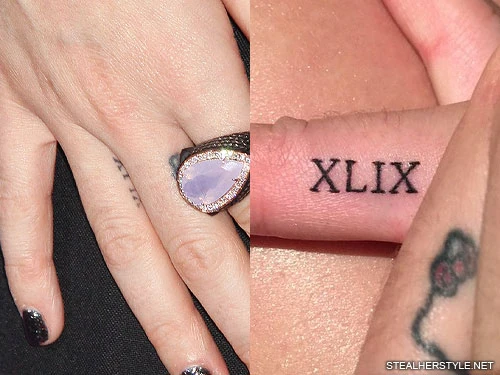
Perry’s small Hello Kitty tattoo sits on a finger and fits the lighter, collectible side of her image. It was associated with the character’s anniversary and Perry’s own birthday timing. The design is instantly recognisable, but its scale means it is often hidden when she holds a microphone or curls her fingers.
She also marked her Super Bowl XLIX halftime appearance with the Roman numerals XLIX. This is one of the most straightforward tattoos in the archive: the number points to the event, and the finger placement turns a career milestone into a discreet reminder rather than a large piece of branding.
Those two tattoos show why a celebrity inventory should include small marks instead of counting only large, camera-friendly designs. A finger tattoo can be meaningful because of the moment it records, even when the image itself occupies only a few millimetres of skin.
What Katy Perry’s tattoo record actually tells us
Perry’s tattoos combine faith, relationship history, album imagery and career milestones. The strongest meanings are the ones attached to her own explanations: Jesus, the matching Sanskrit phrase, the album-era ankle pieces and XLIX for the Super Bowl. The lotus, Hello Kitty and cherry blossom can be described confidently as designs and placements without pretending that every private reason has been published.
The collection is colourful because the subject matter is tied to pop music, but it is not random. Words sit on the wrists and bicep; album symbols gather around the ankles; tiny finger tattoos mark a character and a performance. Read that way, the tattoos form a timeline that is much more personal than a generic list of celebrity ink.