
Halsey has the kind of tattoo collection that rewards a close look. There are obvious pieces on the hands and arms, tiny numbers on the knuckles, bits of lettering, little red symbols and designs that only show up when a sleeve moves. The collection has grown across different eras, so it is better read as a scrapbook than as one carefully planned sleeve.
Some meanings are easy to trace because Halsey has talked about them. Others are simply visible in photographs. This guide keeps those two things separate. A number can be named without inventing a story for it, and a phrase can be connected to a song without claiming that every nearby line has the same meaning.
Halsey’s hand tattoos bring the numbers and three Xs into focus

The hand is one of the busiest parts of Halsey’s tattoo map. Close photographs show small marks around the fingers and knuckles, including 929, 17 and the group of three Xs. They are tiny designs, but they change the whole look of the hand because they sit where rings, nails and gestures keep bringing them into view.
The three Xs have one of the clearest personal explanations. Halsey has connected them with herself and two brothers, turning the three matching marks into a family reference. There is also a playful connection to the Xs used on parental-advisory labels. That makes the tattoo work on two levels: it is a simple visual trio, but it also carries a private family count that Halsey has chosen to make visible.
The number 17 is another hand tattoo that has been explained in published coverage. Halsey has described it as a lucky number and linked it to the year their career began to change. Numbers are easy to misread in a quick photograph, especially when the hand is turned or jewellery sits across the knuckles, but this one has been repeatedly identified as 17 rather than left as a guess.
The 929 mark is more date-like. It is commonly tied to September 29, Halsey’s birthday, which gives it a neat place in the collection: three Xs for family, 17 for a formative year and 929 for a personal date. The designs are small enough to live together without becoming one large picture. They look like notes written around the hand.
There are other tiny symbols close to the fingers and palm. Some are visible in one photograph and hidden in the next. That is why a responsible list does not turn every dot into a separate tattoo with a confident meaning. The hand is moving, the images are cropped differently and several marks are too small to read clearly. The confirmed entries are enough to make the placement interesting without stretching the evidence.
Halsey’s hand work also shows why scale matters. A small tattoo does not mean a small story. The three Xs take up very little skin, but the family explanation gives them more weight than a much larger decorative line. At the same time, not every tiny mark needs a dramatic explanation. Some are simply visual choices, and the collection feels more believable when both kinds are allowed to sit together.
The arm collection mixes flowers, script and small standalone designs
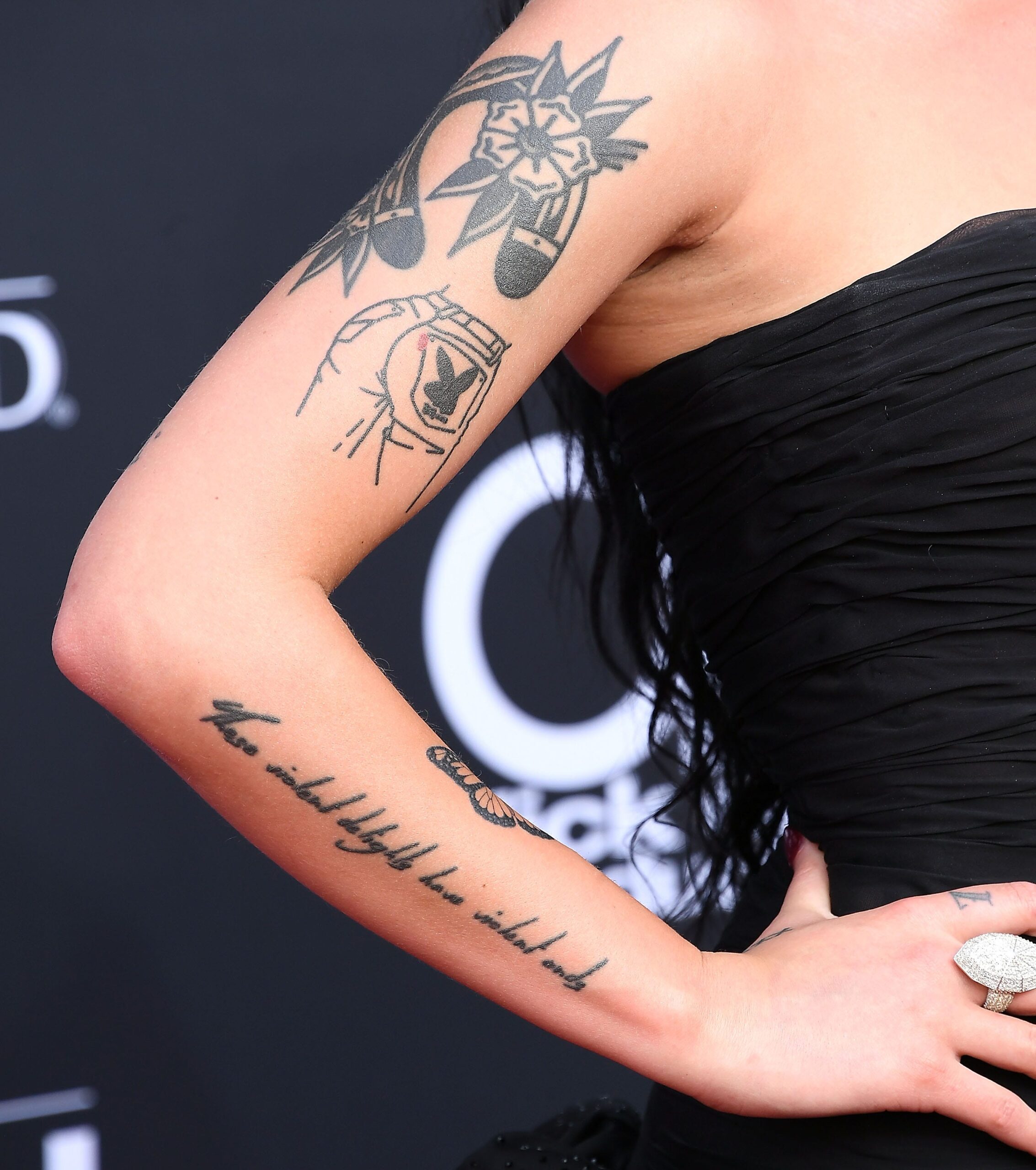
Halsey’s arms carry a loose mix of flowers, script and simple black illustrations. The designs do not all share one style. Some are delicate, some are heavier, and some use colour instead of sticking to plain black ink. The result feels collected over time rather than planned as one matching sleeve.
Floral tattoos appear among the most visible arm pieces. They soften the stronger lettering and give the arm a changing rhythm as it moves from shoulder to forearm. A flower can be described by its shape and placement even when its private meaning is unknown. Halsey’s public tattoo conversations explain some pieces directly, but they do not give a personal biography for every petal.
Lettering is another recurring choice. Halsey has used song titles, short phrases and compact numbers in places where the words can be read at close range. The lettering tends to work like a handwritten note rather than a huge chest statement. That suits a collection filled with references to music, memory and identity without making every tattoo look like album merchandise.
The arm photographs also show how tattoos change when they sit beside one another. A matchstick can look almost like a line in a larger drawing from a distance, while a close-up shows that it is a separate little object. The same is true of numbers and short script. Halsey’s collection has plenty of negative space, so each mark can keep its own edge instead of being swallowed by a solid sleeve.
Some tattoos are matching pieces. Halsey has discussed tattoos connected with friends and fans, including designs made through shared experiences. Matching ink does not always mean identical placement or identical personal meaning, so the useful point is the relationship around the design, not a claim that every person involved carries the exact same story forever.
The arm is also where old and new tattoos can be hardest to separate. A cover-up can leave a darker patch, while a new piece can make an older line look like part of a larger composition. Readers comparing photographs should pay attention to dates, sleeve length and lighting. A tattoo guide that treats every image as if it were taken on the same day will miss how much the collection has shifted.
The matchstick and Mars symbol show Halsey’s taste for small graphic ink
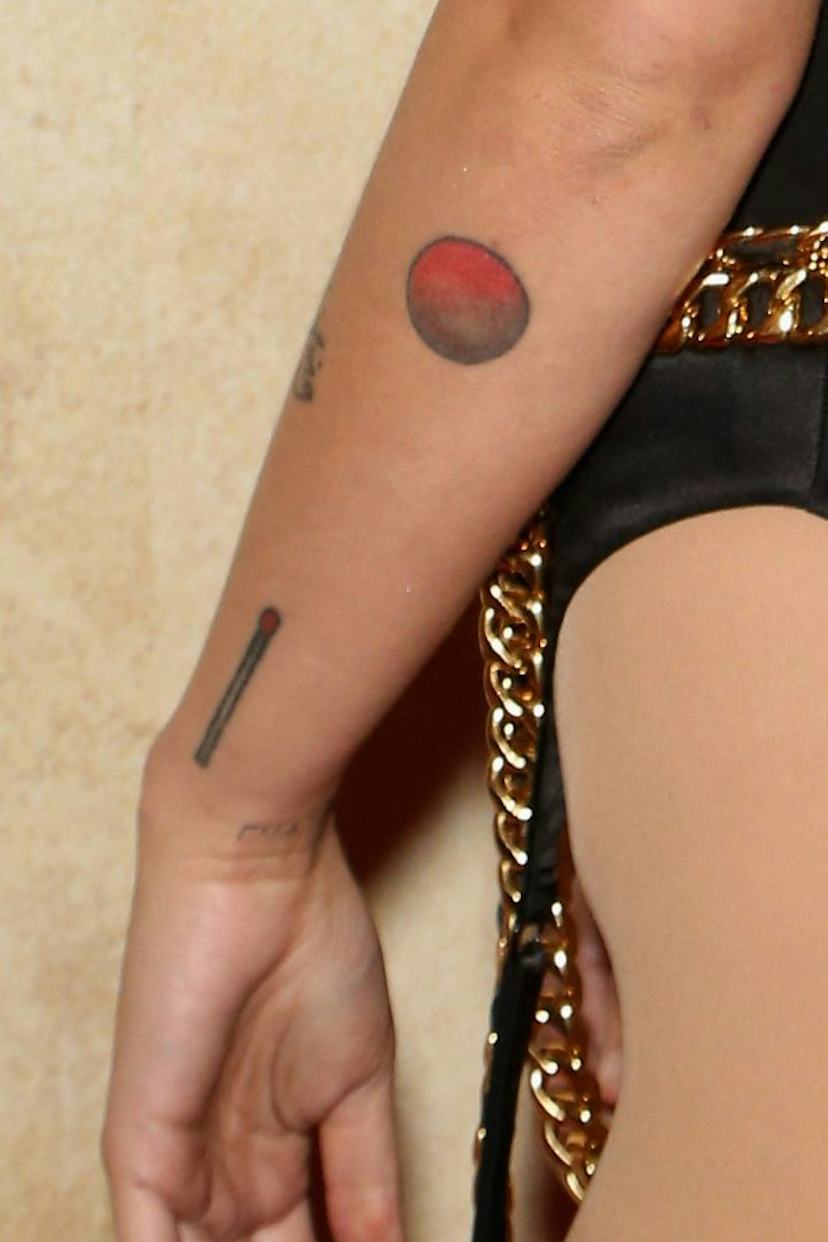
The matchstick is one of the easiest Halsey tattoos to recognise once you know where to look. It is a narrow design with a red tip, placed among other small marks on the arm. The shape is simple enough to read in a photograph without needing a close crop, but it still has a little drama: a tiny flame-ready object sitting beside more delicate ink.
Near it is a circular Mars symbol with a red-to-black look in published photographs. The two designs make a good pair for understanding Halsey’s visual taste. Neither needs a large realistic portrait or heavy shading. They rely on clean outlines, compact colour and recognisable shapes. That gives the arm a graphic quality, almost like a page of small illustrations.
It is tempting to assign a large meaning to the Mars image, especially because Halsey’s music often deals with identity, conflict and changing moods. The safer approach is to describe what has actually been reported. The symbol is there, the colour is visible and the placement is clear. If Halsey has not given a definitive personal explanation in the source being used, the guide should not manufacture one.
The matchstick is also a good example of why a tattoo inventory needs images beside the text. A written description alone could mean a realistic match, a cartoon match or a single red line. The photograph narrows it down. Readers can see the scale and the way it sits against other arm tattoos, which is much more useful than a vague sentence about a “meaningful symbol.”
Halsey has several small designs that work in this same register: compact, readable and easy to place beside a larger tattoo. They are not filler. They make the collection feel personal because they look like choices made one at a time. The different sizes also keep the arm from becoming visually flat. A long script line leads the eye, then a tiny object interrupts it.
Some of the arm pieces have colour while others have faded toward grey or black. That does not necessarily mean one is newer. Lighting, camera processing and skin tone can change how the ink appears. The safest dating clues come from the publication date and the surrounding outfit or event, not from guessing that a pale red mark must be old.
Neck lettering and tiny face ink sit outside the arm collection
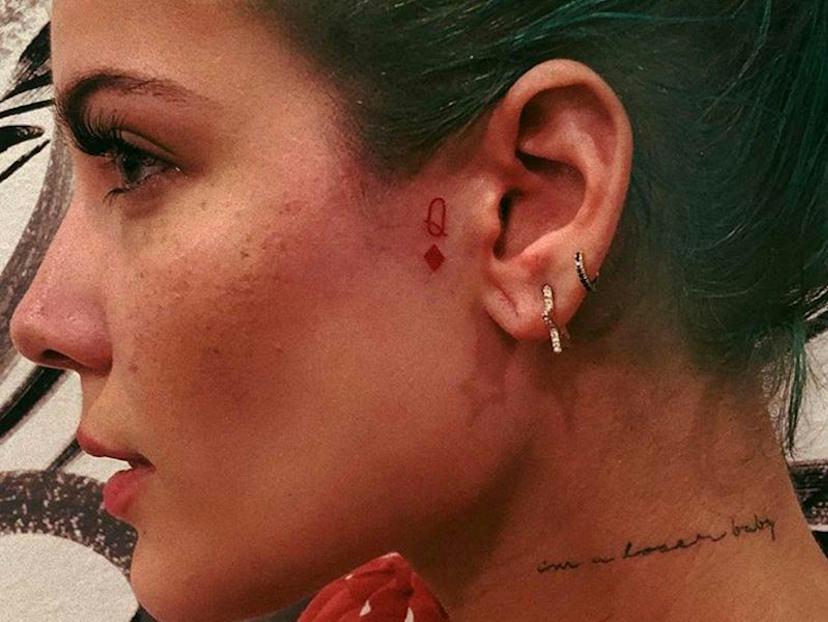
Halsey’s neck and face tattoos give the collection a more visible edge. A small queen-of-diamonds symbol has been photographed near the ear, while the words I’m a loser baby appear in red script along the side of the neck in published close-ups. These pieces are easy for readers to notice because they sit near the face, but they are still small and can disappear under hair, makeup or a change of camera angle.
The neck phrase is a good example of Halsey using short text as a mood rather than a full explanation. The wording is memorable, but the photograph cannot tell us every reason it was chosen. It is enough to identify the phrase, colour and location. The tattoo can be connected to Halsey’s public style without pretending that the image reveals a private diary entry.
The queen-of-diamonds mark is similarly compact. Its outline reads quickly, which is why it appears in portraits where a larger arm tattoo would be hidden. Small face-adjacent designs also change how the whole portrait feels. They become part of the expression, even though they are only a few lines of ink.
Halsey has also been photographed with other small marks around the face, neck and hands. Some are clear enough to describe, while others are too soft to separate from makeup or shadow. The distinction is important. A tattoo guide should not promise a complete count when the photographs do not support one. It is better to list the identifiable pieces and mark the rest as uncertain.
The wider collection includes other documented designs linked to music, family, relationships and personal dates. A right-forearm phrase reading Heaven in Hiding has been connected with Halsey’s music, and tattoo coverage has discussed pieces associated with albums and relationships. Those references should be dated because Halsey’s collection has changed. A cover-up, a new matching tattoo or a faded line can alter the map.
That is what makes Halsey’s tattoos worth looking at as a group. The collection is not built from one repeated symbol. It moves between family marks, numbers, song references, flowers, planetary imagery and tiny graphic objects. Some pieces have a clear story, some have a clear design but no confirmed meaning, and some only become visible in a well-lit close-up. The best guide gives each category its proper weight.
The featured portrait at the top of this article is separate from the tattoo photographs. It gives readers a clean view of Halsey’s face, while the four body images show the hand, arm, forearm and neck details discussed in the text. That separation keeps the page attractive without pretending that a general portrait is evidence for a particular tattoo.
Halsey’s collection keeps changing, so dates matter. A photograph from the early career period may show fewer designs, while later images reveal new hand marks, fresh lettering or changes around the arm. The most useful way to read the collection is to stay specific: name the tattoo, locate it, show it clearly and explain only the meaning Halsey or a strong source actually supports.
One thought on “Halsey’s Tattoos: Hand Ink, Matchsticks, Numbers and Song References”