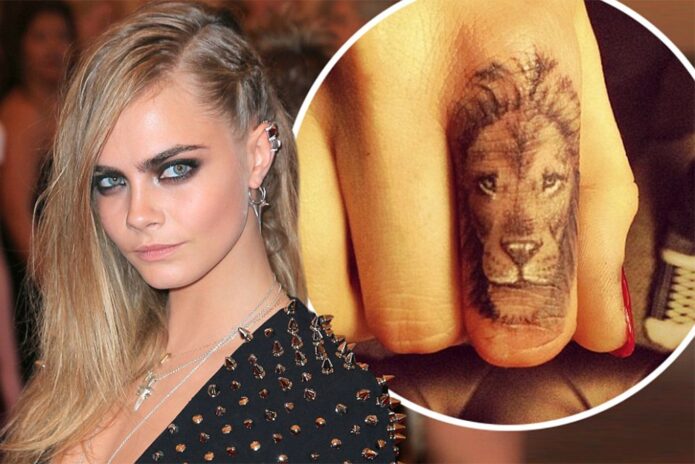
Cara Delevingne’s tattoos are easy to recognise, but they’re not all the same kind of ink. There’s the tiny lion on her finger, bits of lettering on her feet, fine-line animals, friendship tattoos and small marks that only show up when a photograph catches them properly. Some of the stories behind them are public. Others are just things we can see, and that’s where the answer has to stop.
She started building the collection in her early modelling years, and the designs have never looked like one planned sleeve. They’re a mix of quick ideas, personal references and pieces made with artists she trusted. Keith “Bang Bang” McCurdy is linked to many of the best-known designs, while Dr. Woo made the delicate elephant on her inner forearm and Daniel Tucci is credited with the Roman numerals on her side.
The useful way to read Cara’s tattoos is design by design. A clear photo can tell us where something sits and what it looks like. It can’t automatically tell us what every mark means, when it was done or who tattooed it. The sections below stick to the pieces that have been shown or discussed clearly.
The hand tattoos that started the collection
The lion on Cara’s index finger is the tattoo most people think of first. It was her first tattoo, and it arrived when she was still a teenager in modelling terms. The design sits on the side of the finger, so it’s small, exposed and surprisingly hard to photograph well. A wide red-carpet shot can show that she has ink on her hand, but a close image is needed to make out the lion’s face and shading.
She has connected the lion with her Leo star sign, which gives the piece a simple explanation without turning it into something grander than it is. It also makes sense as a first tattoo: the image is bold enough to be noticed, but the placement keeps it compact. It doesn’t take over her hand.
Bang Bang is associated with the lion tattoo, and he has worked on many of Cara’s other pieces too. That doesn’t mean he made every tattoo she has. It just means the lion belongs to a period when she was returning to the same New York artist for several designs.
There are photographs where the lion looks darker and others where it seems softer. That difference can come from lighting, age, editing and the angle of the finger. It shouldn’t be read as proof that the tattoo was completely redone. The safest description is still the same: a small lion portrait on the index finger, widely described as her first tattoo and linked by Cara to Leo.
Feet, family and the tattoos that fill in the story
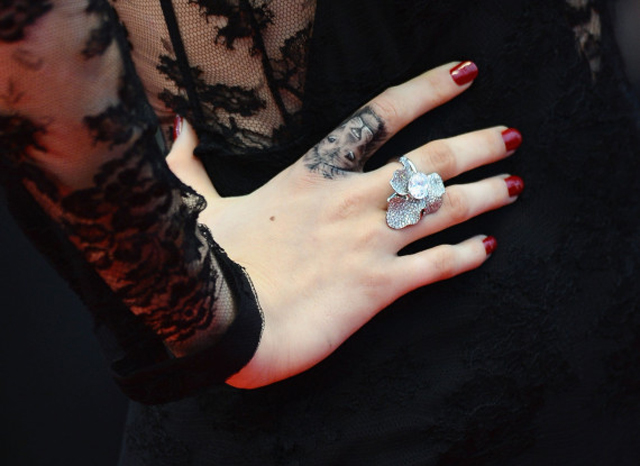
Cara’s hands carry more than the lion. The initials “CJD” refer to Cara Jocelyn Delevingne and sit on the side of her hand. It’s a very visible place for a personal mark, but the design itself is plain lettering rather than a large picture. That makes it a good example of how different her collection can be from one tattoo to the next.
She has also been photographed with small white-ink work, including a dove on a finger and other pale marks that almost disappear under normal lighting. White ink is tricky to document because it can look like a highlight in one photograph and vanish in another. The image has to be sharp before it’s sensible to name the design.
There are also tiny stars and a diamond around one ear. Those pieces are easy to miss because they sit close to jewellery, hair and the edge of the face. They’re not part of a large composition, and there’s no need to force them into one. They work better as small, separate additions that show how Cara kept adding little flashes of detail.
Her inner wrist carries the word “silence”. Cara has explained the phrase with the line “silence speaks when words can’t,” so this is one of the clearer examples of a tattoo with a public meaning attached to it. Even here, the wording matters more than a long theory about her personality. It’s a short phrase, in a small spot, and the explanation is already enough.
The hand and wrist pieces also show why old photographs need care. A ring, sleeve or shadow can cover half a letter. A low-resolution crop can make one small mark look like another. When the source image doesn’t show the detail, the honest answer is simply that the mark is visible but not fully identifiable.
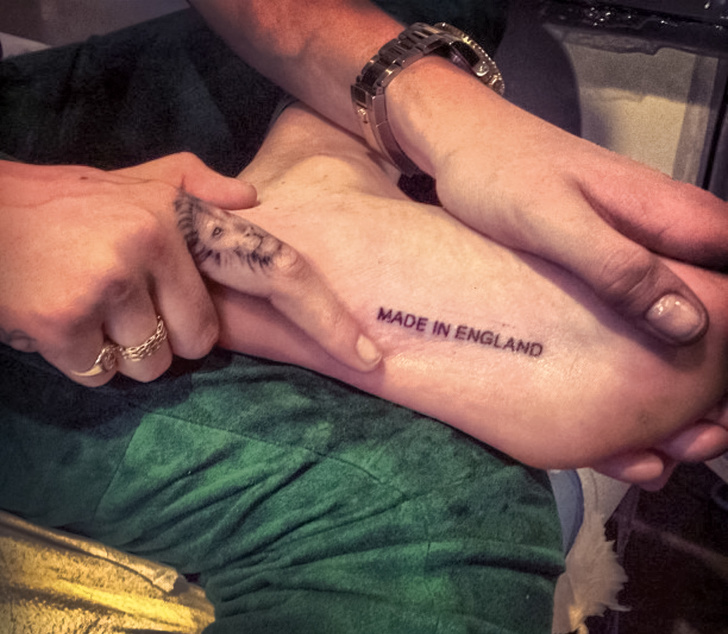
The words “Made in England” sit on the bottom of Cara’s left foot. It’s one of her most talked-about tattoos because she has actually explained why she chose it. The phrase came from a period when modelling made her feel less like a person and more like something being moved around for other people’s use.
In interviews, she described feeling like a puppet or a mannequin and said the tattoo was a way of putting that frustration on her body. That context is much stronger than the usual internet habit of assigning a deep meaning to every visible mark. Cara gave the phrase its own explanation, so the article can repeat that without guessing.
The placement adds a bit of humour too. It’s a blunt label hidden on the sole of the foot, which means it can stay private until she chooses to show it. The lettering is simple and blocky. It doesn’t need decoration because the joke is in the words and the location.
Photographs of this tattoo vary a lot. Some are close-ups where the letters are easy to read. Others show the foot at an angle, with only part of the phrase visible. The clearest versions are the ones worth using for the tattoo itself. A fashion portrait where the foot is covered doesn’t add anything useful.
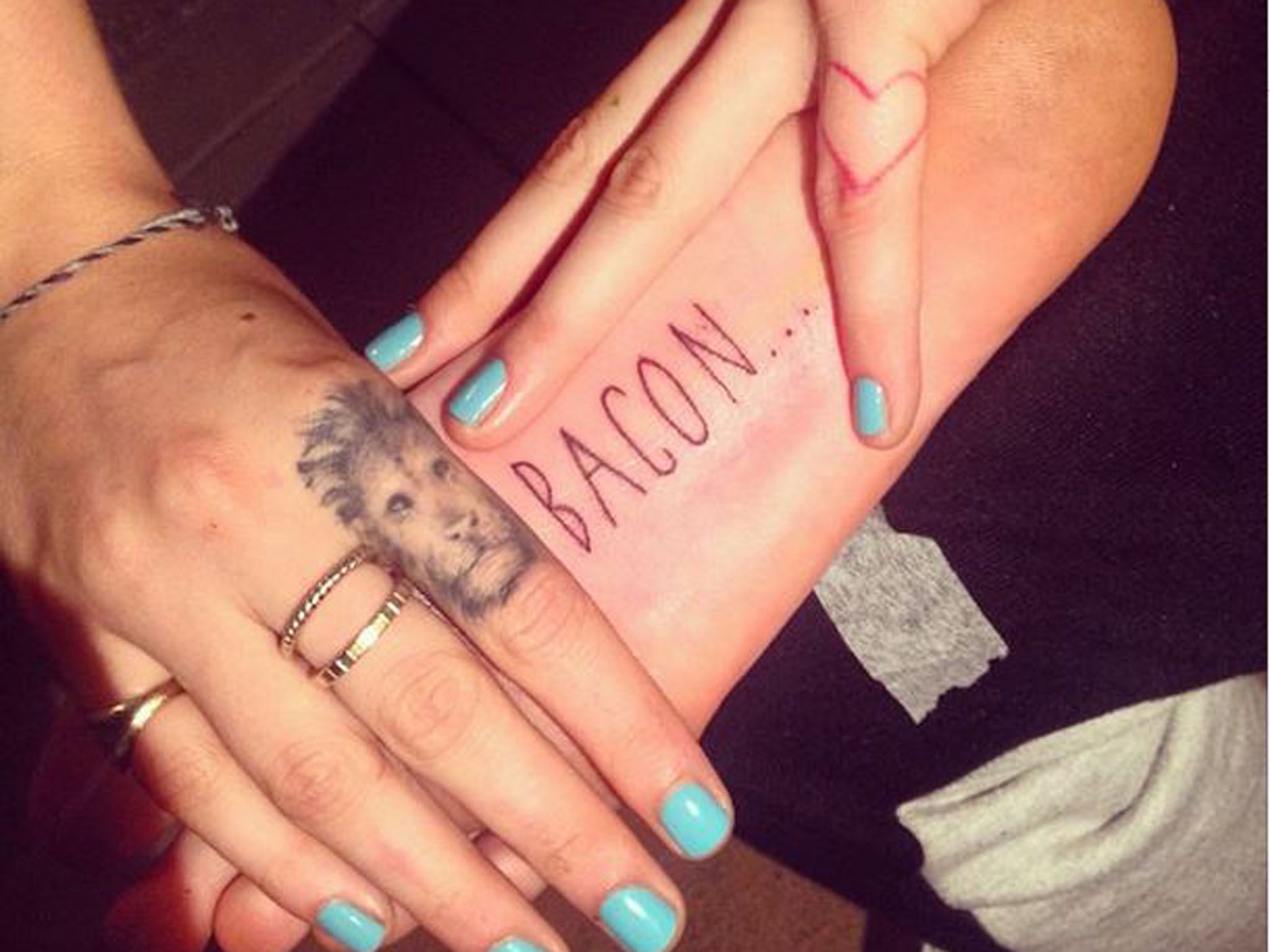
The “Bacon” foot tattoo is exactly as silly as it sounds.
Cara also has “Bacon…” tattooed on the sole of her other foot. The design is much less serious than “Made in England”, and that contrast is part of the fun. One foot carries a career-related frustration; the other carries a joke about breakfast. They don’t need to share a big symbolic message.
The punctuation is usually shown as part of the design, although the exact number of dots can be hard to judge in different images. It’s another reason not to over-read old photographs. Foot tattoos can fade and blur faster than ink in areas that get less friction, and the sole is rarely photographed under perfect conditions.
The piece is often linked to Bang Bang, and it appeared around the same period when Cara was collecting lots of small, playful tattoos. It sits in the same general category as the toe smileys she got with Margot Robbie: informal, a little ridiculous and tied to people or moments rather than a formal design plan.
This is one of the tattoos where the image should do most of the work. Readers want to see the lettering and the placement. A generic photograph of Cara doesn’t help, even if it’s a good portrait. The tattoo is the subject, so the foot needs to be clear enough for the words to be read.
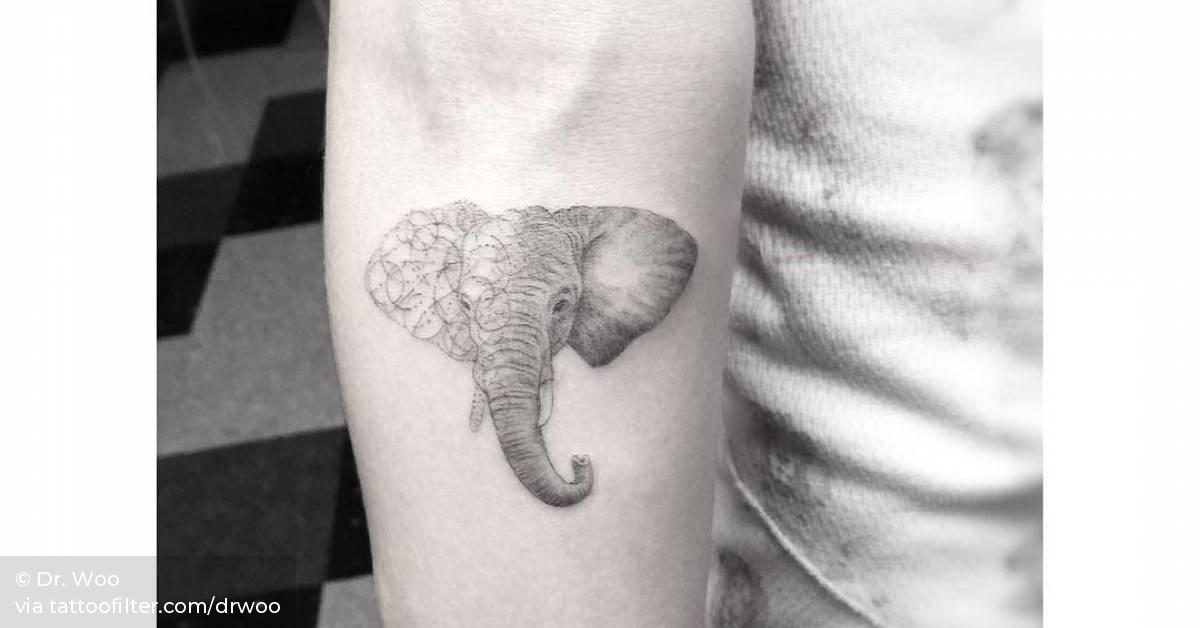
The elephant on her inner forearm.
Cara’s fine-line elephant sits on the inside of her right forearm and was made by Dr. Woo using a delicate “half-needle” style. It’s a much more detailed piece than the tiny lettering on her feet. The elephant has a soft, sketch-like look, with fine lines and shading that can disappear if the picture is compressed too much.
She has said the elephant is the tattoo with the most personal weight for her because it was made in memory of her late grandmother. That makes the design one of the clearest family tattoos in her collection. The meaning comes from Cara’s own explanation, not from a fan-made list.
The placement works well for the shape. An elephant needs a little more room than the lion on her finger, but the inner forearm still lets it stay close to the body rather than becoming a huge statement piece. When her arm is turned outward, the design is easy to miss. In a close-up, the face, ears and trunk become much clearer.
Dr. Woo’s involvement also shows that Cara’s tattoos were not all made by one artist. Bang Bang is responsible for many of the familiar pieces, but the elephant has a different line quality and a different artist history. That difference is visible if the photographs are large enough to show the detail.
Roman numerals, “breathe deep” and the side tattoos.
One of Cara’s smaller side tattoos is “XII” in Roman numerals. Tattoo guides usually place it on her side and credit Daniel Tucci. The number is commonly described as a lucky number for Cara, although the exact private reason behind choosing twelve is not always explained in the same detail as the lion or elephant.
She has also been photographed with the white-ink words “breathe deep” on her side. This is the kind of piece that looks obvious in one image and almost invisible in another. White ink reflects light, skin tone changes how it reads, and a photograph taken from across a room won’t show the letters properly.
Another phrase reported in the same general area is “don’t worry, be happy.” It’s a useful reminder that Cara’s tattoos move between small images and short bits of text. Some are easy to quote because the words are clear. Others should stay labelled as reported unless a strong close-up or direct explanation confirms the exact lettering.
The side is also a difficult place to document because clothes cover it most of the time. A cropped fashion photograph may show a few lines without proving the full design. That’s why a good tattoo guide needs the date and the clearest available view, rather than one blurry image stretched into a complete inventory.
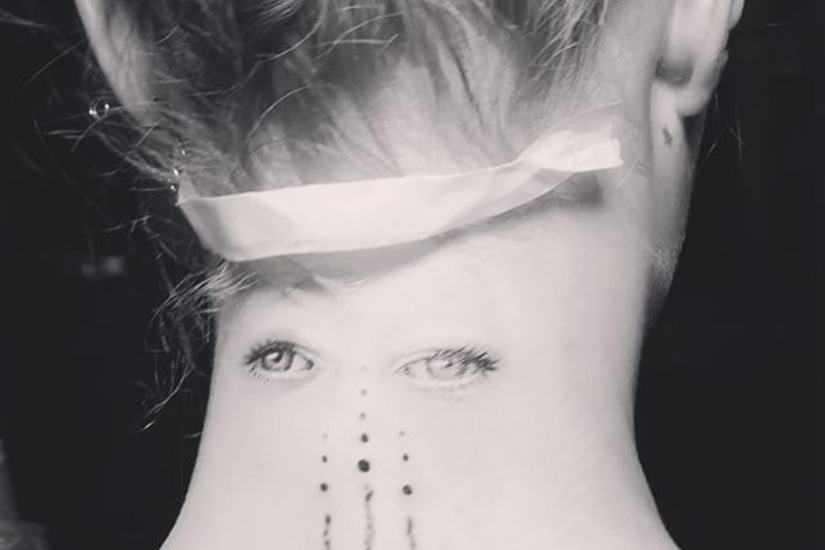
Eyes, sak yant and the tattoos around her neck.
The pair of eyes on the back of Cara’s neck was done by Keith “Bang Bang” McCurdy. The eyes sit above an older tattoo on the nape, creating a layered look rather than one single design. The strongest close-ups show the eyes clearly, while wider portraits often lose the detail in hair and shadow.
Below that, Cara has a sak yant-style tattoo. Sak yant refers to a traditional Southeast Asian tattooing practice, and the marks on her neck are usually described in that context. It’s better to describe the visible script and placement than to translate every line with certainty unless the translation comes from a reliable source.
The eyes are visually different from the rest of her collection. They’re more direct and more obviously figurative than the little stars or wrist lettering. Still, the public information about why she chose them is limited. The artist and the design are better supported than any sweeping claim about what the eyes represent.
That distinction is important with tattoos on the neck. They attract a lot of interpretation because they’re visible in portraits, but visibility is not the same thing as a confirmed private meaning. The image can show the eyes. Bang Bang can be linked to the work. Anything beyond that needs to be presented as uncertain.
Pandora, friendship ink and the smaller stories.
The name “Pandora” appears on Cara’s upper arm and is generally described as a tribute to her mother. It’s a simple script tattoo, but it carries more personal context than a random word would. The spelling and placement are easy enough to see in strong photographs, although the lettering can look different depending on the angle of her arm.
Cara has also shared matching or friendship tattoos with people close to her. The best-known example is the set of smiley-face toe tattoos connected to Margot Robbie during the Suicide Squad period. Cara described them as “toemojis”, and the joke was that the two friends gave each other small smiley faces on their toes.
She has been credited with having smiley faces on several toes, but the exact number can be confusing because not every photograph shows both feet. A photo from the original moment is evidence of the friendship tattoo; it isn’t automatically a complete count of every toe tattoo she has today.
That playful side matters. Cara’s collection isn’t only animals, memorials and career statements. Some tattoos are there because she and a friend thought the idea was funny. That mix is what makes the designs feel like hers: a serious elephant can sit alongside a silly food word, and neither one has to explain the other.
Seen together, the documented pieces move from the lion finger tattoo and the initials on her hand to the words on her feet, the elephant on her forearm, the eyes on her neck and the family names on her arm. The important details are the placements, the artists and the meanings Cara has actually shared. The rest is best left as a clear visual record rather than dressed up as certainty.
There isn’t one official public list that can prove a final tattoo count forever. New pieces can appear, old ones can fade and clothing can hide designs for years. What can be said with confidence is that Cara’s tattoos are a deliberately mixed bunch: fine-line animals, short phrases, family references, friendship jokes and small symbols placed wherever she felt like putting them.
That’s the real appeal of her tattoo history. It doesn’t look like one carefully planned project. It looks like a running collection of ideas, memories and jokes, built up over time and photographed in pieces.