GloRilla’s tattoo collection is much more specific than the familiar photographs of her red gorilla chest piece suggest. In GQ’s Tattoo Tour, she walks through the tattoos she got in high school, the work she chose while going through difficult periods, and the lettering that records her family, faith, friendships and birth dates. She is also unusually frank about cover-ups, mistakes and tattoos she wants to change.
That honesty makes the collection easier to document. The red gorilla is the visual centre, but it covers an earlier “Big Glo” tattoo, and the surrounding pieces carry their own stories. The details below follow GloRilla’s explanations and keep visible design facts separate from guesses.
The red gorilla covers GloRilla’s badly placed “Big Glo” tattoo
GloRilla says her first tattoo was done in 12th grade and originally read “Big Glo” with a crown. She paid about $20 after asking on Facebook who could tattoo her. The lettering was badly spaced: the L and O sat far away from the rest of the word, making the name look closer to “Big 6” than “Big Glo.” She still remembers the tattoo as ugly and says she decided to cover it.
The cover-up is the large red gorilla face across her chest. GloRilla says the work took roughly five or six hours and that the old lettering can still be seen faintly if someone looks closely. The design is not a random animal chosen by a writer trying to explain her stage name. It is a deliberate cover-up that replaced a lettering mistake with a gorilla she genuinely likes.
She also explains why the gorilla is red: red is her favourite colour. GloRilla says many women might choose a heart for the spot, while she wanted a gorilla instead. She knows people criticise the tattoo, but she calls it one of her favourites and says she has no plan to cover it. That direct preference is more reliable than an outside claim that the gorilla must symbolise aggression, Memphis or fame.
The hand, leg and snake tattoos record pain and impulse
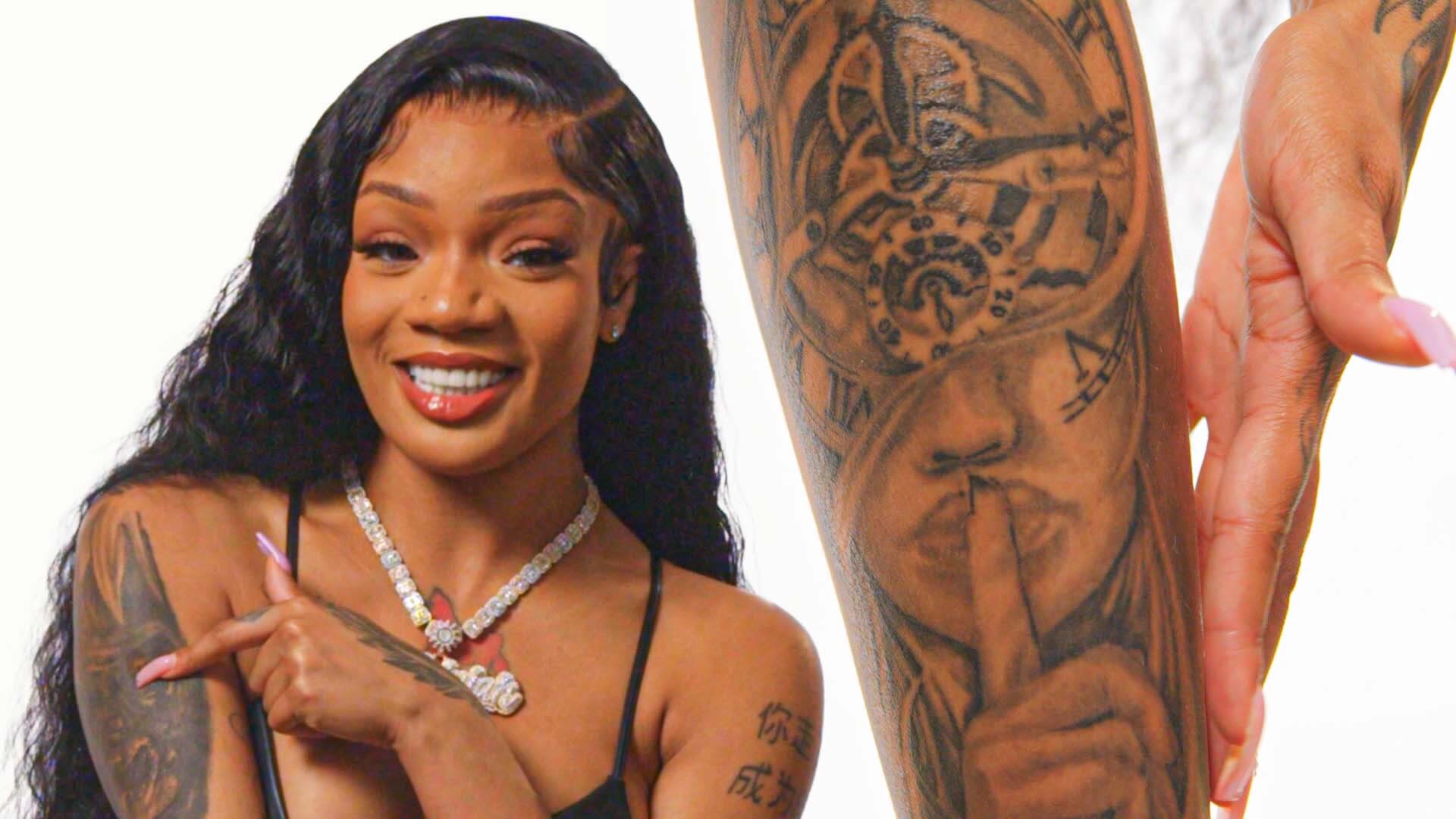
GloRilla describes one hand tattoo as tied for her most painful piece. She says she was at the tattooer’s apartment after her career had taken off, smoking and drinking while wearing a waist trainer. Near the end of the session she felt woozy, stood up to go to the bathroom, took two steps and passed out. She woke with only half the tattoo completed. The account explains why the hand design is remembered as a physical ordeal rather than simply another small mark.
On her leg, she shows a large design featuring someone saying “Shh” beside a clock. She says it took about eight hours, possibly longer, and that it was the biggest tattoo she had at the time. She used numbing cream, but the location was close to the bone and still hurt badly. GloRilla says she could not walk properly and spent about a week in a wheelchair after the session. The size, detail and recovery make the leg piece a separate entry from the smaller hand work.
She is much less affectionate about the snake tattoo. GloRilla says she got it while angry and going through something, because tattoos had become a kind of therapy for her. She calls the snake ugly, says it is there without a clear reason and talks about eventually covering it with something she likes more. That is important context: not every tattoo in the collection was planned as a permanent symbol. Some were decisions made in a difficult moment.
The same comments explain why photographs from different years may show a changing collection. A tattoo can remain present while GloRilla’s opinion of it changes, and a planned cover-up does not prove the original work has already disappeared.
Leo, Saint, Olivia and Glo Gang fill the smaller lettering map
Several smaller designs identify GloRilla’s astrology, faith, family and music circle. On a finger she points out the Leo sign. She also shows the word “saint”, joking that she is not actually a saint while still enjoying the label. The two pieces are easy to list accurately because she names them herself; their exact private significance does not need extra explanation.
Her mother’s name, Olivia, is another confirmed entry. GloRilla also identifies “Glo Gang,” linking the lettering to her name and saying she is a big fan of Chief Keef. She let her friend Teez practise tattooing with that piece, describing the decision as an act of support for a friend learning the craft. The tattoo therefore has both a name-based meaning and a personal story about who put it there.
A small “faith” tattoo is also part of the collection. GloRilla says it was done in the trenches of Memphis, describing the apartment where she got it in blunt terms while still saying she wanted a butterfly on her thigh. The butterfly is a separate visual entry from the word faith, even though both appear in the same broader discussion of her early and local tattoo experiences.
She also shows a matching thigh tattoo with her best friend Gloss. The wording is “Told you I’ll be here forever.” GloRilla explains that the line comes from Rihanna’s “Love on the Brain” lyrics, with the two friends splitting the phrase between them. That makes it a shared friendship tattoo rather than a generic inspirational quote.
Family names, Chinese lettering and dates add the personal detail
GloRilla’s family tattoos include her father’s name, Edwin, and the word “woods.” She explains that her father had seven children at the time, eight later, and that she was the fifth. The details are not just decorative lettering: the tattoo is connected to her position within the family and the way she identifies her father.
Another design uses Chinese lettering to express the idea that she would become a star. GloRilla says a friend who died in 2020 used to tell her that her music was hard and that she would become a superstar, back when she still had what she calls her “baby voice.” She got the phrase to preserve that encouragement and hopes the friend can see what happened. The wording is reported through her explanation, not inferred from the characters alone.
GloRilla also points out “hallelujah” in Arabic, her birth year 1999, the date 7/28/1999 and an AK-47. She says both the gun and date work are red because she likes the colour. The list shows why an article about her tattoos needs more than one hero image: the chest gorilla is memorable, but the smaller lettering and numbers carry much of the biography.
One cousin tattoo reads “A cousin is a sister destiny forgot to give you.” GloRilla says she no longer speaks to that cousin and wants the piece covered. Again, the changing relationship is part of the tattoo’s documented history, but it should not be turned into a claim about every family relationship around her.
GloRilla’s tattoos therefore form a candid record of choices that worked, choices she regrets and designs she still loves. The red gorilla covers an awkward high-school name tattoo; the hand and leg pieces preserve painful sessions; the snake records an angry moment; and the names, dates, faith words, friendship quote and Chinese encouragement keep specific people and milestones close. The collection is most interesting when those differences remain visible instead of being compressed into one vague story about celebrity ink.
One thought on “GloRilla tattoos: the red gorilla, family names and hard-earned cover-ups”