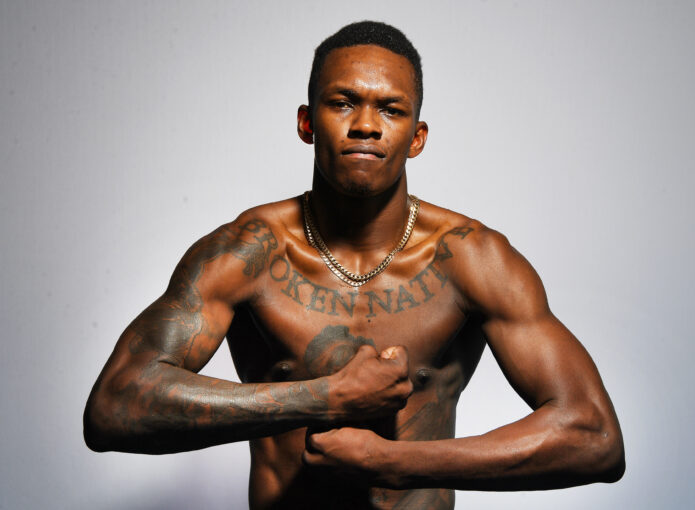
Israel Adesanya’s tattoos are easy to spot, but they make more sense when you slow down and look at the different chapters they represent. There is Nigerian identity across his chest, childhood comics on his arm, anime imagery over his stomach, and newer work around his neck. Some pieces have a clear story because Adesanya has explained them himself. Others are simply designs he liked at the time. That distinction matters, because he has never pretended that every mark needs a grand explanation.
In GQ’s Tattoo Tour, Adesanya says he got his first tattoo at 22 and kept his early ink quiet around his family. He also says he sometimes chooses a design because it looks cool, then lets its meaning reveal itself later. That relaxed attitude is useful when reading his collection. The confirmed details are interesting enough without inventing a private message for every shadow and symbol.
The Broken Native tattoo puts Nigeria and Africa across his chest
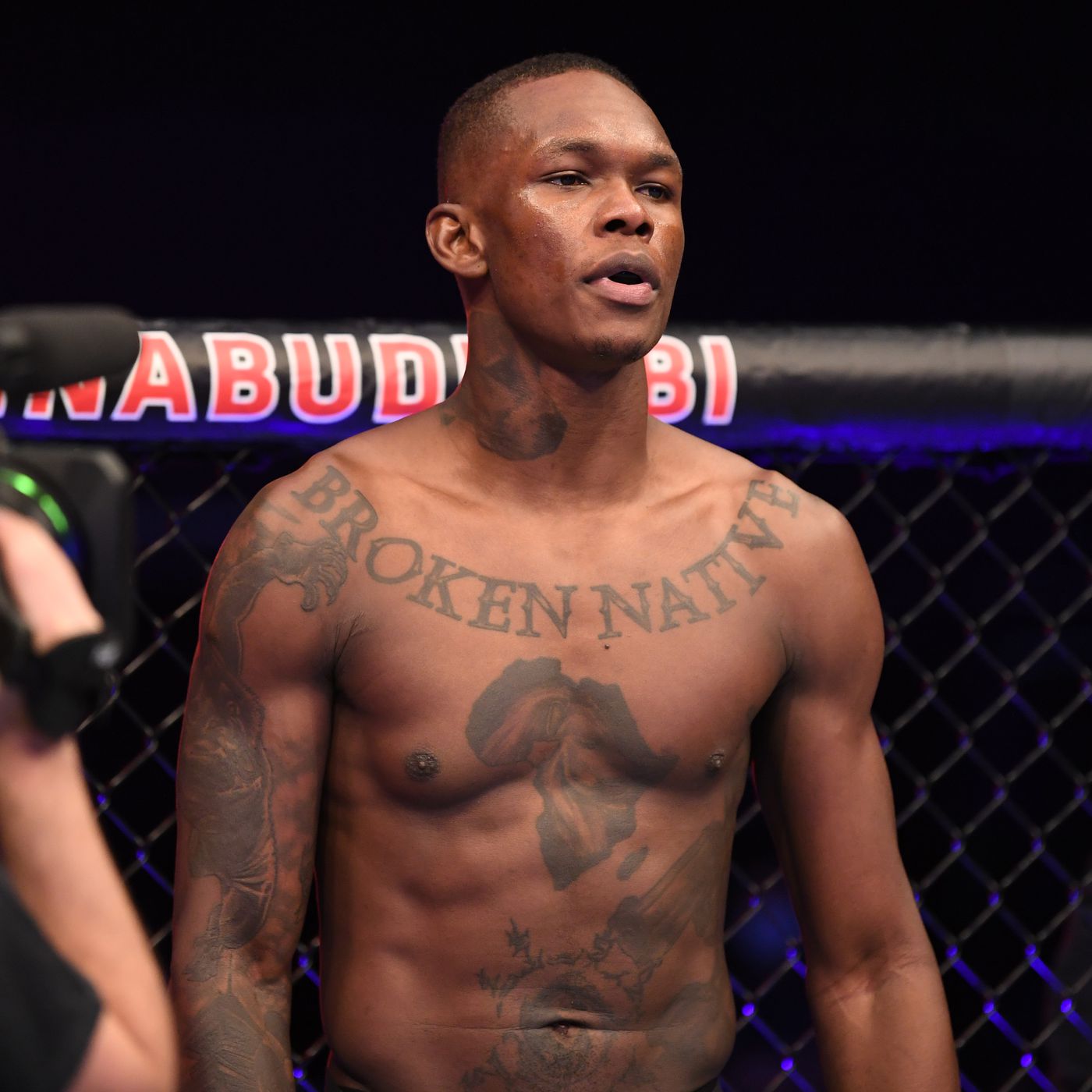
The phrase “Broken Native” is the easiest starting point. It runs across the top of Adesanya’s chest in large, old-style lettering, so it reads clearly even in a fight photograph. Under the words sits a large black-and-grey composition built around Africa, a lion-like silhouette and an outline of Nigeria. It is a big piece, and it has the visual weight of a personal flag rather than a small decorative tattoo.
Adesanya has connected the design to his Nigerian roots and to the route that took him from Lagos to New Zealand. The word native is doing more than describing a birthplace. It points to the feeling of carrying one home while building another. He has also spoken about the dance crew and the people around him before his fighting career became the centre of his public identity. The tattoo sits across his chest because it is meant to be seen, not tucked away as a private footnote.
The map, lion and lettering work as one chest composition.
The chest tattoo is sometimes reduced online to a map of Africa, but that misses the way it is put together. The heavy lettering forms a top border. The continent gives the middle of the design its broad shape, while the darker figure and smaller details pull the eye toward the centre. It is not a clean logo. The shading is deliberately rougher, which suits the phrase and the story behind it.
Photographs taken at different times show why one image is not enough. A front-facing gym photograph makes the lettering easy to read. An octagon photograph can show how the design bends with his chest and disappears under the arms. The ink also changes with lighting and distance, so a careful description should name the visible parts without claiming that every faint mark has a confirmed meaning.
Deadpool and the anime tattoos make the ribs and stomach personal
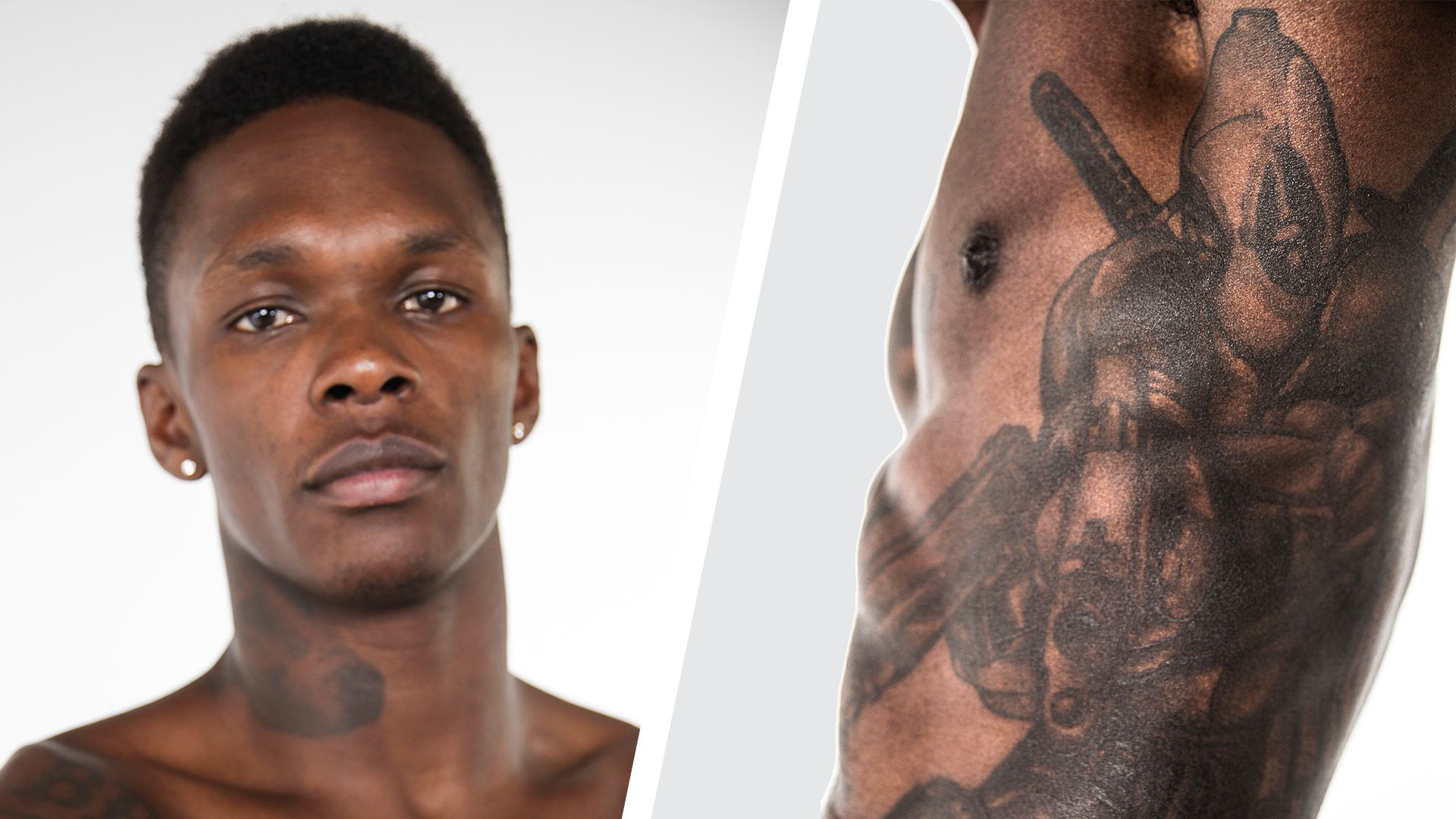
Adesanya’s side and stomach work is where the collection becomes more playful. GQ shows a Deadpool-style figure on the ribs, with the character’s swords and comic-book attitude spread along the side of his body. The tattoo is much harder to see in an ordinary fight photograph because his arm and trunks cover sections of it. A shirtless studio frame gives a better idea of the scale, running from the ribs toward the hip.
Deadpool fits the way Adesanya talks about his ink. It is not presented as a solemn memorial. It is a character he enjoys, and the pose and placement let the tattoo carry some attitude without needing a speech attached to it. That does not make it shallow. Favourite characters can be part of somebody’s identity, especially when they have been following those characters since before they were famous.
Avatar and Naruto meet in the stomach piece.
The stomach tattoo brings together two parts of Adesanya’s pop-culture world. He identifies the upper imagery with the Ocean and Moon Spirit from Avatar: The Last Airbender, while the lower design includes the seal associated with Naruto’s Nine-Tails. He has explained that Avatar’s ideas about mastering the elements connected with his own training. That is a much stronger piece of evidence than a caption that simply says “anime tattoo.”
The design is also a good example of why placement changes how people read a tattoo. The spirits sit in the centre of the torso, where the shapes can be read as a balanced pair. The Naruto seal sits below, making the whole area feel like a stacked panel rather than one single illustration. Sweat, shadows and body movement can blur the edges, so a clear photograph is important before anyone tries to identify the smaller marks around it.
The stomach ink is detailed, but not every detail has a published explanation.
There are plenty of internet lists that attach a meaning to every line in Adesanya’s anime work. The safer version is narrower. He has spoken about Avatar, imagination and the emotional pull of those stories. He has shown the Naruto influence. The exact personal reason for every surrounding shape is not equally well documented. A useful tattoo guide can still describe the composition, direction and placement without filling the gaps with guesses.
Calvin and Hobbes give the bicep tattoo a childhood reference
Inside Adesanya’s right bicep is a tattoo of Calvin and Hobbes. It is one of the most revealing designs in his collection because the reason is straightforward: he read the comics when he was younger and liked what they represented. In the GQ interview, he talks about the power of imagination and the way those stories stayed with him. The tattoo turns a childhood habit into something he carries into adulthood.
The bicep is a smart location for a design like this. It can disappear when he is wearing a shirt, then show up clearly when he raises his arm or poses for a fight photograph. That is different from the chest lettering, which announces itself immediately. The two pieces show that his collection is not built around one level of visibility. Some tattoos are public identity. Others are closer to a private reminder that happens to be photographed from time to time.
Comic art sits beside the fighter’s working body.
The image matters here because Calvin and Hobbes can be mistaken for a dark patch when the arm is bent or the photograph is compressed. A closer frame separates the characters from the surrounding sleeve work. The line quality is lighter than the solid lettering on his chest, and the placement gives the figures a little room to breathe.
There is no need to turn the design into a prediction about Adesanya’s personality. The confirmed link to the comics is enough. It shows that he is comfortable putting a fun, recognisable reference beside much heavier cultural and family imagery. That mixture is one reason the tattoo map feels like a person’s collection rather than a planned brand package.
The neck and hand tattoos show Israel’s newer visual language
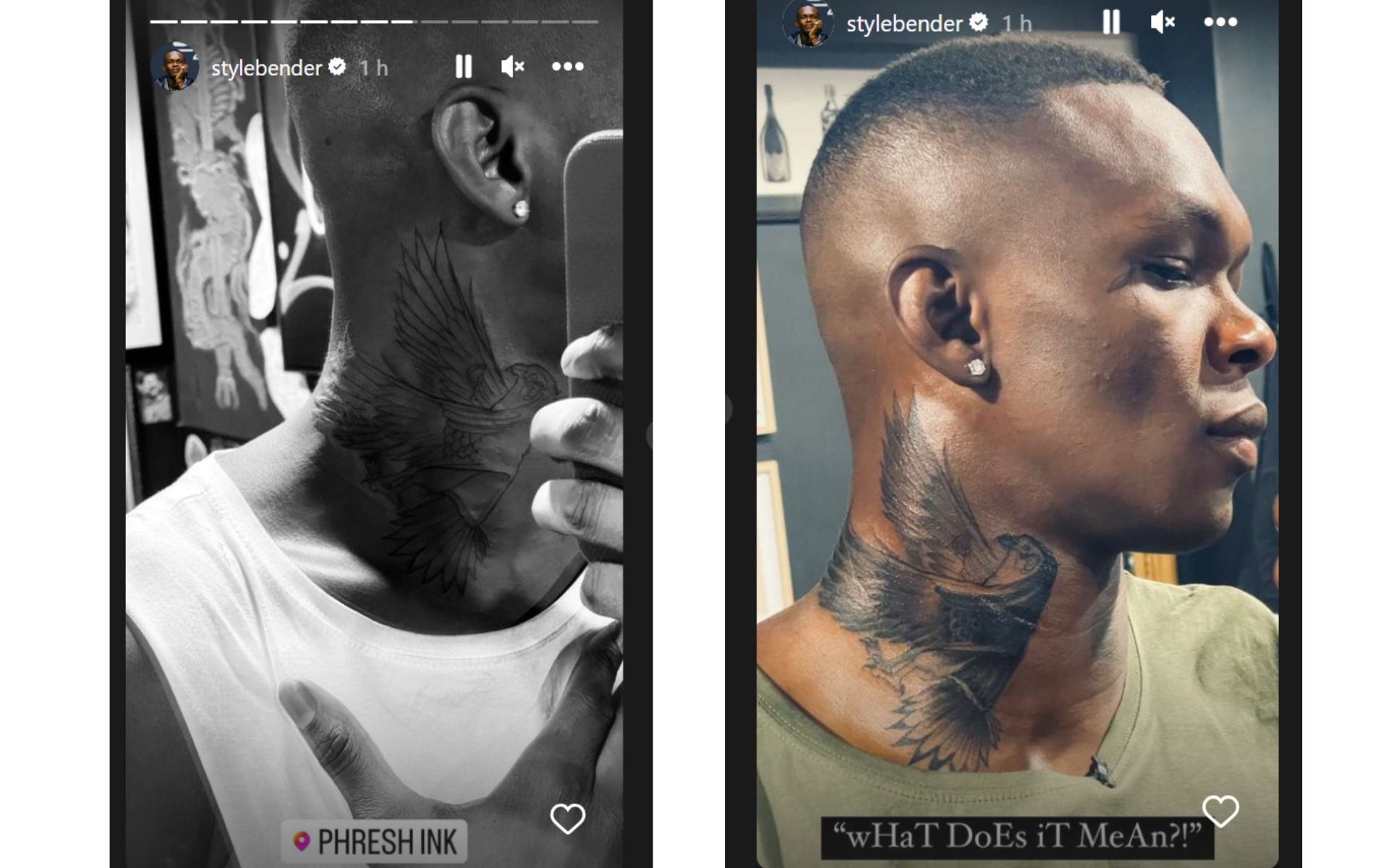
Adesanya has also added more visible work around his neck. A later reveal shows a large eagle tattoo on the side of his neck, with the wings spreading upward and the head angled across the skin. The photograph circulated with people asking what it meant, but the image itself proves the design and placement more confidently than it proves a private explanation. It is better to call it an eagle and leave the symbolism open unless Adesanya explains it directly.
The neck is a different commitment from the early pieces he could cover at home. It changes the outline of his face and shows up in interviews, weigh-ins and everyday photographs. That visibility may be part of the point, but it would be speculation to claim a single reason for the timing. The practical fact is enough: the newer eagle makes the tattoo collection harder to hide and gives the head and shoulders a stronger silhouette.
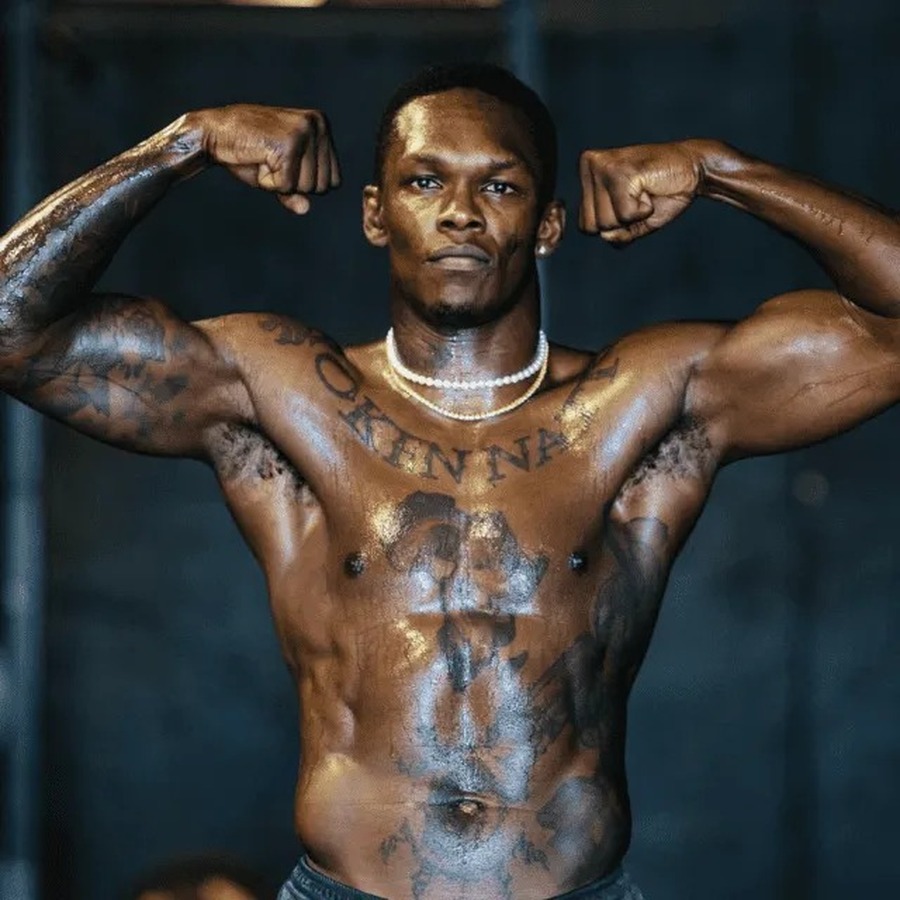
Small marks and the word “Okenna” need careful reading.
Photographs also show smaller lettering and symbols around Adesanya’s shoulders, hands and torso. The word “Okenna” is visible across the upper chest in some training images, while other pictures make the surrounding designs easier to see. A tattoo list should separate what can be read from what is only suggested by a blurry frame. The same rule applies to small hand marks, which can be partly covered by wraps, gloves or the angle of a photograph.
That is the useful way to approach Adesanya’s ink. The Africa and Nigeria composition has a clear cultural connection. The Deadpool, Avatar, Naruto and Calvin and Hobbes pieces have identifiable source material and, in several cases, explanations from Adesanya himself. The eagle and smaller newer pieces are visually clear but less fully explained. Keeping those categories separate makes the article more honest and the tattoos more interesting.
Seen together, the collection moves between heritage, imagination, humour and the physical life of a fighter. The chest announces where Adesanya comes from. The ribs and stomach show the stories he grew up with. The bicep keeps a childhood comic close, and the neck work makes the later version of his visual style impossible to miss. His tattoos do not need one tidy theme. Their variety is the theme.