
J.I.D’s tattoo history has a clear starting point, even though the rest of his collection is harder to catalogue design by design. In the GQ Tattoo Tour, he says his first tattoo arrived when he was 13. He had seen his older brothers and sisters with tattoos and wanted one of his own, but he chose a place where his mother would not immediately find it.
That first piece is the word “Routeboy” across his lower stomach, framed by flames. Route is his family name, so the lettering connects the tattoo to both family identity and the name he was building as a young artist. J.I.D has also been frank about the design looking childish to him now. That honesty is useful: it gives the tattoo a date, a reason and a change in perspective instead of a made-up legend.
The public record is less complete for the many tattoos that came later. Photographs show extensive work across his chest, stomach, arms and hands, but not every shape has a confirmed title or meaning. The safest guide names the pieces the sources identify, describes the visible composition, and leaves uncertain marks open rather than turning every shadow into a symbol.
The Routeboy stomach tattoo came first
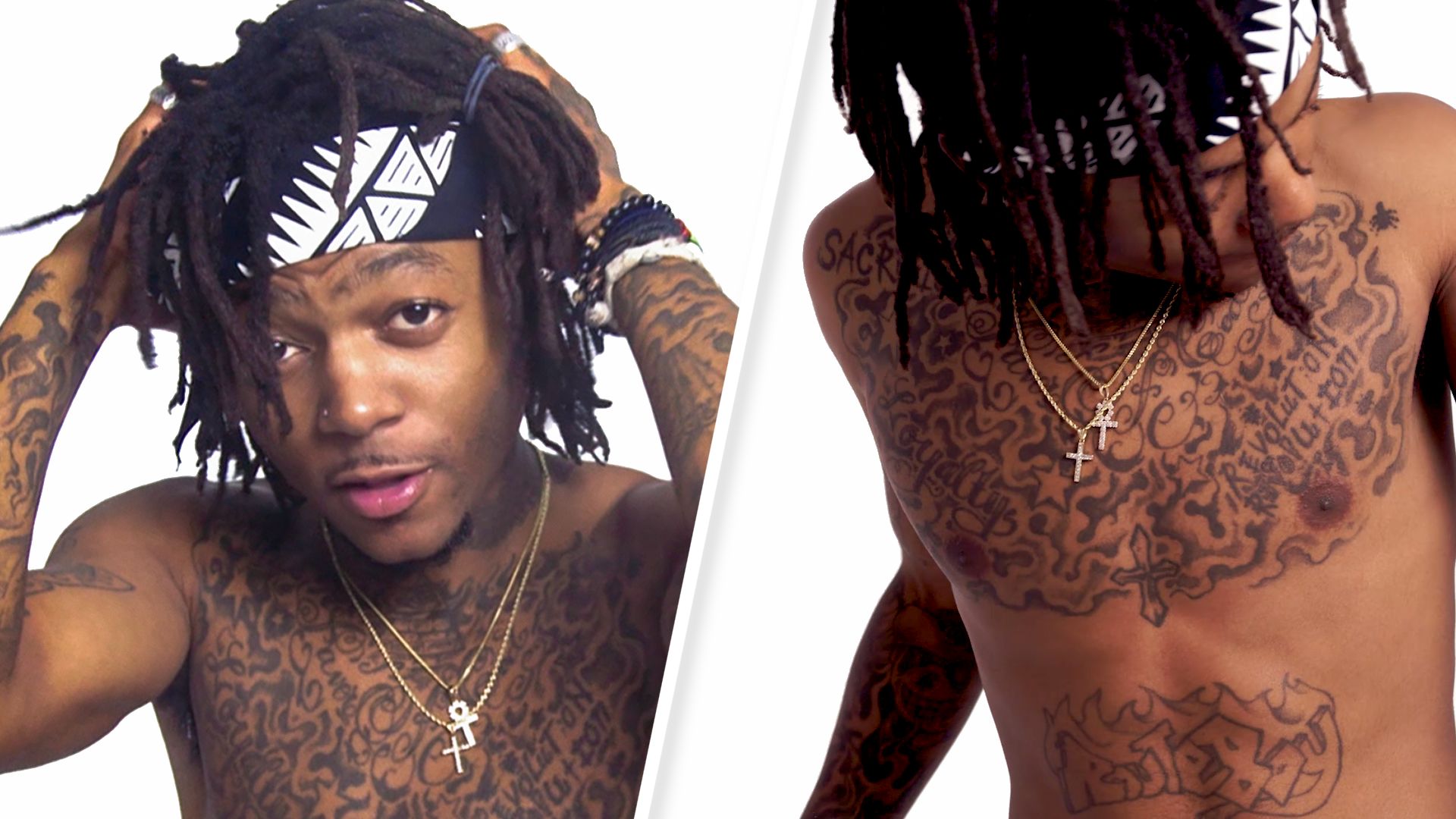
The Routeboy piece is a word tattoo with flames above and below the lettering. The composition is broad enough to read as one design rather than a separate word with unrelated decoration. Its lower-stomach placement also explains why J.I.D chose it as a teenager. A shirt, jacket or performance outfit can hide the piece completely, so early photographs do not always prove whether it was already there.
Route is not a random word in this context. It is part of J.I.D’s name, and “Routeboy” turns the family name into a personal label. The GQ interview supports that connection, but it does not require a more complicated interpretation about destiny or ambition. The lettering and the family reference are enough to explain why the first tattoo mattered to him.
The age is part of the design’s history too. Getting tattooed at 13 places the piece before the public career, albums and tours. J.I.D was copying an example set by older siblings and making a decision that felt adult while he was still very young. His later description of the result as childish does not erase the tattoo’s importance. It shows how his taste changed while the original piece remained part of the record.
The flames belong to the same first composition

The flames around the word are easy to over-explain because fire is a familiar tattoo motif. In J.I.D’s case, the available first-person account treats the flames as part of the original Routeboy design. There is no reliable statement that they stand for anger, rebirth, danger or a particular event. A visual description is stronger than a generic list of tattoo meanings.
In the close GQ image, the flame shapes act as a border. They give the lettering a wider silhouette and make the stomach piece more graphic from a distance. The linework is less polished than the elaborate chest and arm work visible in later photographs, which fits the fact that it was made when he was 13. The design looks like an early declaration of identity, not a later attempt to match the style of a finished sleeve.
That difference in finish helps explain why the first tattoo remains such a useful anchor. J.I.D’s later collection is dense and visually varied, while Routeboy has a simple centre: one word, one family connection and one flame frame. It can be discussed precisely without pretending that every part of his body has been mapped.
Later photographs show a much larger chest and arm collection

J.I.D’s later work extends well beyond the first stomach tattoo. Photographs show dense linework across the chest, shoulder and arms, with script, small figures, abstract shapes and religious imagery appearing close together. The designs do not read like a single uniform sleeve. They overlap in places, but the changes in scale and line weight suggest separate sessions and separate ideas.
The chest is particularly difficult to catalogue from a single image. Dreadlocks, necklaces and the angle of the torso can hide the upper edge, while the lower stomach may disappear beneath clothing. A portrait can establish that the work exists without showing enough detail to name every mark. That is why the Routeboy tattoo should not be merged with the later chest pieces simply because the designs sit in the same broad area.
His arms show a similar mixture. The photographs reveal full areas of black and grey linework, lettering and compact illustrations, but the published sources do not provide a complete official list. It is accurate to say that his arms carry extensive later work. It would be less accurate to label every visible shape with a meaning borrowed from another rapper’s tattoo collection.
The arm tattoos are visible, but not all are individually named

Public portraits show tattoos running from J.I.D’s shoulders down his forearms and onto his hands. Some areas contain repeated curves and flame-like outlines, while others use lettering or small illustrations. The work is clearly substantial, but a broad photograph cannot establish the exact boundary of each tattoo. A reliable inventory should separate visible facts from assumptions about where one piece ends and another begins.
The hand tattoos are especially vulnerable to misreading. Fingers bend, jewellery covers parts of the skin and shadows collect around the knuckles. A mark that looks like a letter in one photograph may be a small symbol seen from another angle. The right approach is to name a word only when it is legible or reported by J.I.D, then describe the remaining marks as visible linework instead of manufacturing a translation.
These later tattoos also change the way the first piece is perceived. Routeboy began as a single childhood decision hidden below a shirt. The arm and hand work is much more public, appearing in photographs, live performances and fashion portraits. The collection therefore moves from a concealed family-name tattoo toward an openly tattooed public image, even though the record does not provide a precise date for every later addition.
Chest lettering and religious motifs form separate visual groups

Close torso photographs show several recognisable groups in the chest area. There is lettering near the shoulders, smaller symbols around the centre of the chest and larger decorative work that continues toward the stomach. Cross pendants in some portraits are jewellery, not tattoos, so they should not be counted as part of the ink. This is a small but important distinction when an image contains several kinds of body decoration at once.
Religious-looking forms also appear in the collection, but the available sources do not attach one confirmed message to every cross, figure or ornamental mark. The tattoos can be described as religious or symbolic imagery when the shape is clear. Their private meaning should remain unconfirmed unless J.I.D has explained it directly.
The chest work is visually different from Routeboy. The first tattoo uses a simple word and a strong flame border. The later torso designs are layered, crowded and built from many small decisions. That contrast is useful when discussing the evolution of his collection, but it should not become a claim that he deliberately planned a complete style from the beginning. His own account points to gradual accumulation.
The clearest documented fact about the collection is still the beginning. J.I.D got his first tattoo at 13, chose the lower stomach for privacy, and used his family name in the design. The later images show how much the collection grew, but they do not automatically provide a story for every visible mark.
What the tattoo photographs can and cannot prove
J.I.D’s tattoo record is strongest where the photograph and the interview support each other. Routeboy, the flames and the lower-stomach placement are documented together. His age and the influence of older siblings come from his own account. The later chest and arm work is strongly visible, but its individual names and meanings are less complete in the public material.
That boundary is not a weakness in the article. It keeps a useful distinction between a documented tattoo and a guess. Readers can see the scale of J.I.D’s collection, follow the Routeboy design from his first session into later photographs, and understand why the tattoo remains important without being told that every line has a private explanation.