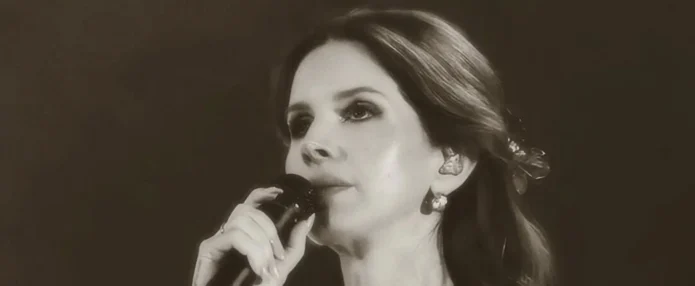
Lana Del Rey’s tattoos have always felt like small pieces of a notebook she carries from city to city. They are mostly words, names, and references to people or places that matter to her. That makes the collection unusually easy to understand. You don’t have to guess at a favourite symbol when she has already explained why the phrase is there.
In an interview, Lana said she likes the idea of carrying someone with her while she is away on tour. That is the thread running through nearly every known piece. The ink is personal, literary, musical, and often written in delicate cursive rather than built as one big visual sleeve.
The newest addition is different in tone but not in spirit. In May 2026, Lana revealed a small chest tattoo reading “Cold War.” Inked Magazine reported the phrase but also made clear that she had not explained its meaning. That uncertainty matters. It is easy to build a dramatic theory around two words, but the responsible version is simply that this is a new, clearly documented piece whose backstory has not been confirmed.
The new Cold War tattoo is the clearest recent addition
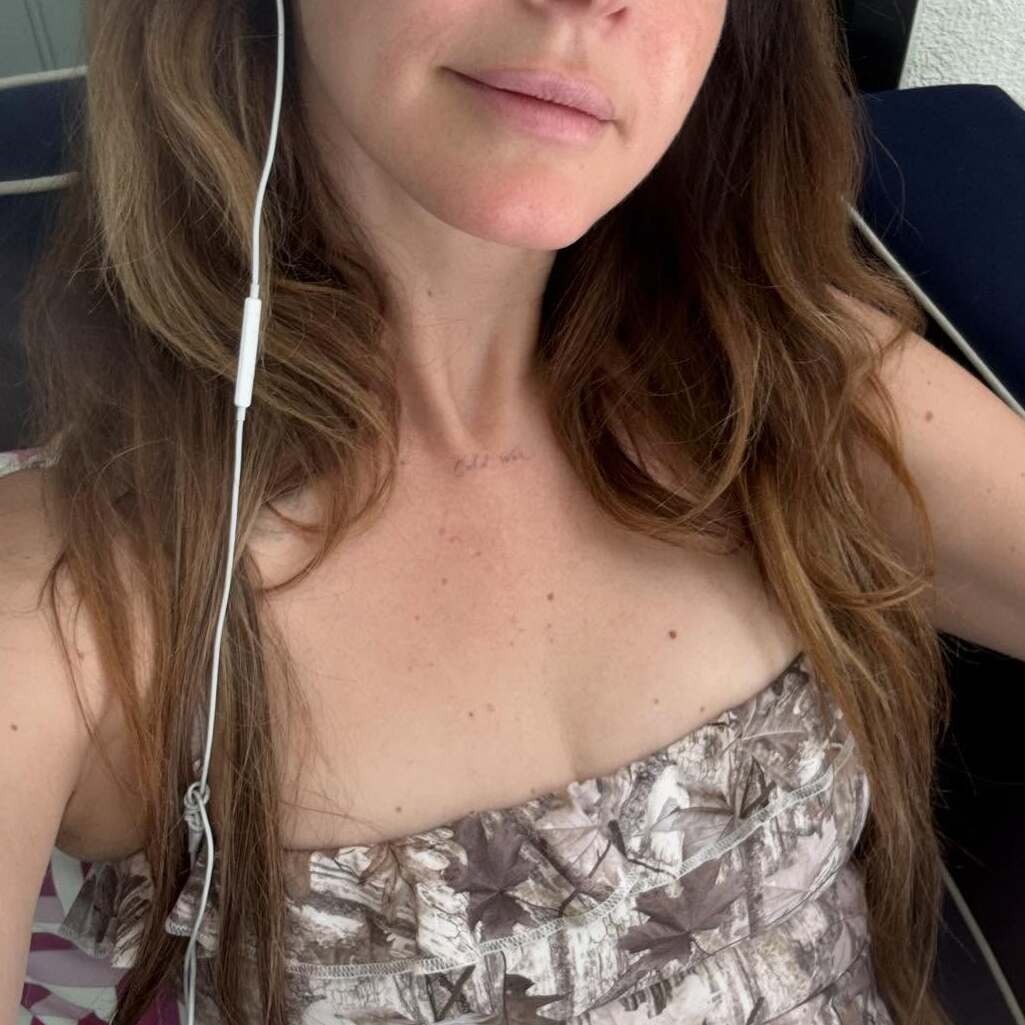
The Cold War chest tattoo sits high on Lana’s upper chest in very light script. It is small, easy to miss, and photographed close enough that the lettering is the main subject. That placement fits the rest of her collection. The words are visible when she wants them seen, but they are not presented like a giant slogan across her body.
Inked described the phrase as something fans were already speculating about, with theories ranging from a lyrical reference to a sign of a new musical chapter. Those are theories, not confirmed explanations. Lana has not said whether the words connect to a song, a relationship, a political idea, or a private memory.
The useful fact is the phrase itself, not an invented meaning. It also adds a slightly colder and more confrontational note to a collection usually associated with paradise, favourite writers, classic singers, and romantic fatalism. The design is minimal, but the words leave plenty of room for Lana’s audience to project stories onto them.
The photograph shows a real tattoo rather than a clothing design, fan edit, or embroidered reference. That distinction is important because Lana’s visual world often blurs music, fashion, and old Hollywood imagery. Here, the mark is physically on her skin, even if the reason for it remains private.
Paradise sits on the side of her left hand
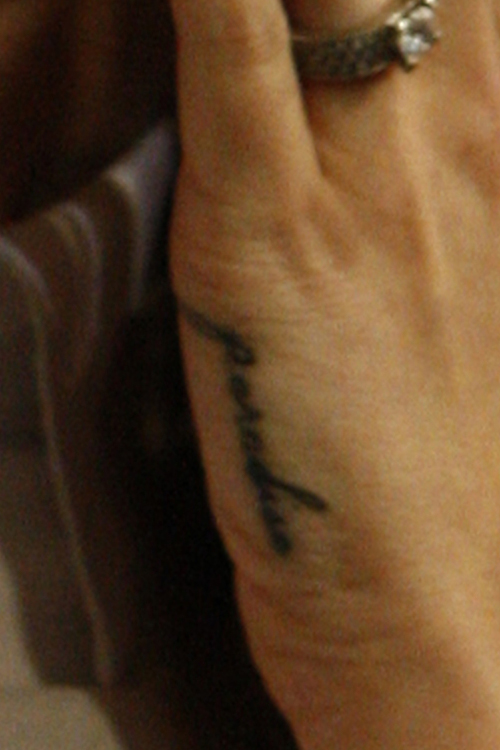
Lana’s “Paradise” hand tattoo was done in 2012 in connection with her third studio album. The word is written in cursive on the side of her left hand, a placement that makes it easy to glimpse while she is holding a microphone or moving through a photograph.
She explained the idea in an interview with Der Spiegel, saying that death and paradise are linked for her. She described paradise as something calm and relaxed after death, while also admitting that she simply liked the word. That combination is very Lana: a large philosophical thought sitting beside an appreciation for how a single word looks and sounds.
The hand placement makes the tattoo feel like a private note that happens to be visible. It is not hidden, but it does not dominate her appearance either. Paradise reads like a destination she keeps close rather than a declaration she needs everyone to understand.
Trust No One reflects a harder view of life
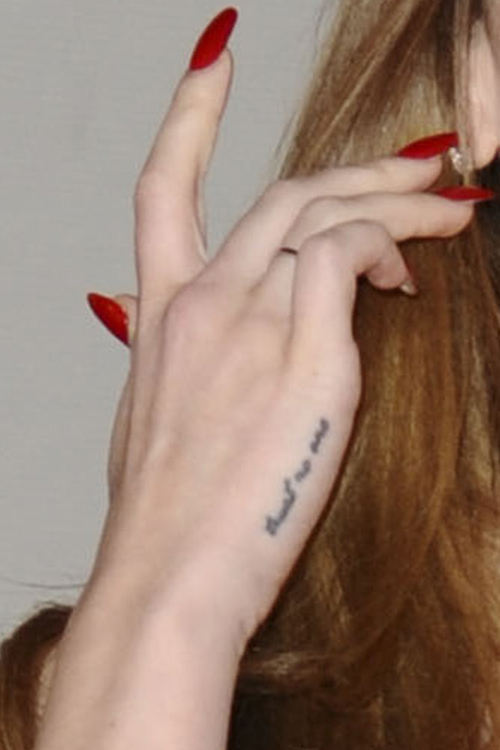
On the outside of her right hand, Lana has “Trust No One” in small cursive script. She has said the phrase reflects the more cynical outlook she developed through difficult experiences. In a 2017 interview, she talked about possibly removing it while also saying that, deep down, she still agreed with the message.
That ambivalence makes the tattoo more interesting than a simple slogan. It is both a statement and something she has questioned. A phrase can make sense during one part of life and feel too blunt later, especially when it sits somewhere as exposed as the hand.
The piece is also a useful counterweight to Paradise. One word points toward calm and the afterlife; the other warns against trusting people. Together, they show the two moods that run through Lana’s work: romantic longing and the knowledge that longing can hurt.
Die Young runs along her right ring finger
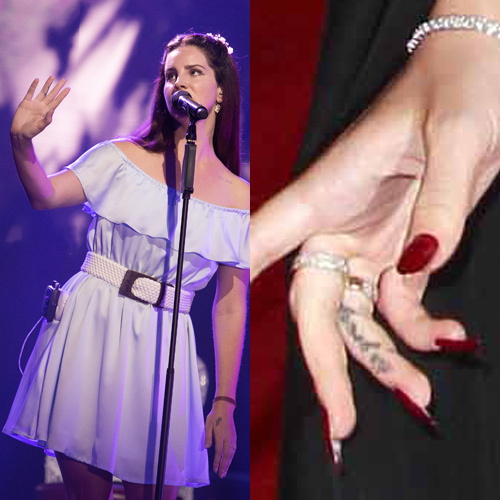
Lana also has “Die Young” in cursive along the side of her right ring finger. She discussed the phrase in a 2014 Guardian interview, explaining that she was not afraid of dying young in the way some of her heroes had.
The reference connects to artists such as Amy Winehouse and Kurt Cobain, whose early deaths became part of the mythology around their music. Lana’s tattoo does not necessarily celebrate dying. It reads more like an awareness of the shortness and intensity attached to certain artistic lives.
Finger tattoos are small by nature, but this one carries more weight than its size suggests. It sits beside Trust No One and turns the hand into a compact collection of ideas about risk, time, and emotional survival.
The M tattoo honours her grandmother
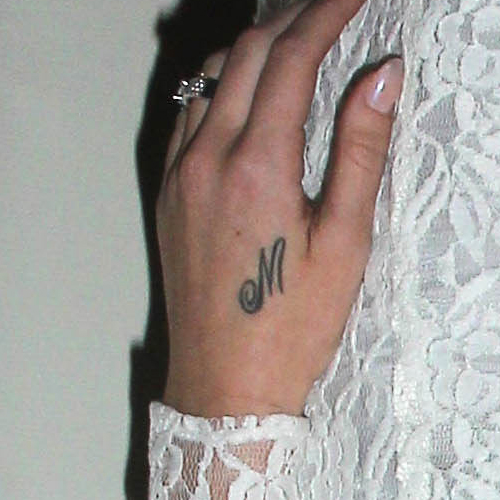
Near the thumb on the back of her left hand, Lana has a cursive “M” for her grandmother Madeleine. It is one of the simplest pieces in the collection and one of the most direct. There is no literary puzzle to solve and no public persona to decode. It is an initial for a family member she wanted to carry with her.
The location makes the letter easy for Lana to see. It also places the family tribute close to Paradise, so the left hand holds both an abstract idea and a specific person. That mix keeps the collection from becoming only a catalogue of artistic influences.
Nabokov and Whitman are written down her right forearm
On her right forearm, Lana has the names “Nabokov” and “Whitman” written vertically in fine cursive. They refer to Vladimir Nabokov and Walt Whitman, two writers she has said she admires. She explained that looking at the names reminds her that life can be great.
This is one of the clearest examples of Lana’s preference for script. Rather than tattooing a portrait of a writer or an obvious illustration from a book, she uses the name itself. The tattoo works like a reading list, but a deeply personal one.
She is not pretending literature made life painless; she is keeping the reminder that it can still be beautiful. That is a quieter idea than many celebrity tattoos, and the narrow vertical placement gives it the feel of a margin note.
Chateau Marmont brings Los Angeles into the collection
Her left forearm carries another vertical script tattoo reading “Chateau Marmont.” The words refer to the famous Los Angeles hotel, a place that has appeared in Lana’s lyrics, including “Heavy Hitter” and “Off to the Races.”
This tattoo is less about a person than a location. Chateau Marmont has long carried associations with old Hollywood, glamour, privacy, and the messy lives of people passing through. Those ideas fit naturally alongside Lana’s fascination with the past.
The forearm placement puts it opposite Nabokov and Whitman, creating a loose conversation between writers and a place. One arm holds names from books. The other holds a name from the city and its mythology.
Nina and Billie sit across her upper left chest
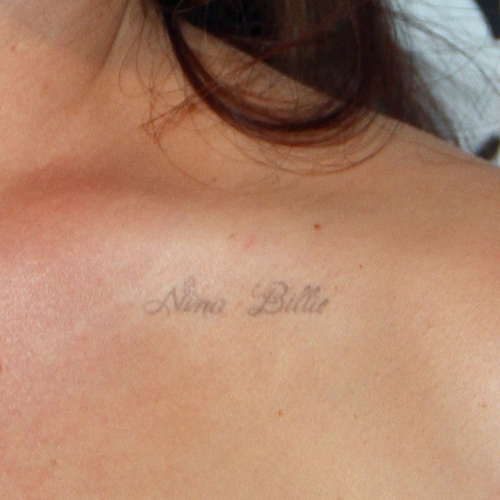
On the upper left side of her chest, Lana has “Nina” and “Billie” in light cursive. The names honour Nina Simone and Billie Holiday, two singers whose voices and lives have influenced her.
The tribute is not vague. Lana has covered Simone’s “Don’t Let Me Be Misunderstood” and “The Other Woman,” and she references Billie Holiday in “The Blackest Day.” The names on her chest therefore connect directly to the music she has chosen to carry into her own work.
The light ink and high placement make the design feel almost like a dedication written in the margin of a songbook. It is personal, but it is also a clear statement about lineage. Lana’s own voice sits in conversation with the women she is naming.
Whitney and Amy honour two more musical heroes
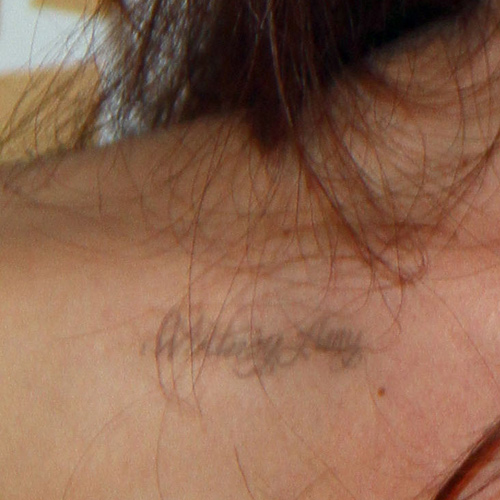
Across her left collarbone, Lana has “Whitney” and “Amy”, referring to Whitney Houston and Amy Winehouse. She has spoken about both artists in connection with her music, and she has performed the names in the live version of “Get Free.”
These chest tattoos sit close to Nina and Billie, so the upper body becomes a small map of the women Lana hears behind her own work. It is not a random list of famous names. It is a group of singers whose voices, lives, and public mythology have shaped how she thinks about performance.
The four names also explain why Lana’s collection feels cohesive even though the phrases come from different parts of her life. The words keep circling the same ideas: home, influence, mortality, art, and the people who remain present while she is travelling.
Why Lana’s tattoos are mostly words
Lana has said she prefers script because she likes the idea of carrying people with her on the road. She has Nabokov and Whitman, the names of singers, a grandmother’s initial, a hotel, two short warnings, an album title, and now Cold War.
That makes the inventory feel more like a set of handwritten reminders than a collection built for visual impact. The tattoos are small, but they are not throwaway. Each one points to a person, place, record, book, or idea that Lana wants close.
The common thread is not one font or one placement; it is attachment. Her tattoos give physical form to the things she does not want distance to erase. Some are public references and some are private, but all of them have a reason behind them.
The new Cold War tattoo fits because it continues the pattern without explaining itself yet. Maybe Lana will connect it to a song or a new record later. For now, it is simply a fresh phrase in a collection that has always treated language as a kind of keepsake.
Watch a Lana Del Rey performance after the tattoo inventory
There is no verified tattoo-specific YouTube tour attached to the newest Cold War reveal, so this related Lana Del Rey performance is included instead.