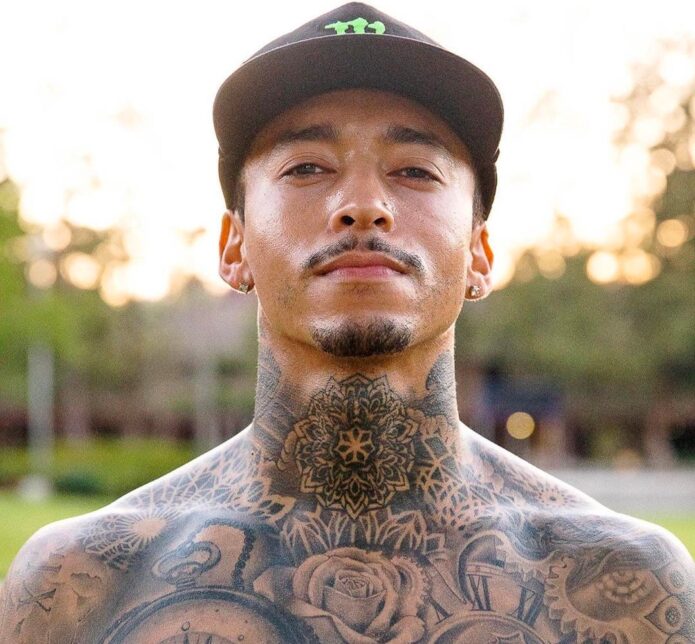
Nyjah Huston has never treated tattoos like a neat little collection with a beginning, middle and end. His ink is closer to a running sketchbook. Some pieces are carefully planned black-and-grey work, some are tied to skating or family, and some are there because he simply thought the idea was funny. That mix is a big part of what makes his tattoos so interesting.
In his GQ tattoo tour, Huston guessed that he had around 200 tattoos and said roughly 90 percent of his body was covered. That number is only an estimate, but the photos make it believable. His neck, chest, arms, hands, legs, back and even his backside have all become part of the project. There is still a lot to look at, even when one photo only shows a small piece of the bigger picture.
What follows is a closer look at the main designs Huston has talked about, plus the way the smaller tattoos fit around them. The important thing is not pretending every tiny mark has a confirmed meaning. Huston has been pretty open that plenty of his tattoos are just things he likes. That honesty makes the whole collection feel more human.
The first tattoo was a simple Skate and Destroy piece
Huston got his first tattoo on his arm when he was 18. He was at Tampa Pro, where tattooers were working out of the back of the contest area, and his friend Chase kept pushing him to get something. The design he picked was the classic Skate and Destroy wording, a phrase that feels almost too obvious for a professional skateboarder until you hear how impulsive the decision was.
He has said he did not even know if he wanted tattoos before that day. The tattoo happened because he was there, his friend was getting one, and a design he liked was available. He then went back to skate in the contest with a fresh tattoo. It is a very Nyjah origin story: a little reckless, very skate-focused, and followed by a lot more ink.
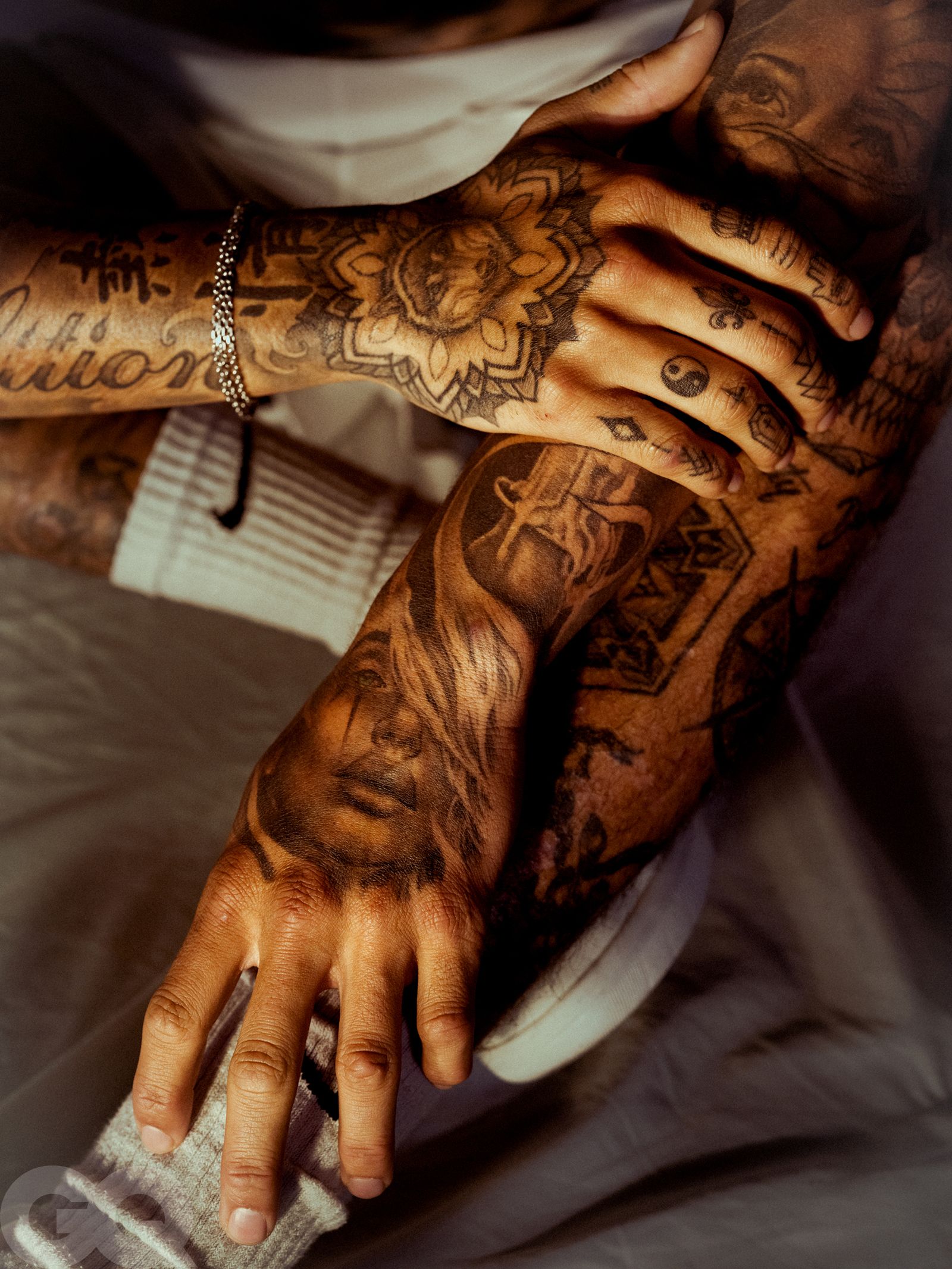
The close-up photos of his hands and forearms show how far things went after that first piece. His fingers carry tiny symbols, lettering and small shapes, while the larger forearm work folds into portraits and darker shading. The hand tattoos are not all one matching sleeve. They look more like lots of separate decisions that have slowly crowded together over time.
His chest is built around roses, clocks and compass details
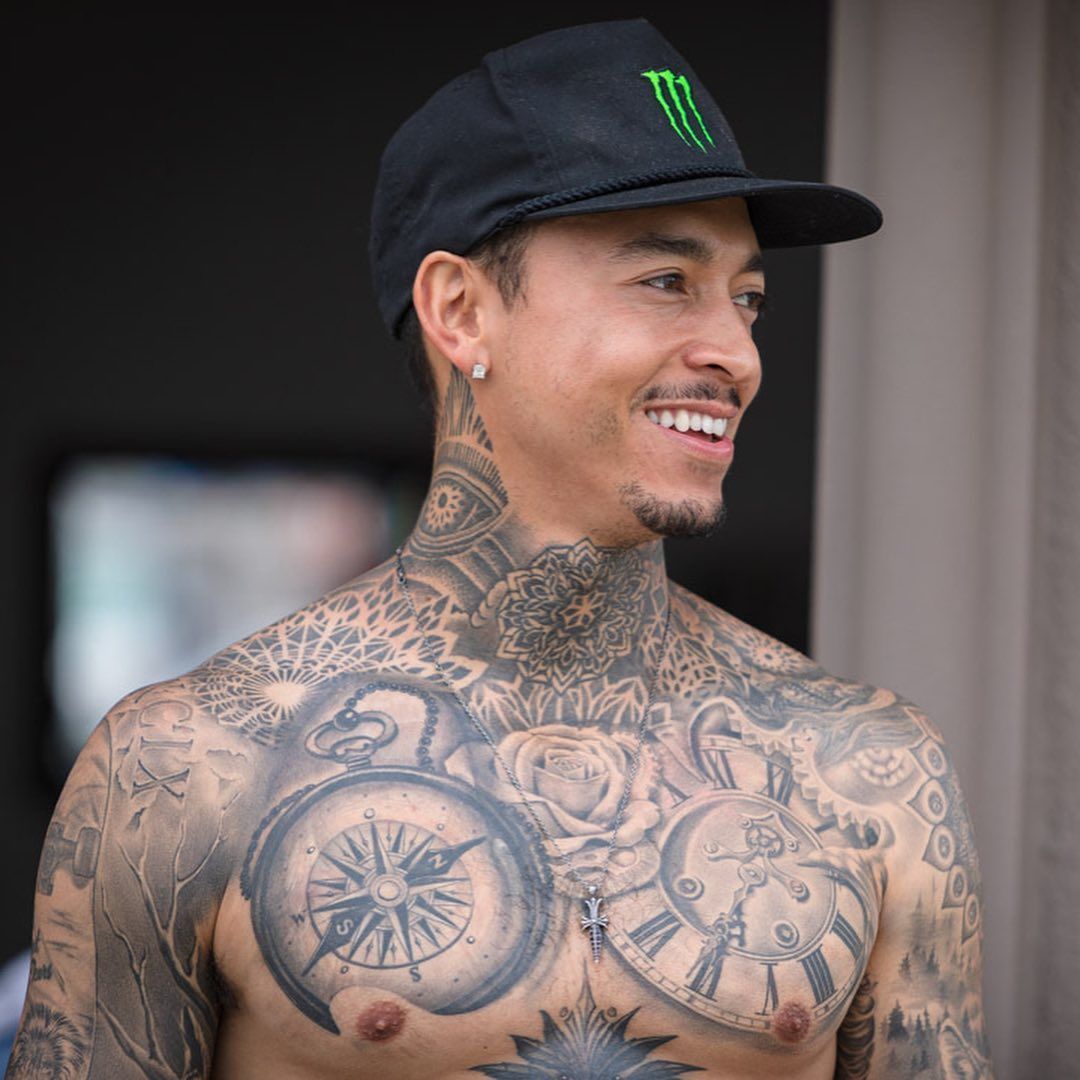
The chest is where Huston’s collection starts to look more planned. The main photographs show large black-and-grey pieces arranged across both sides of his chest, with a rose near the middle, compass imagery, clock details and geometric patterning around them. They are not tiny filler tattoos. They have enough weight to hold the whole torso together.
A compass is visible on one side and a clock sits nearby, while the rose softens the harder shapes. There are also smaller symbols and lines tucked between the bigger images. From a distance it reads as one big chest piece, but up close it is really a group of separate designs. That is why a close-up matters here. The shading, little numbers and fine lines disappear quickly in a wide portrait.
Huston has also talked about changing parts of the chest as his taste changed. An early portrait of his mother was later removed with laser treatment because he did not like the way the light-coloured tattoo sat in that area. He replaced it with darker work, including the clock and other pieces. He was clear that the affection for his mother never changed; the tattoo itself just did not work for him visually.
The lion on his stomach carries the biggest personal story
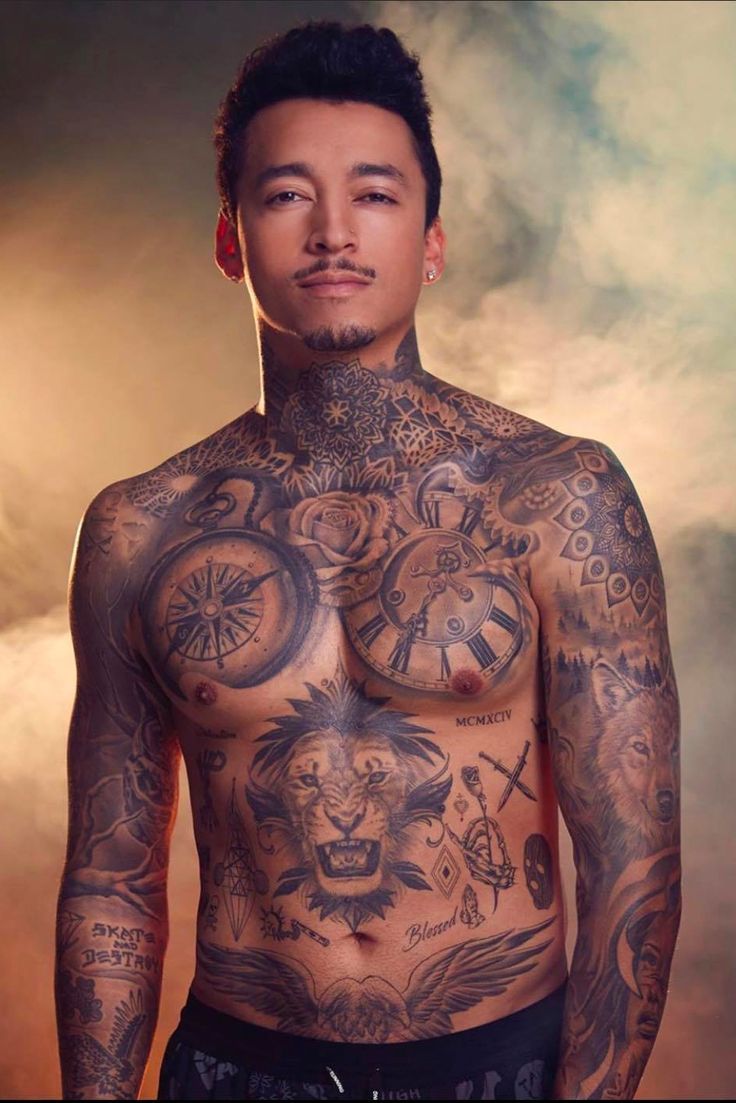
The lion on Huston’s stomach is one of the tattoos he has explained most clearly. He has said the lion has always been his animal, going back to the years when he wore long dreadlocks and became known as a young skater. In his words, the piece is tied to the image people had of him as a kid: a small, fearless skater with the dreads and the huge personality.
The full torso view shows the lion sitting below the chest work, with the face, mane and heavy black-and-grey shading giving it a strong centre point. It is not a quiet design. The expression is fierce, but the surrounding tattoos stop it from feeling like a random sticker placed on the stomach. The chest clocks, rose and compass details lead the eye down toward it.
There is also another lion-related design in his wider collection, along with a lion skull. That is a good example of why it is hard to describe Huston’s body art in one simple list. A single theme can show up in more than one form, while totally unrelated pieces sit right beside it. He has said that he likes tattoos that fit his vibe, not that every design needs one grand explanation.
The same photograph also shows lettering on his torso, including Blessed and the Roman numerals MCMXCIV, which refer to his 1994 birth year. Those smaller details help the larger lion piece feel connected to the rest of the body rather than standing alone.
His neck and throat work took serious time and pain
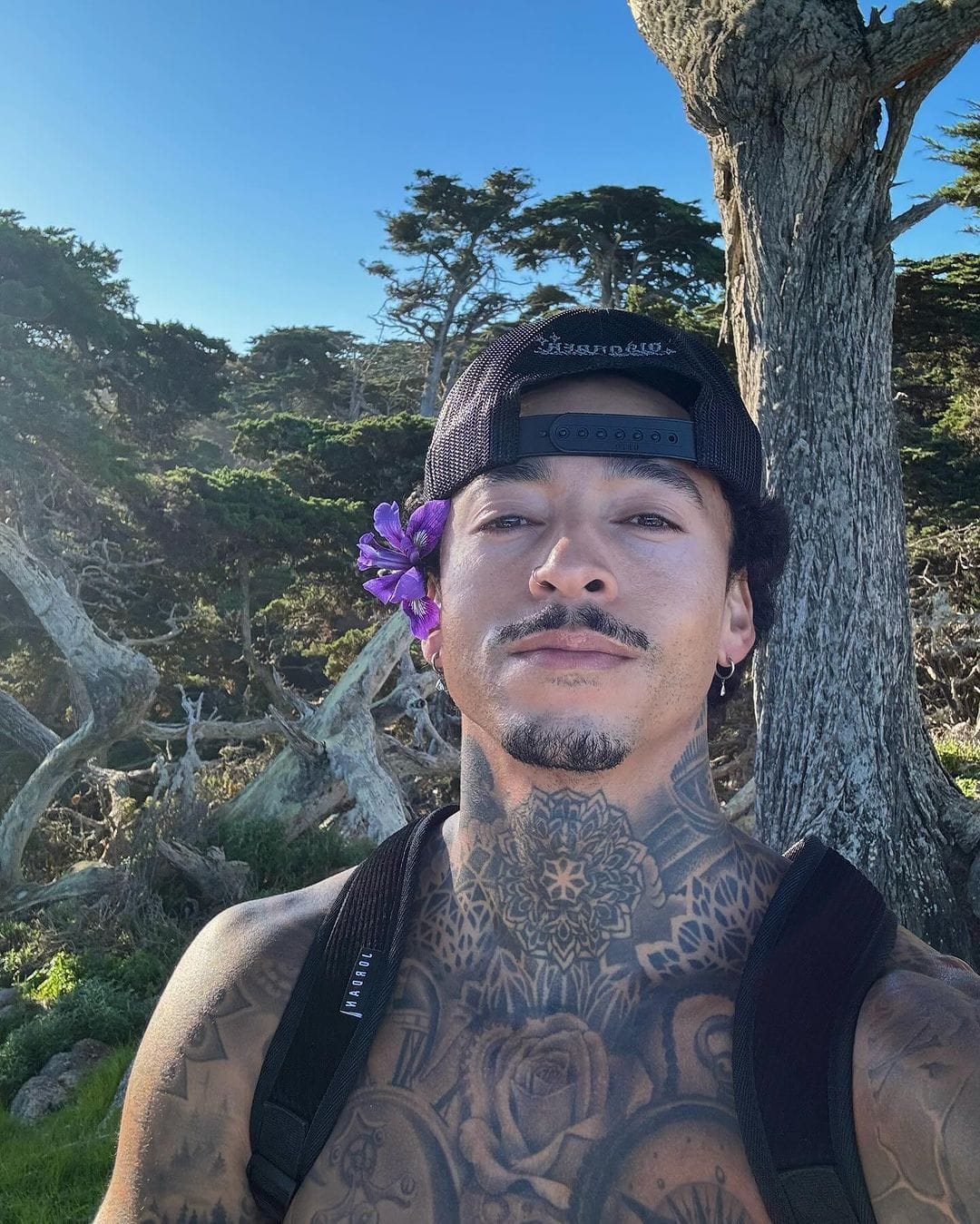
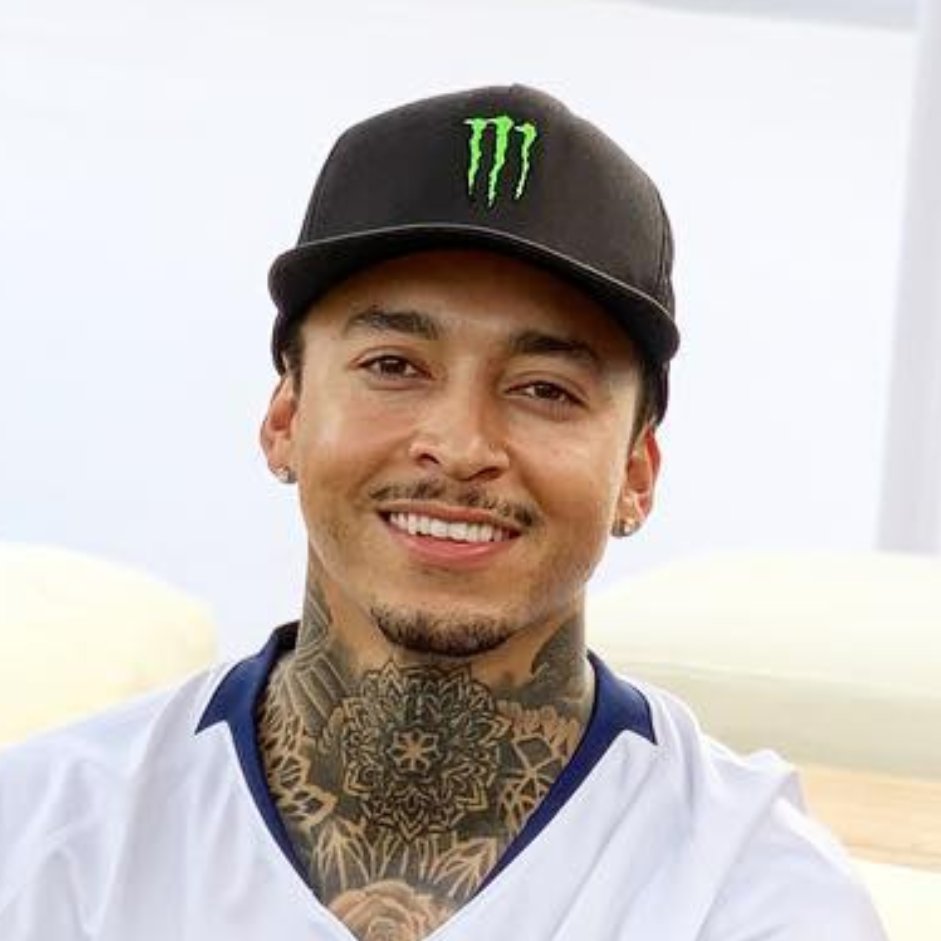
Huston’s neck is one of the hardest areas to miss. A large mandala-like design spreads across the throat, with patterned lines climbing toward the sides of his neck and down into the chest. The work is detailed enough that it can look almost like lace or carved metal in photos. It gives the top half of his body a clear visual signature.
On the right side of his neck, he has described a triangle with an eye in it as having an Illuminati vibe. He also has an eagle on the left side. These are separate ideas, but the surrounding geometry helps them sit together. The neck is not just filled with one solid black shape; there are open areas, dots and repeating lines that let the different pieces breathe.
The neck sessions were not easy. Huston said the work took about three days, with each day lasting around five or six hours. He described the skin being stretched and his head and neck pulled into awkward positions, especially around the Adam’s apple. That is the kind of detail that gets lost when people only say someone has a neck tattoo. In his case, it was a major project and one of the most painful parts of his collection.
He has also said he might get a small face tattoo one day, but at the time of the GQ tour he had not gone for it. That leaves the neck as the closest his most visible facial area gets to a full tattooed statement.
One leg is his home for random ideas
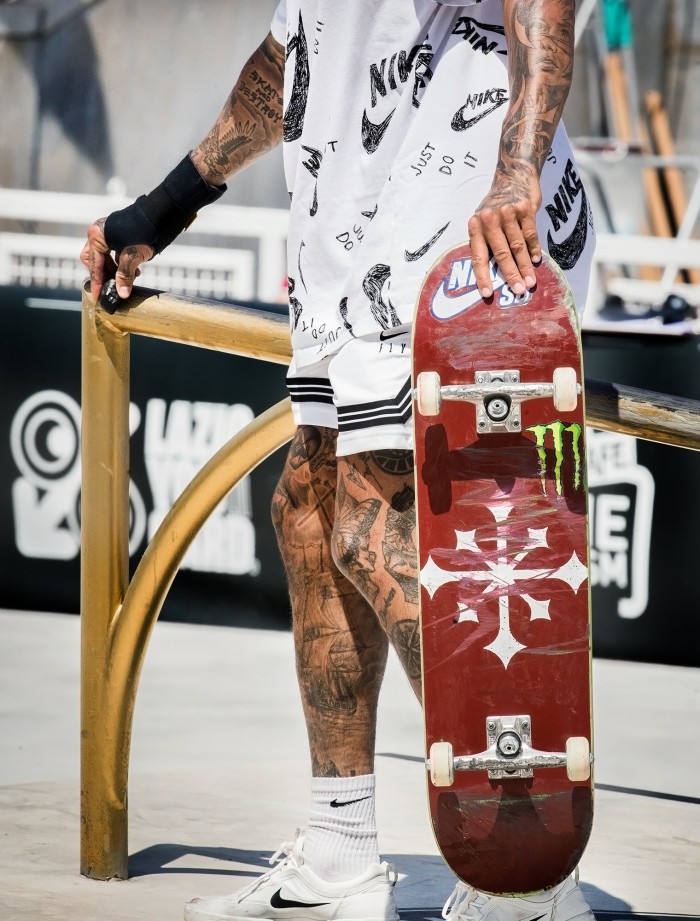
If the chest is the organised part of the collection, one of Huston’s legs is where he lets himself be silly. He has called it his random leg and pointed out a Jason mask, a pineapple, a grim reaper, a lion skull and a waffle. The designs do not need to match. The fun is in the fact that they are all sharing the same space.
The waffle is exactly what it sounds like. Huston likes waffles, so he got one. He has joked that people might think it is stupid, but he has no regrets. The ferret riding a skateboard came from a similar place. A friend kept asking him when he was going to get a ferret tattoo, and when his friend Cody was in town tattooing, Huston decided to just do it. He was not in the mood to spend ages planning a serious design, so the ferret won.
That same random leg includes darker ideas too. There are butterflies, a tombstone marked See Ya Soon, a skeleton giving the middle finger, a mushroom and other small drawings. The mix can sound strange on paper, but in the photographs it looks like a personal flash sheet that kept expanding.
His skateboarding life shows up around those jokes as well. Skateboards, small symbols and lettering appear among the larger images. Huston has said some tattoos come from things he sees and gets excited about in the moment, while others are more thought out. This leg is the clearest proof that both approaches can live on the same person.
The back and hips are a newer, more symmetrical project
Huston said he only started working seriously on his back about a year before the GQ tattoo tour. His friend Kry, who works at Bang Bang in New York, did much of it. Unlike the random leg, the back has a more deliberate layout. Huston described it as symmetrical, with paired elements dropping down on both sides and other images running through the middle.
The symmetry matters because the rest of his tattoos are so loose. The back gives the collection a little structure without making everything match. Geometric designs continue across the shoulder blades and hips, and the shapes connect with some of the patterning already visible around his neck and shoulders.
He has also mentioned geometric pieces on both sides of his backside that line up with the back work. They are not the kind of tattoos that can be understood from a single front-facing photo, which is another reason his collection needs several different views. A chest portrait can show the rose and clocks while completely missing the newer work on his back.
Across the wider collection there are also angels, wolf imagery, crosses, American flag details, small crowns, diamonds, praying hands, anchors and lots of tiny finger tattoos. Not all of those pieces have a confirmed story attached to them. Some are simply shapes or images he liked. That is worth keeping honest because Huston’s tattoos are more interesting when they are allowed to be random.
The easiest way to sum up Huston’s style is black and grey, dense and constantly growing. He has said he prefers black-and-grey work because he thinks it looks best with his skin tone. The collection leans heavily on soft shading, dark outlines, geometric patterns and realistic faces or animals. Even the funnier tattoos still sit inside that wider visual world.
It also helps that he has worked with several strong tattoo artists. His collection has been linked with artists including Thomas Hooper, Paul Timman, Sam Dusenberry and Daniel Silva, as well as friends who have tattooed him over the years. Different artists bring different marks, but Huston’s taste keeps the body art from feeling totally disconnected.
There is no single message hiding behind all 200 or so tattoos. Some pieces are about skating, some about his family, some are tied to childhood memories, and some are just a waffle or a ferret because he thought they would look cool. That is probably the most honest way to read his ink. He treats his body like a place where serious work and dumb ideas can sit next to each other.
For anyone looking at his tattoos for design ideas, the useful lesson is not to copy the whole collection. It is to notice how the pieces are spaced, how a large chest design can sit beside tiny finger marks, and how a random joke tattoo can still become part of a bigger personal style. Huston keeps finding room, even when he says there is barely any left.
Watch Nyjah Huston explain the tattoos himself
Huston talks through his first tattoo, the ferret, the waffle, his neck work, the lion and the random leg in this tattoo tour. It is worth watching because the meaning comes from him, not from guesses made from a photograph.