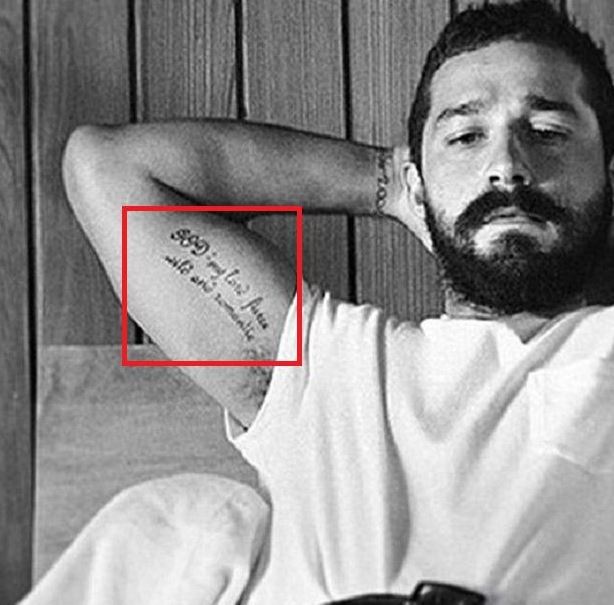
Shia LaBeouf’s tattoo record is unusually difficult to summarise because it combines long-term personal marks with a large chest piece made for a film. Photographs show script on the arm, lettering on a finger and small designs around the wrist and hand. The chest tattoo received the most attention because it was created during preparation for The Tax Collector, but it should not be treated as the whole collection.
The safest account keeps the dates and sources beside the designs. People reported the film-related chest work, while photographs from tattoo guides identify the GOD script and Bakersfield lettering. Older biographical references describe a wrist date and other small marks, though the quality of the available images varies. A careful article names what can be seen and avoids treating uncertain details as settled fact.
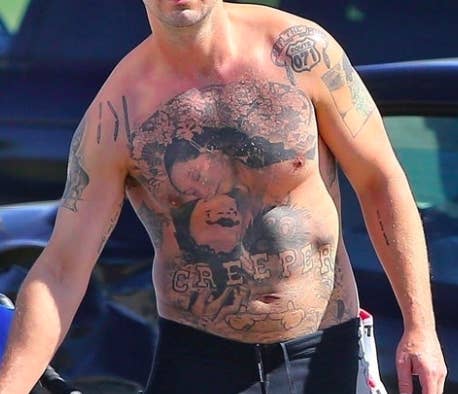
The Creeper tattoo covers the chest and abdomen
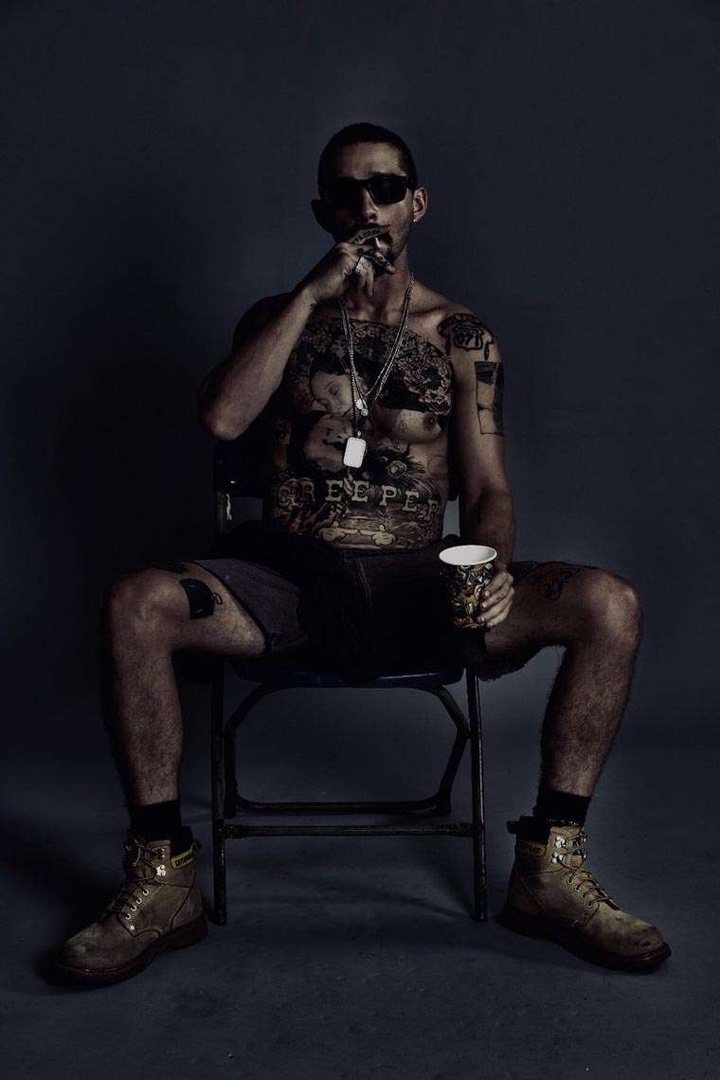
LaBeouf’s most visible tattoo is the large chest and abdomen piece associated with The Tax Collector. People reported that the work was real rather than temporary makeup, and the word Creeper appears across the lower part of the composition. The image is substantial enough to change the entire appearance of his torso.
That context matters. An actor can wear temporary designs for a role, but this work was described as permanent. The film connection explains the timing and the scale without proving that every part of the design belongs to LaBeouf’s private life. It is best described as a real tattoo made during a specific period of his career.
Photographs often show the chest at a distance, where the portrait-like elements merge into one dark field. A close source image is more useful because it establishes the word, the outline and the surrounding figures. It also prevents the article from repeating a generic claim that he is simply heavily tattooed.
GOD is a long script tattoo on the inner bicep
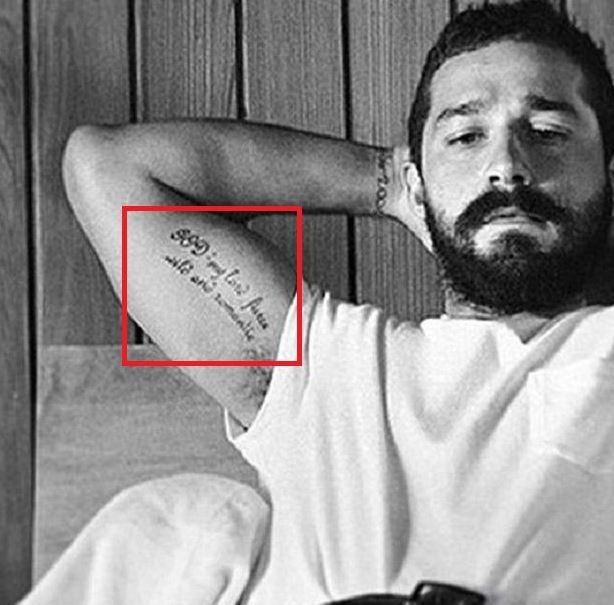
A separate image shows script running along LaBeouf’s inner bicep. The wording is reported as GOD: My Lord, Fierce, Wild, and Romantic. The phrase is specific enough to name, but a photograph alone does not reveal when it was made or how LaBeouf interprets every word.
The lettering has a different visual character from the chest piece. It is narrow, dark and arranged as a paragraph-like block, so it reads at close range rather than across a red carpet. The placement also means that the tattoo can be hidden by a short sleeve, which helps explain why it appears less often in general celebrity photographs.
A guide should not turn the phrase into a complete religious biography. The safe claim is that the script exists and that the wording has been reproduced by tattoo-focused coverage. If LaBeouf has supplied a fuller explanation in a named interview, that source can be added later. The image itself establishes the design and location.
Bakersfield is written across a finger
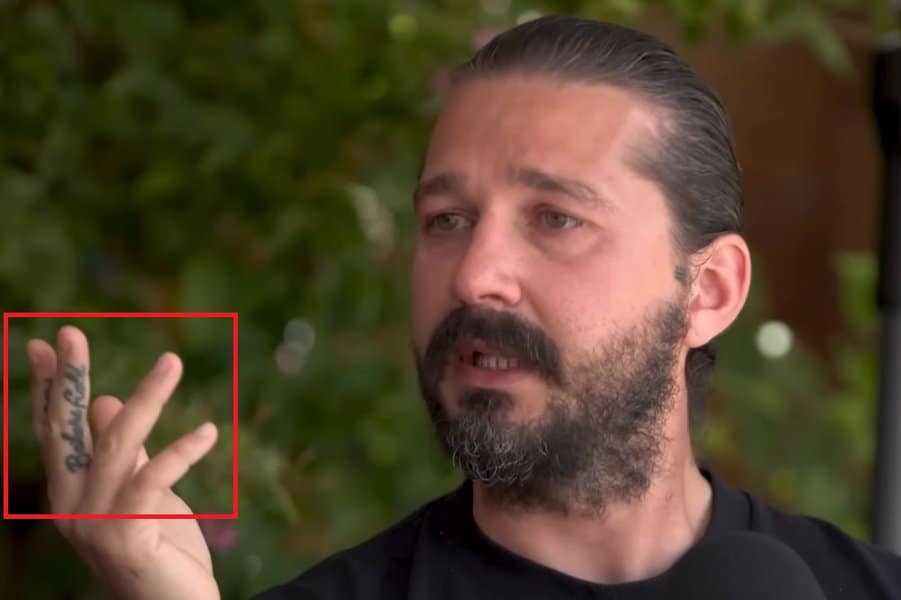
Photo coverage identifies Bakersfield written along a finger. It is a small location word, but it is unusually readable when the hand is held near the face. Finger tattoos are easy to miss when a celebrity is holding a phone or microphone, and the hand can turn away from the camera during an otherwise clear portrait.
The word invites a biographical reading because Bakersfield is a place name. Even so, the guide should not invent a private origin without a source. The design can be reported as lettering on the finger, with the spelling visible in the close photograph. That is enough to distinguish it from the nearby compass and smaller marks.
Its scale also shows why one full-body photograph cannot satisfy every tattoo section. A torso image may establish the Creeper piece, but it cannot prove a finger word. Separate targets need separate photographs, especially when the design is made from only a few thin characters.
The wrist date belongs to an earlier layer of the collection
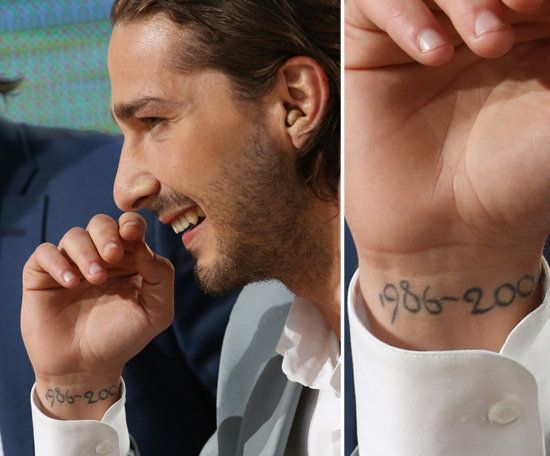
Older biographical coverage has described a tattoo reading 1986-2004 on the inner wrist. The dates are linked to an earlier period of LaBeouf’s life, but the surviving photographic evidence is less consistent than the newer chest images. That difference should remain visible in the article rather than being hidden by a confident caption.
Wrist tattoos are vulnerable to blur because the arm is often angled away from a camera. They can also be obscured by watches, bracelets or long sleeves. A close hand photograph is therefore more valuable than a distant premiere portrait. If the numbers cannot be read in the final image, the guide should describe the area conservatively.
The date design gives the collection a quieter counterpoint to Creeper. One is a large, professionally photographed chest piece connected with a film role. The other is a compact mark associated with an earlier life period. They belong in the same inventory, but they should not be given the same level of certainty or visual prominence.
Why the film tattoo should not erase the smaller designs
LaBeouf’s body art became news because the chest tattoo was so large and because it was tied to acting work. That attention can make the smaller tattoos seem like background detail. They are not. The GOD script, Bakersfield finger lettering and wrist date show a different scale of decision-making, where a few words or numbers occupy a narrow patch of skin.
The collection is therefore best read in layers. The film-era chest work is the broadest visible statement. The script supplies a sentence-like mark. The finger word supplies a place name. The wrist numbers preserve an earlier date. The designs do not require one master explanation to be worth documenting.
A reliable guide keeps photographs and evidence together. It names the chest design beside the chest photograph, the bicep wording beside the arm image, the finger word beside the hand image and the date beside the wrist view. That method is slower than copying a list, but it gives readers a chance to check what is actually visible.
What the sources can and cannot establish
The sources establish that LaBeouf has had a real Creeper chest tattoo, that specific script and finger lettering have been photographed, and that older reporting identifies a wrist date. They do not establish a complete official count or a private meaning for every symbol. Small tattoos may have been added, altered or hidden since the photographs used here.
That uncertainty is not a weakness. Tattoo records change because skin changes, roles change and people make cover-ups. A photograph from one production cannot serve as a permanent map. The useful details are the designs that have names, readable shapes or direct reporting behind them.
Shia LaBeouf’s tattoos are consequently a mix of career-related ink and smaller personal marks. The chest piece explains the headlines, but the quieter designs give the collection its texture. Showing each tattoo beside a relevant image keeps the article grounded in what can be checked rather than what a writer might imagine.
7 thoughts on “Shia LaBeouf’s tattoos mix private marks with a film-era chest piece”