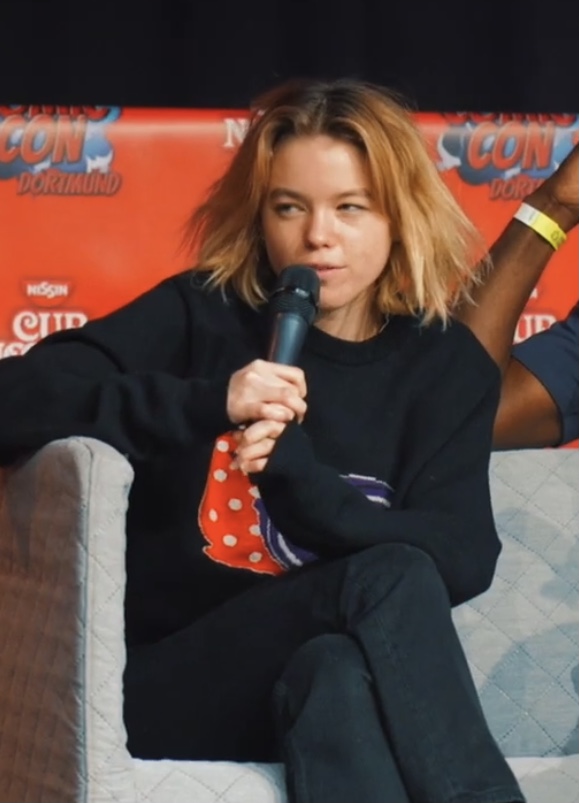
Milly Alcock has never treated tattoos as a minor detail in her public image. During a 2026 interview connected with Supergirl, she said she has 20 tattoos, then explained why she keeps adding to them even though acting requires her body to change for different characters. That number is useful, but it should not be mistaken for a complete public catalogue. Photographs show some of the designs clearly, while other pieces appear only briefly or at a distance.
Her explanation is more revealing than a simple list. Alcock described her body as her professional tool, but also as something that belongs to her when the costume, makeup and character are gone. She said tattoos make her skin feel personalised and help ground her while travelling and living away from Australia. That gives the collection a clear emotional thread without forcing every flower, key or abstract mark to carry a separate secret meaning.
The arm tattoos are a visible collage rather than one single style

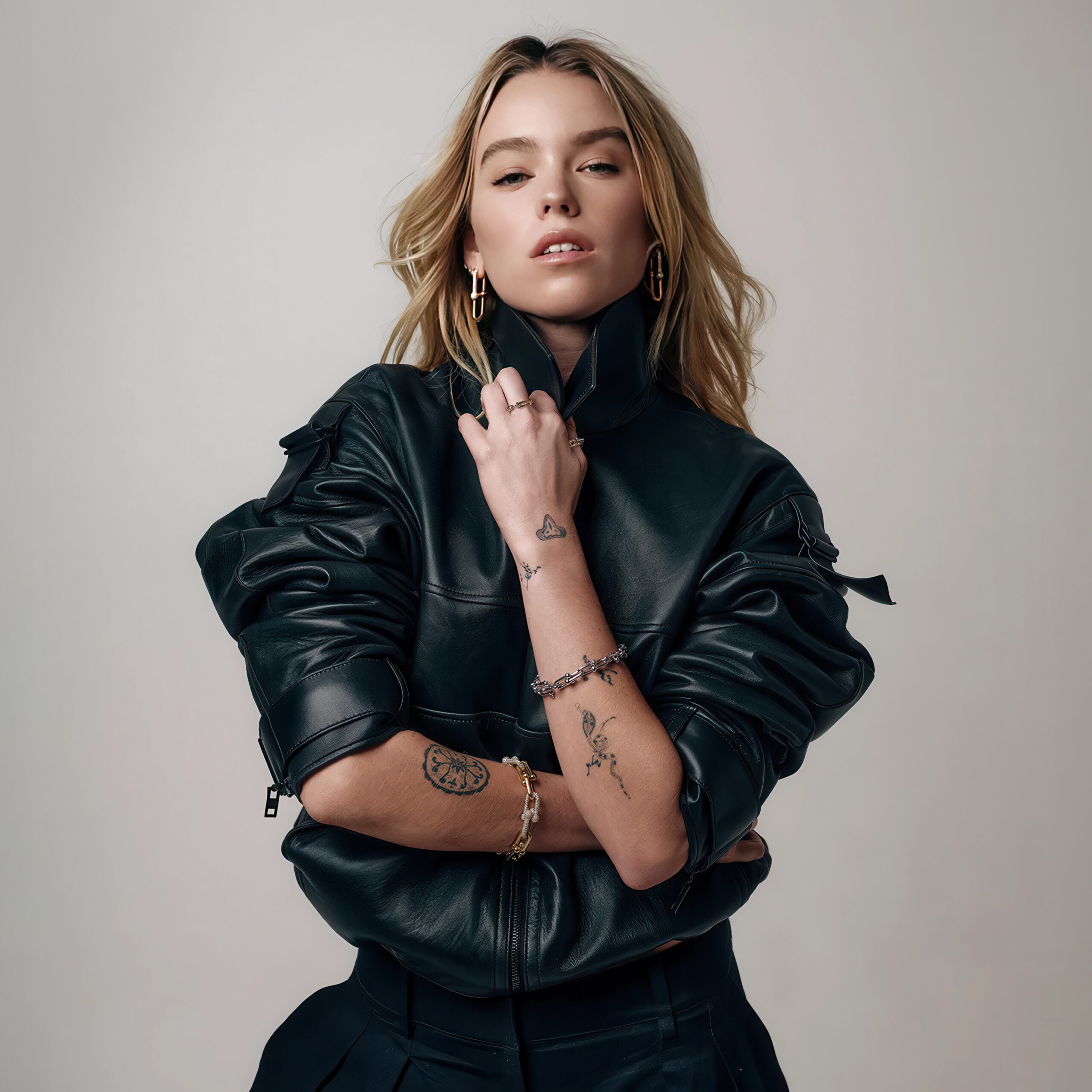
The clearest current photographs show a group of tattoos across Alcock’s arms. The images published with recent coverage show flowers, key-like shapes and smaller abstract designs sitting beside one another. They do not form the kind of traditional sleeve built around one large central image. Instead, the work feels like a personal collage that has grown in stages. Some marks are fine and delicate, while others have heavier outlines or more unusual silhouettes.
The floral imagery is easy to recognise in the portrait photographs, but its meaning should be kept separate from Alcock’s broader comments about tattoos. She has spoken about ownership, identity and feeling grounded. She has not publicly assigned a detailed explanation to every individual flower. The fair description is therefore visual: flowers are part of the documented arm collection, they sit among other small motifs, and they help create a varied surface rather than a single unified picture.
The keys deserve the same careful treatment. They are visible in the recent tattoo photography and are specific enough to include in an inventory, but a key can mean almost anything when it is separated from the person’s own explanation. It might be a private reference, a design she simply liked, or one part of a longer story that has not been made public. The photograph proves the motif is there. It does not give permission to invent the lock, the person or the memory it supposedly represents.
That uncertainty does not make the images less interesting. In fact, it shows how Alcock’s collection differs from a celebrity tattoo map built around only famous matching pieces. The visual interest comes from spacing and contrast. A small key can sit beside a flower, while a darker mark changes the rhythm of the skin around it. The designs are individual, but the gaps between them matter too. They allow new tattoos to be added without forcing the entire arm into a fixed theme.
There is also a practical reason the arms are photographed so often. Alcock works in film and television, where tattoos may be covered for a role, and her arms are the easiest part of the collection to show in a sleeveless portrait. A red-carpet frame can reveal the general outline of the work, while a closer image can establish whether a shape is a flower, a key or an abstract line. The safest guide uses both kinds of evidence and avoids pretending that a distant photograph provides the same detail as a close one.
The small forearm pieces show why close photographs matter
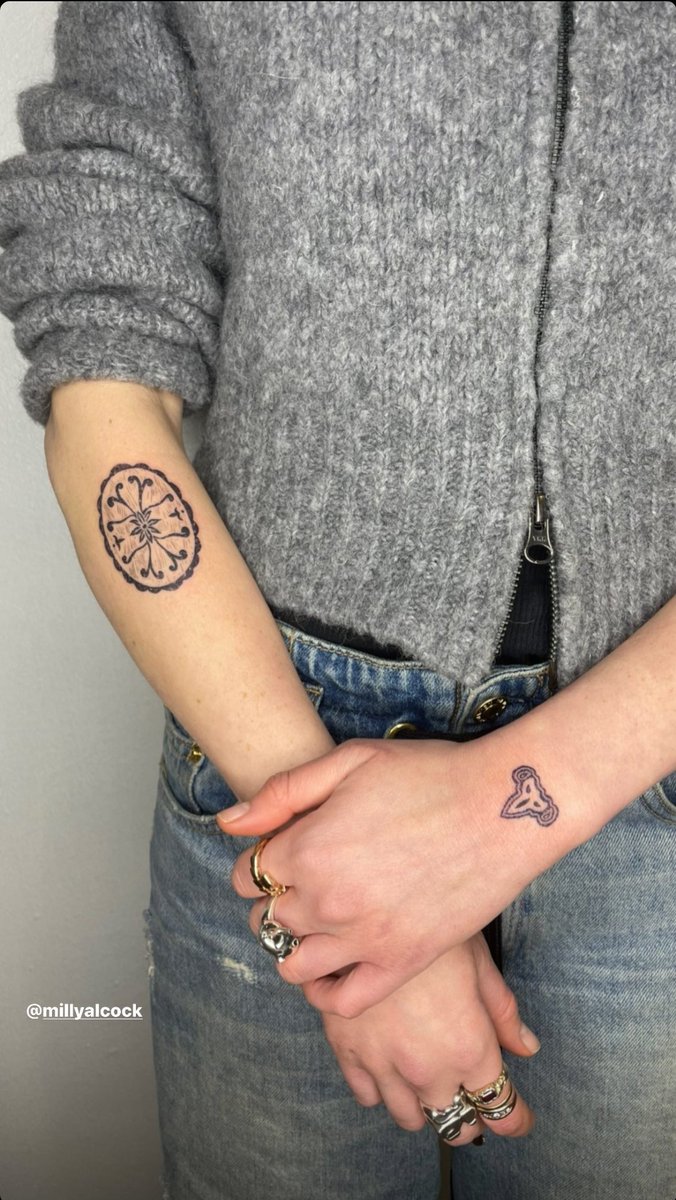
A separate close photograph shows a small oval floral tattoo on one forearm and a compact knot-like design on the other. These pieces are easy to lose in a general gallery because they are surrounded by rings, sleeves and changing poses. Seen up close, they demonstrate how much of Alcock’s collection depends on small-scale marks rather than giant portraits. They are neat enough to recognise, but not clear enough to justify a confident story about their private meaning.
The oval floral design has a contained shape, almost like a miniature emblem. Its value in the inventory is its placement and visual character, not a translation supplied by an anonymous caption. The knot-like mark is even more dependent on the photograph because simple line designs can be misread when a wrist turns or a bracelet crosses the frame. A good tattoo guide names what the image supports and stops there.
These forearm tattoos also show how Alcock’s collection can be read as a record of changing taste. Fine-line pieces remain visually light, while darker designs anchor them. The result is less like a finished mural and more like a notebook that has been added to over time. That reading fits her own description of tattoos as a collage of where she comes from and who she is while living in different places.
It is tempting to attach the word meaning to every small design, especially when a celebrity has twenty of them. Alcock’s public comments point in a better direction. The collection matters because it gives her a sense of herself outside the roles she plays. A flower can be personally important without having a published explanation. A key can be memorable without being a clue that readers are expected to solve. The absence of a quote about one tattoo is evidence of a boundary, not a gap that needs polished filler.
The forearm photographs also help separate current work from older images. Tattoos can be covered, extended or photographed under different lighting. A design that looks like a solid black symbol in a low-resolution picture may contain open linework in a better frame. That is why the article keeps the close-up as the evidence for these small pieces and does not use a distant premiere shot to make a longer list.
The small upper-back mark is visible but its meaning remains unconfirmed
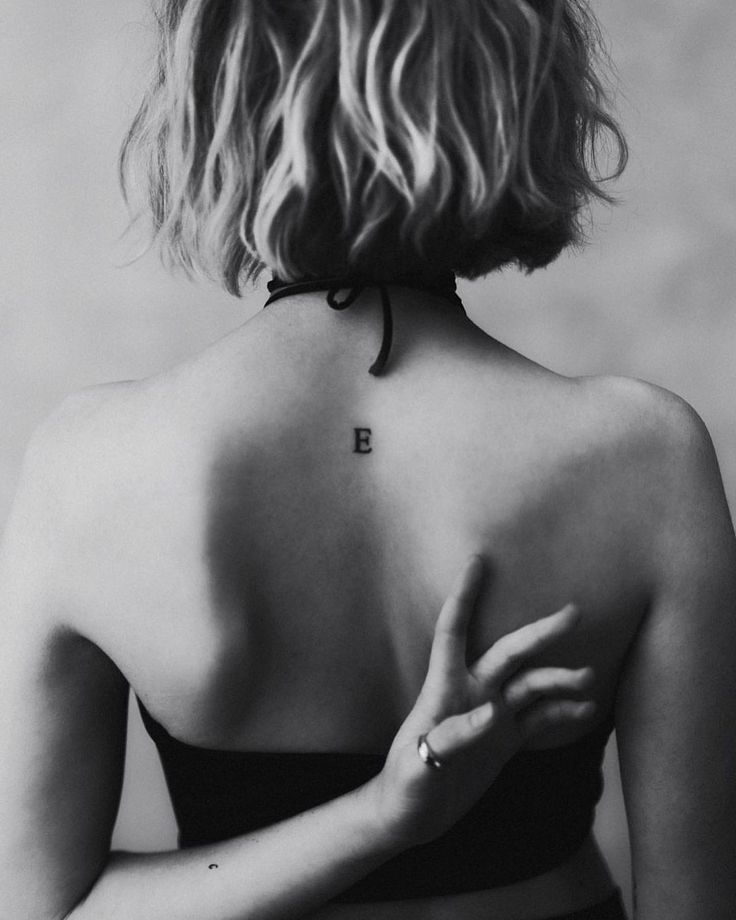
Another published photograph shows a small E mark on the upper back. The design is simple and positioned where a halter top or open-backed outfit can reveal it, but it is not accompanied by a reliable first-person explanation in the sources used for this guide. It belongs in the visual record because the photograph shows the mark clearly enough. This guide should not turn the letter into a name or relationship without Alcock saying that herself.
Upper-back tattoos have a different relationship with public photography than arm tattoos. They can be hidden for months by ordinary clothing, then appear suddenly in a fashion shoot or a candid frame. That makes date and source especially important. A picture can establish that the E was visible in that period, but it cannot prove when it was added or whether the tattoo has since been changed.
The placement also gives the collection a quiet counterpoint. Alcock’s arm work is busy and varied, while the upper-back letter is spare. It occupies a small area and relies on the viewer noticing it rather than announcing itself. That contrast is another reason not to describe the entire collection as one style. The tattoos range from tiny lettering to denser groups of motifs, and their different placements affect how they are seen.
There is no responsible shortcut for identifying the letter. It might refer to a person, a place, a private phrase or simply the shape Alcock wanted on her back. Without a source, all of those readings are guesses. The useful details are the letter itself, the upper-back placement and the photograph that records it. Readers get a more accurate guide when the confirmed visual information is allowed to stand on its own.
Why Alcock says the tattoos keep her grounded
Alcock’s strongest public explanation is about the collection as a whole. She said that acting can make her body serve a character, a production and other people’s ideas, while tattoos give her a visible reminder that the skin still belongs to her. That comment explains why a list of twenty designs should not be reduced to a search for dramatic symbolism. The point is personal control. Ink remains when a costume is removed.
She also connected the tattoos with movement and identity. Living in a different country and travelling for work can make a person feel pulled between places. Alcock described herself as a collage of where she is from and who she is at the centre of that movement. Her tattoos fit that image because they do not need to share one subject. Flowers, keys, abstract marks and a small back letter can coexist as separate memories or simply as choices made at different times.
That is the most honest way to read the collection. Some designs are visible but unexplained. Some are described in recent photography but not named in a quote. The confirmed interview gives the overall reason Alcock values tattoos, while the images give readers a grounded inventory of what can actually be seen. She has also joked that tattoos are addictive and that she wants another one, so the number twenty should be treated as a moment in a continuing record rather than a final count.
Milly Alcock’s tattoos are therefore best documented in layers. The arm photographs show a collage of flowers, keys and smaller motifs. The close forearm frame makes the oval floral and knot-like pieces legible. The upper-back image records a solitary E without inventing its owner or meaning. Her own comments explain why the collection matters to her. That combination gives readers detail without pretending that every private story has been made public.
One thought on “Milly Alcock’s 20 Tattoos and the Personal Map Behind Them”