Bad Bunny’s tattoos are tied to the same subjects that run through his music: Puerto Rico, memory, romance, playfulness and the tension between public confidence and private feeling. He has never needed one fixed tattoo style. The collection moves from small album references to large chest imagery, from a clean outline of Puerto Rico to a playful forearm group that includes a vase and cartoon flowers. The strongest accounts identify designs visually and connect some of them with his records, but not every piece has a confirmed first-person explanation.
That distinction matters because Bad Bunny’s tattoos are often photographed in dramatic settings. A campaign image can make a small tattoo look like the centre of the body, while a casual thigh photograph may reveal a design that disappears under stage clothing. The most useful guide therefore combines close images, reliable reporting and a clear separation between what a source identifies and what a reader might merely imagine.
The chest tattoos mix numbers animals and personal symbols
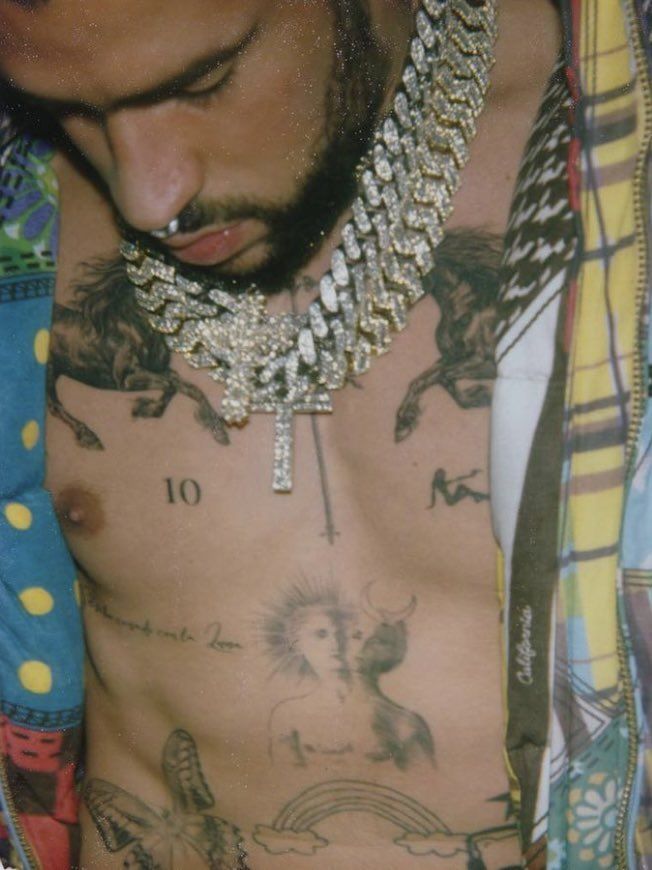
Bad Bunny’s chest is one of the most recognisable parts of his tattoo map. Published photographs show the number 10, animal imagery, a small reclining figure and a sun-and-moon face among the designs. Later campaign photography also shows a horse and the number 1994, a direct-looking reference to his birth year. The chest does not read as one single illustration. It is a group of symbols placed around the body so that each can remain visible when a different pose changes the frame.
The horse is a good example of why dates and images need to be kept together. The Calvin Klein coverage shows the tattoo clearly in a portrait made for a campaign, while the number gives readers a concrete detail that can be named without adding a guessed story. The image proves the horse and the year are there. It does not establish whether the horse represents freedom, speed, a childhood memory or something else. The safe description is stronger because it stays with what the evidence supports.
The number 10 has also attracted attention because it is so plain. Numbers can refer to birthdays, sports, personal milestones or private codes, and Bad Bunny has not publicly assigned one meaning to every numeral visible on his body. The value of the photograph is its placement and scale. The number sits among more illustrative forms, creating a contrast between clean typography and the softer shapes around it.
The sun-and-moon design adds another layer of visual contrast. It gives the chest a symbolic centre without turning the whole collection into a single spiritual statement. A guide can call it a dual-face sun and moon tattoo because that is what the image shows. It should not claim a detailed cosmology unless Bad Bunny has explained one. In a collection built around music, personal style and changing public imagery, restraint is more useful than a decorative paragraph of invented symbolism.
The chest also shows how the singer uses negative space. The tattoos are separated rather than packed into a solid block, and that keeps the individual marks legible. The result feels closer to a patchwork of memories than a traditional full chest plate. Different photographs reveal different sections, so the body map should be read across several images rather than from one cropped portrait.
The thigh tattoos hold the Puerto Rico outline heart and Saturn
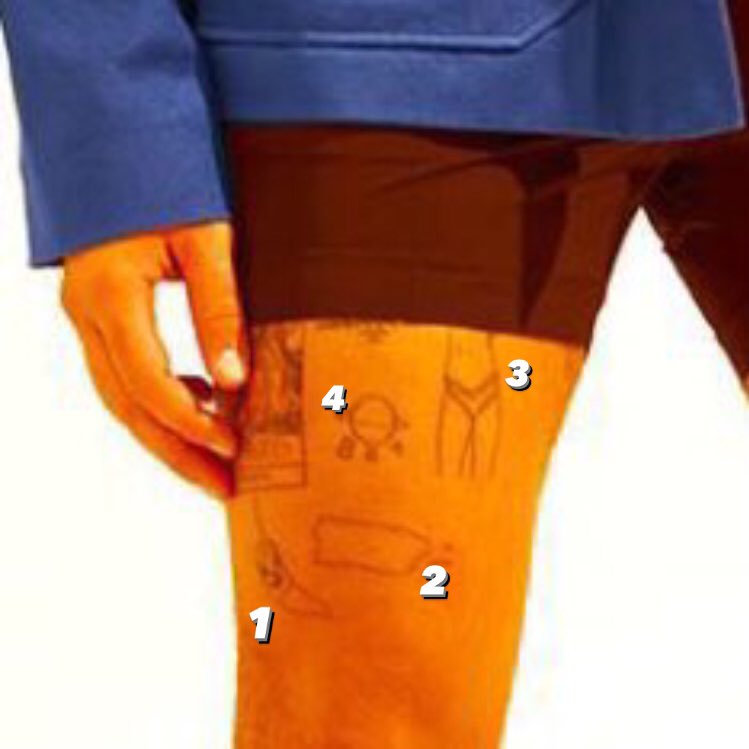
The thigh group contains some of the clearest connections between Bad Bunny’s music and his identity. El Pais describes a sad heart associated with Un Verano Sin Ti, the outline of Puerto Rico and a Pokemon Go logo. The three designs sit within a part of the body that can remain hidden in normal clothing, which makes them feel less like stage branding and more like pieces Bad Bunny can reveal when he chooses.
The Puerto Rico outline is particularly direct. It is a geographic symbol, not a vague tropical motif, and it places home at the centre of the collection. Bad Bunny’s music has repeatedly returned to the island, its language and its social life, so the tattoo fits a much larger public identity without requiring a private explanation. The shape can be described precisely, while the wider emotional importance is supported by his interviews and the way journalists discuss his work.
The sad heart works differently. It is connected with an album image and carries a feeling that is more emotional than geographic. The design does not need to be treated as a permanent diary entry about one relationship. Album imagery can hold several meanings at once, and listeners may connect with it through the record even if the tattoo’s private context changes over time. What matters for the tattoo record is the clear link to Un Verano Sin Ti and the placement on the thigh.
Another thigh photograph shows a fine-line Saturn beside three letter Bs. The planet is a small but distinctive design, and its placement next to the letters gives the group an unusual balance. The image also shows why close crop photography is important. A broad campaign photograph can reveal that the thigh is tattooed, but the Saturn and the letters need a tighter frame before the design can be named responsibly.
The thigh work is not all one era or one visual language. The Puerto Rico outline is stark and geographical, the heart is graphic, the Pokemon reference points to gaming culture, and Saturn adds a more delicate line. Together they look like a personal archive. The designs sit near each other without becoming a single logo, which is typical of a collection that has grown as Bad Bunny’s music and public life changed.
The forearm moves between realistic ink and cartoon flowers
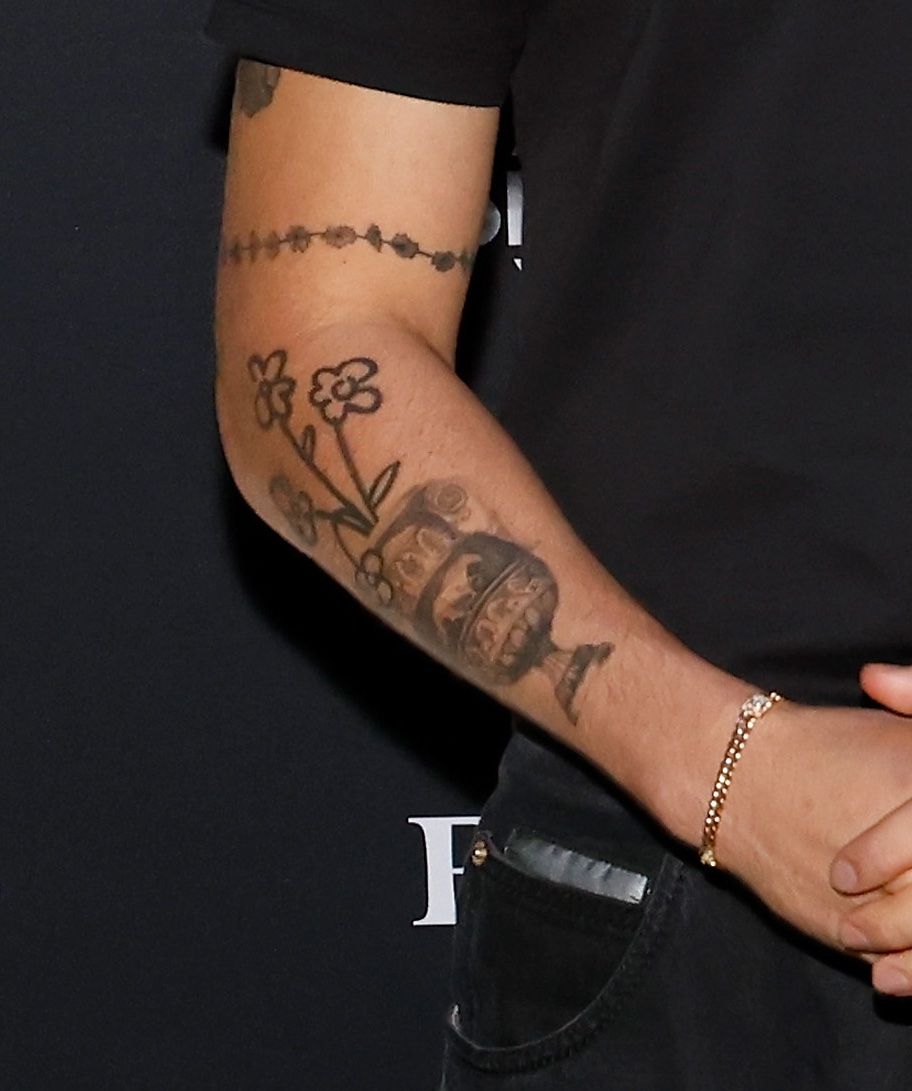
An Allure photograph focuses on a different part of the collection: a forearm with a realistic vase near the wrist and cartoon-like flowers climbing the arm. This pairing is one of the clearest examples of Bad Bunny allowing contrasting styles to share the same body. The vase has a more traditional illustrative feel, while the flowers are lighter, stranger and more playful. Neither design needs to be forced into the same meaning.
The arm group also explains why generic lists of celebrity tattoos are not enough. Saying that Bad Bunny has flowers does not tell readers how those flowers sit beside the vase, how much open skin remains around them or how the scale changes from the wrist upward. The photograph gives the visual relationship. The written account can then describe the contrast without pretending that the flowers are merely decoration.
Cartoon tattoos can be wrongly treated as jokes, especially when the wearer has a serious public image. Bad Bunny’s collection resists that split. He can carry a playful flower group and a politically meaningful Puerto Rico outline without one cancelling out the other. The lighter imagery may reflect humour, taste or a private memory, but the sources do not establish one fixed explanation. The accurate point is that the work gives the forearm a different mood from the darker sword and angel pieces elsewhere.
The vase is useful for a different reason. It gives the forearm a recognisable anchor and shows how a realistic object can sit inside a more relaxed group. The design appears close enough to photograph that its outline and location can be described confidently. It is a reminder that tattoo coverage should mention the actual object, not collapse every black-and-grey mark into the word sleeve.
Placement changes the way these pieces are read on stage. A wrist and forearm tattoo can flash into view when a microphone is lifted or a sleeve moves, then disappear again. A thigh tattoo requires a deliberate reveal. That difference helps explain why photographs from campaigns, concerts and social posts show different parts of the collection. No single image is a complete catalogue.
The sword and angel designs add a more traditional tattoo vocabulary
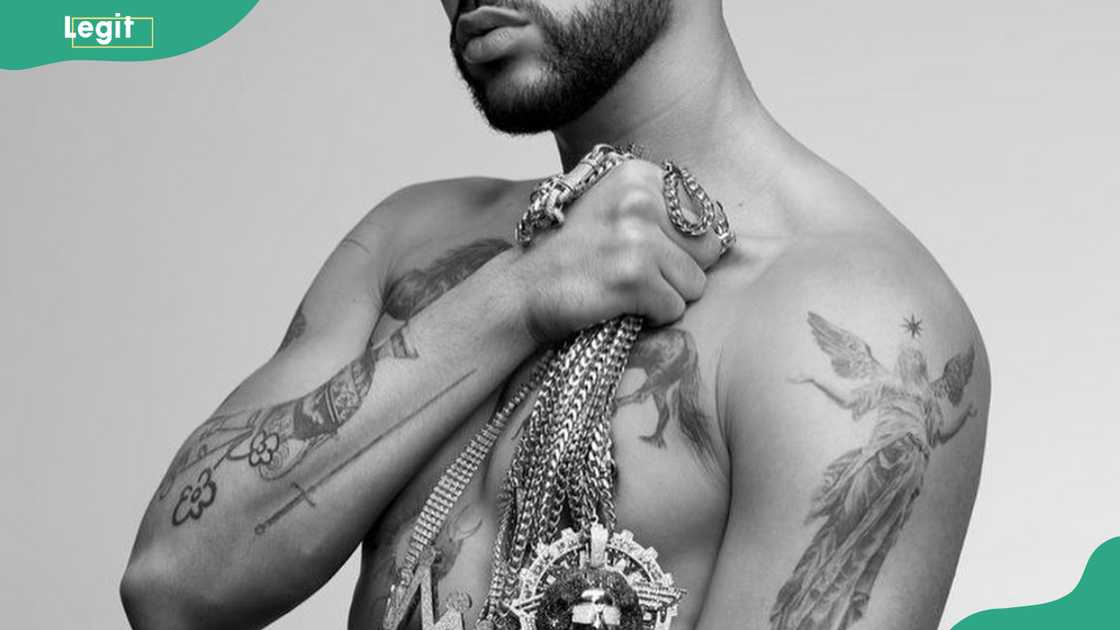
Other coverage identifies a sword on one arm and an angel with a star on the other. These are more familiar tattoo subjects than the album heart or the Saturn letters, but they still deserve specific description. The sword has a strong vertical line and reads clearly in the published image. The angel and star create a more figurative group, with the star acting as a small focal point above the figure.
Legit.ng attaches symbolic readings such as bravery, resilience and protection to these designs. Those interpretations are useful as reported context, but they should not be presented as if Bad Bunny personally gave a full explanation for every part of the image. A sword can be a traditional emblem, a reference to a story or simply a design he liked. The photograph establishes the design. The article can mention the reported reading while keeping the source level visible.
The sword also balances the playful arm work. Beside the vase and cartoon flowers, it makes the collection look deliberately mixed. Bad Bunny does not appear to be building a single traditional sleeve with one consistent theme. He is collecting designs from different visual worlds, including music, geography, gaming, romance and familiar tattoo symbols.
The YHLQMDLG bunny logo belongs in the same music-linked conversation. The album title became a recognisable visual identity, and tattoo catalogues show a small bunny-head design paired with the letters. It is important to distinguish a fan-inspired tattoo from Bad Bunny’s own ink when images circulate online. The singer’s tattoo can be discussed as an album reference, while a tattoo idea page may only show designs made by fans. That distinction prevents borrowed images from being mislabelled as celebrity photographs.
Bad Bunny’s tattoo record is therefore broad without needing a single invented story. The chest holds numbers, a horse and animal imagery. The thighs carry Puerto Rico, the sad heart, Pokemon and Saturn. The arms move between vase, flowers, sword and angel, while music-linked logos connect the skin to his catalogue. Some meanings are documented, especially the relationship between tattoos and albums or Puerto Rico. Others remain private. That balance is what makes the collection interesting: it is specific enough to map, but personal enough that the photographs do not explain everything.
The best way to read the tattoos is as a set of identities that overlap. Bad Bunny is Puerto Rican, a musician, a gaming fan, a performer and a person with private memories that do not all need public captions. The images show how the designs are placed and how their styles differ. The reporting supplies context where it exists. Everything else should remain clearly labelled as interpretation rather than fact.