
Anthony Kiedis has never had the kind of tattoo collection that can be explained with one quick list. His ink developed over decades, and the most recognisable pieces are spread across the upper arms, forearms, wrists, back and torso. Some designs are tied directly to the Red Hot Chili Peppers. Others come from his interest in Native American imagery, old-school line work and large black tribal shapes.
The useful way to read his tattoos is one design at a time. A photograph can establish the placement and the look of a piece. An interview can establish its meaning. When neither source gives a clear answer, the honest description is simply what the tattoo looks like and where it sits. That is more helpful than repeating a dramatic explanation that Kiedis never gave.
The named chief portraits anchor Kiedis’s upper arms
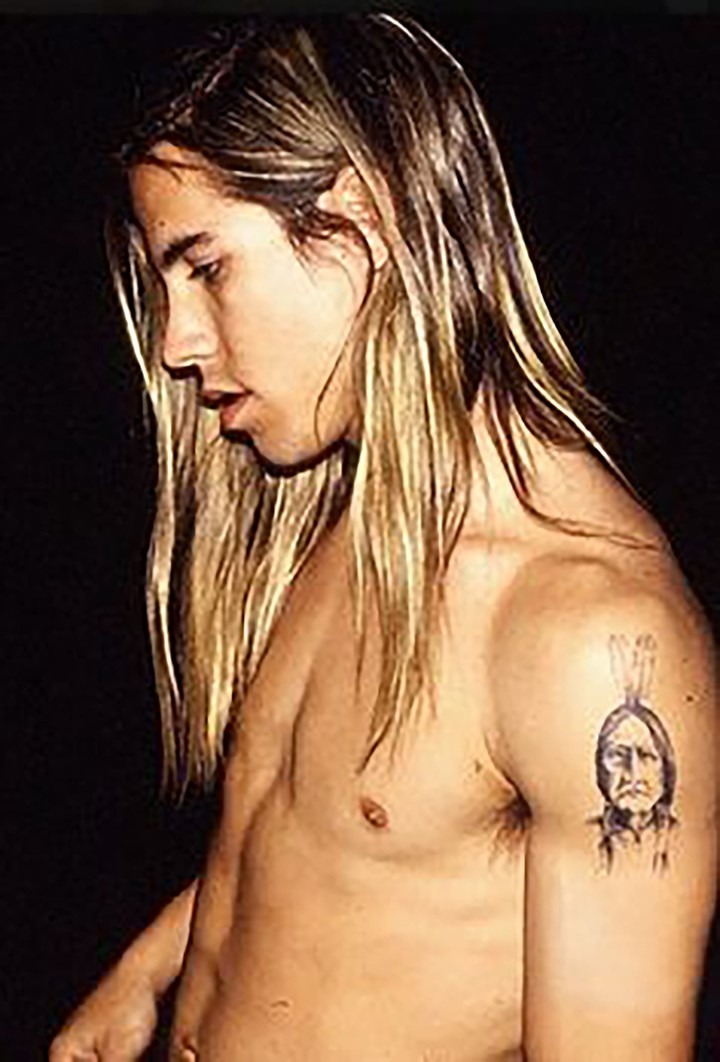
Accounts of Kiedis’s tattoo history identify Chief Sitting Bull on the upper right arm as his first tattoo. The design is treated as a portrait rather than a small emblem: the face fills the upper arm and is meant to be read from a short distance. Older photographs show the portrait surrounded by other lines and shapes, but the chief remains a separate subject with its own outline and shading.
The tattoo belongs to the part of Kiedis’s collection that was often described through Native American portrait imagery. It should not be collapsed into the later tribal bands on his forearms. A face tattoo and an armband work differently on the body. The portrait asks the viewer to look at a person’s features, while the bands and daggers create direction around the limb.
It is also worth being careful with the word “meaning.” The sources connect the name and the image, but they do not provide a complete personal statement from Kiedis about every reason he chose Sitting Bull. The confirmed point is the tattoo’s identity, age in his tattoo history and upper-arm placement.
The tiger gives the inner forearm a completely different subject
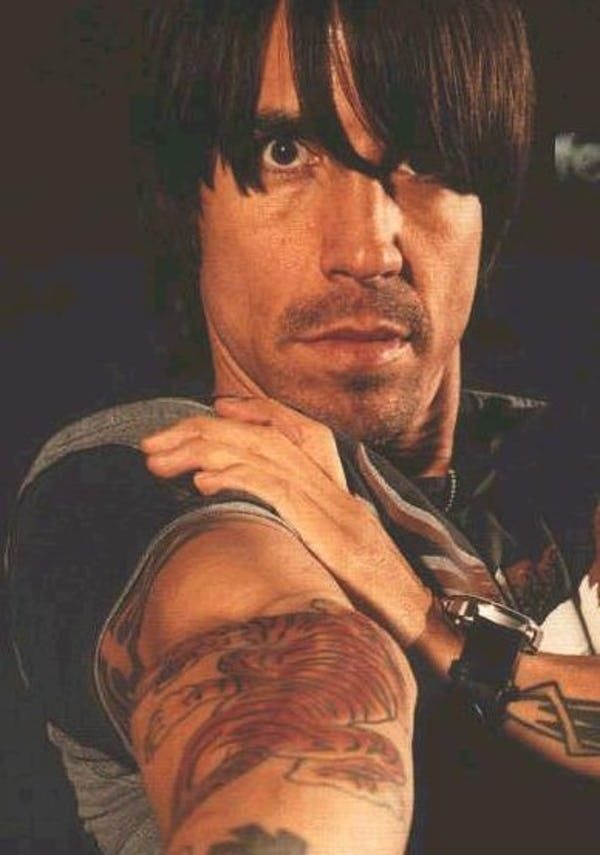
A tiger is reported on Kiedis’s right inner forearm or upper-arm area, depending on the photograph and the way the surrounding work is divided. The close image shows the animal as a separate piece, with curved stripes and a face that reads differently from the human portraits above the biceps.
The tiger also changes the rhythm of the sleeve. The chiefs are vertical faces. The tiger introduces a wider animal form, with the body and stripes following the arm rather than standing upright like a portrait. That is why it is useful to show the tiger on its own instead of using a distant full-body image where it disappears into the rest of the ink.
No reliable first-person explanation is needed to make the design interesting. The tattoo is identifiable in the photograph, the location is documented in specialist inventories, and the contrast with the chief portraits is obvious. The image tells readers more than a vague sentence about Kiedis having “tribal work.”
Tribal daggers and armbands run down the forearms
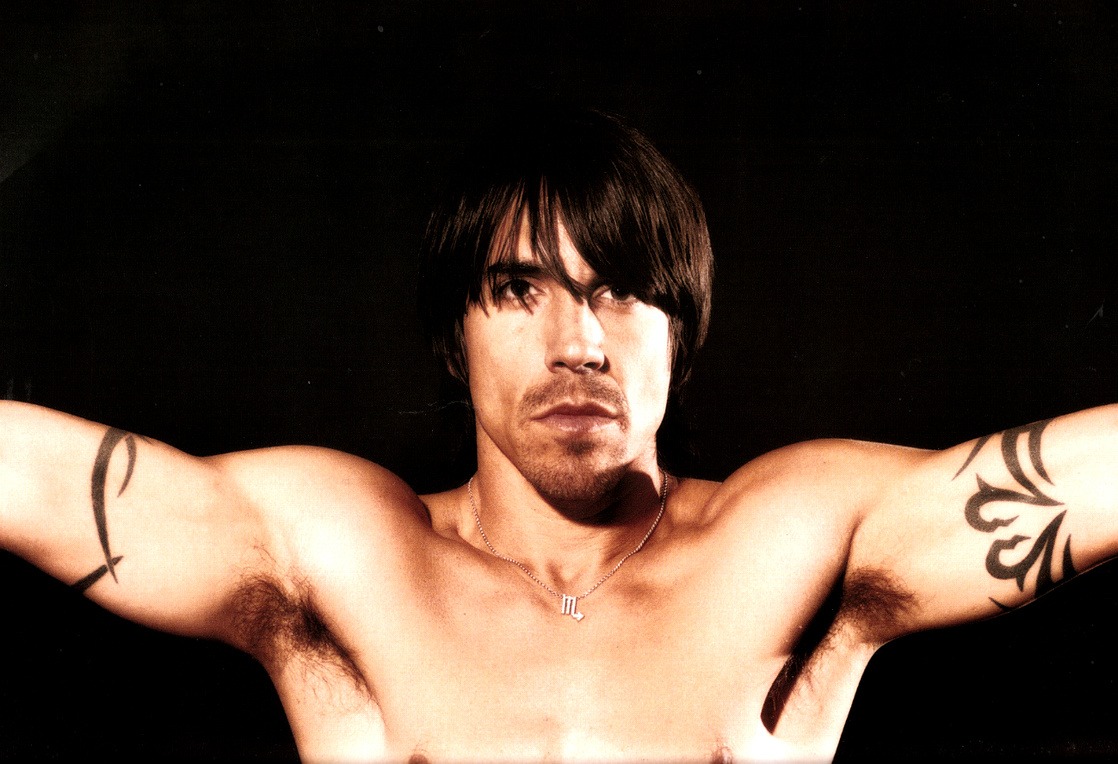
The forearms carry a group of bold black designs that are often described as tribal daggers, bands and angular motifs. The shapes point along the arms, creating a strong vertical direction from the elbow toward the wrist. In the clearest photographs, the work looks built from separate pieces rather than one solid sleeve.
The dark bands are easier to recognise than many of the small marks around them. Their edges remain readable when the arm is bent, which is part of the reason they became a regular feature of Kiedis’s stage appearance. Some sections are broad and heavy; others narrow into pointed shapes that leave skin showing between the lines.
These designs are sometimes given invented cultural explanations online. The safer account is visual: black tribal-style work, dagger-like forms and bands wrapping or travelling down the forearms. Unless Kiedis has explained a particular symbol, the article should not turn the design into a claim about ancestry, spirituality or a private event.
The Red Hot Chili Peppers asterisk is a band mark on the wrist

The Red Hot Chili Peppers’ asterisk logo is associated with Kiedis’s wrist tattoo. It is one of the pieces with an obvious career connection because the symbol is the band’s best-known visual mark. The design is small compared with the portraits and arm bands, but its meaning is easier to establish because the logo belongs to the group he helped front.
The wrist placement matters. A logo on the wrist is visible in rehearsal, performance and everyday hand movements, while a large upper-arm portrait can disappear under a shirt. Kiedis’s collection therefore mixes private-scale pieces with work designed to be seen from across a stage.
The asterisk should still be kept separate from the forearm daggers. They may appear in one photograph, but they do different jobs: one is a compact band emblem and the other is a set of larger decorative forms. That simple distinction makes the tattoo map much easier to follow.
The back piece spreads across the shoulder blades in a broad geometric field
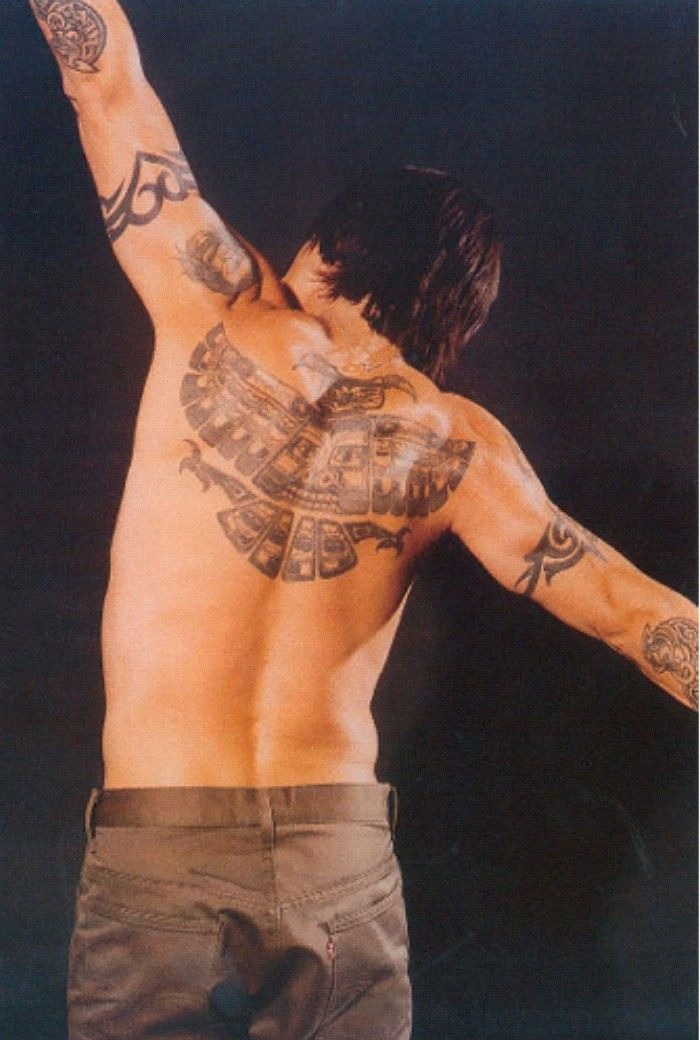
The back tattoo is one of the largest parts of Kiedis’s collection. Published photographs show dark geometric and tribal-inspired work spreading across the shoulder blades, with repeated shapes that create a wide panel rather than a single small emblem. The size is easy to underestimate in a front-facing photograph because the design is normally hidden by clothing.
The composition is built for the back’s width. Lines fan across the shoulders, while the centre and lower sections pull the eye toward the spine. It looks more architectural than the tiger or the two named portraits. Instead of a face or animal acting as the sole subject, the back relies on repeated shapes, spacing and the movement of the pattern across the muscles.
Some catalogues call the imagery Aztec-inspired or tribal. Those labels should be treated as descriptions of the visual style, not proof of Kiedis’s personal heritage or the exact source of every symbol. The photograph clearly establishes a large black design across the upper back. The private meaning of the individual marks remains less certain.
The torso and shoulder photographs show how the collection changed around the main pieces
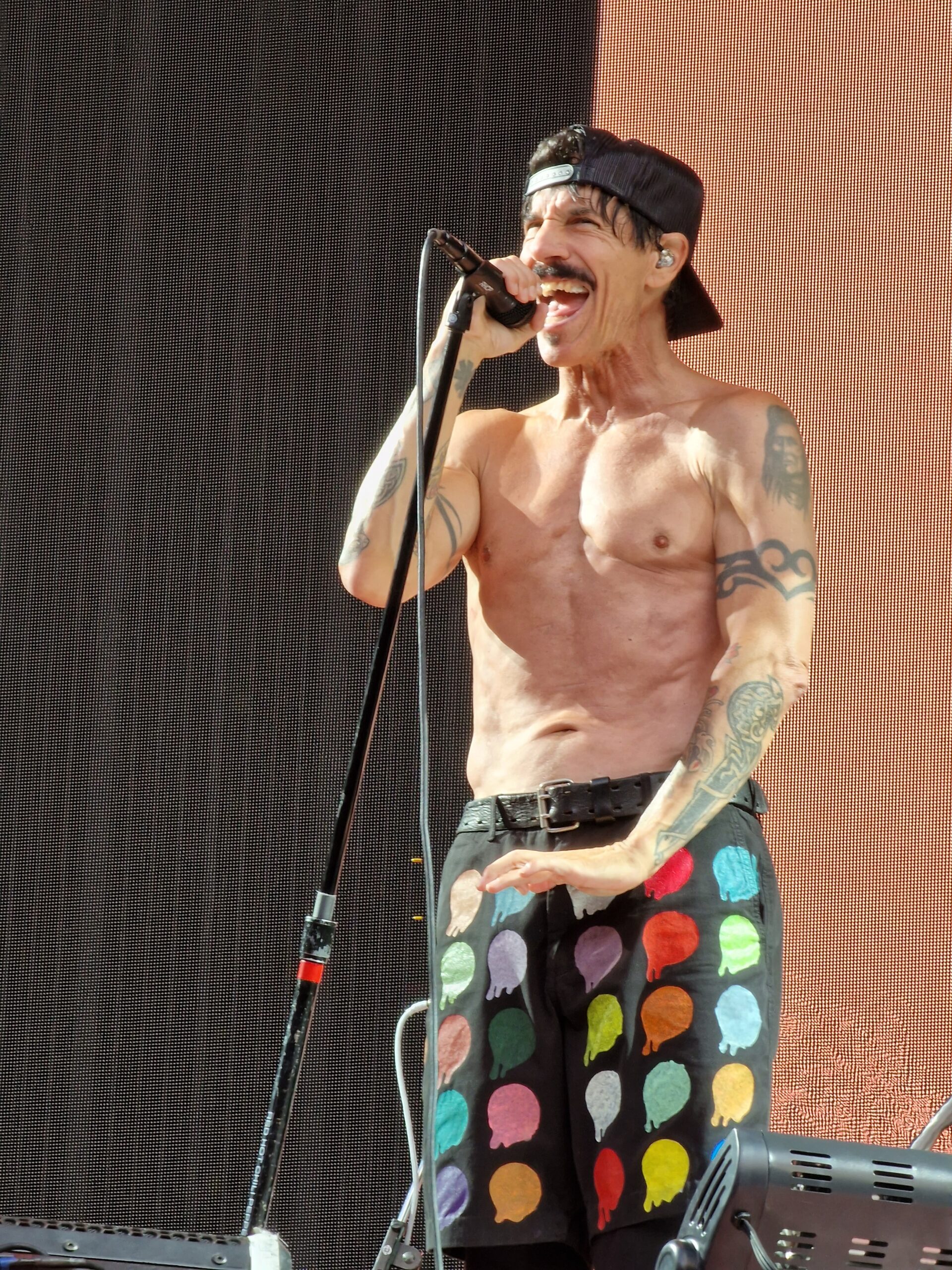
Fuller photographs show additional marks around the shoulders, chest and torso that do not always receive a separate name in published coverage. Some look like short bands, some like small emblems, and some are partly hidden by movement or stage light. They are useful for understanding the scale of the collection, but they should not be promoted to named tattoos without a clear source.
The body map changed as new work was added around older portraits. A design that looks like one continuous sleeve may actually contain a chief, a tiger, an armband and several filler marks from different sessions. The gaps between those pieces matter. They show where one tattoo ends and another begins.
Kiedis’s tattoos also look different across eras. Early photographs show the portraits and arm work before later additions made the limbs appear denser. Concert lighting can hide thin lines or make blackwork look heavier. Comparing dated photographs is therefore more useful than trying to force every image into one fixed “current” count.
The practical detail is in the placement. The upper-arm portraits sit where a short sleeve can hide them, the tiger follows the inner arm, and the forearm bands become more visible when Kiedis raises a microphone. The back piece is the opposite: it can be large and clear in a shirtless photograph but disappear completely in ordinary performance pictures. That difference explains why some fans remember the arm portraits while missing the wider work across his shoulders.
It also explains why the collection should not be judged from one date. Kiedis has been photographed on stage, in studio portraits and shirtless in older interviews. Each setting reveals a different section. A useful article puts those views together without pretending that one frame captures every line he has ever carried.
What can be confirmed without inventing meanings
The strongest tattoo record identifies Chief Sitting Bull, Chief Joseph, the tiger, tribal daggers and armbands, the Red Hot Chili Peppers asterisk and the large back work. Those pieces can be discussed by name, placement and appearance. The smaller shoulder, chest and hand marks should be treated more cautiously when no interview or clear catalogue names them.
Kiedis’s collection is interesting because it mixes portraits, animals, band identity and large graphic patterning. The portraits give the arms recognisable faces. The tiger breaks up the human imagery. The wrist logo ties the body art to the band. The forearms and back add width and movement, turning separate tattoos into a much larger visual map.
There is no reliable reason to pad the list with every blurry mark visible in a concert photograph. A good guide gives readers the designs they can actually identify, shows each major section clearly and keeps uncertainty where it belongs. That leaves a fuller and more useful record than a long paragraph of repeated claims.
5 thoughts on “Anthony Kiedis Tattoos: Designs, Meanings and What Is Confirmed”